 About Woodturning
Woodturning Trades Creative Freedom for a Satisfying Carving Loop
If you are used to building a house, styling a set of nails, or turning a blank canvas into a project of your own, Woodturning asks for a different kind of patience. You do not plan a whole creation from scratch. You shave a spinning block into shape, follow a requested outline, smooth the surface, apply color, and judge the result. The appeal is immediate and physical; the trade-off is that your freedom lives inside a narrow, satisfying routine. Switching makes sense if you want a calmer, more tactile game, not if you are looking for a bigger creative sandbox.
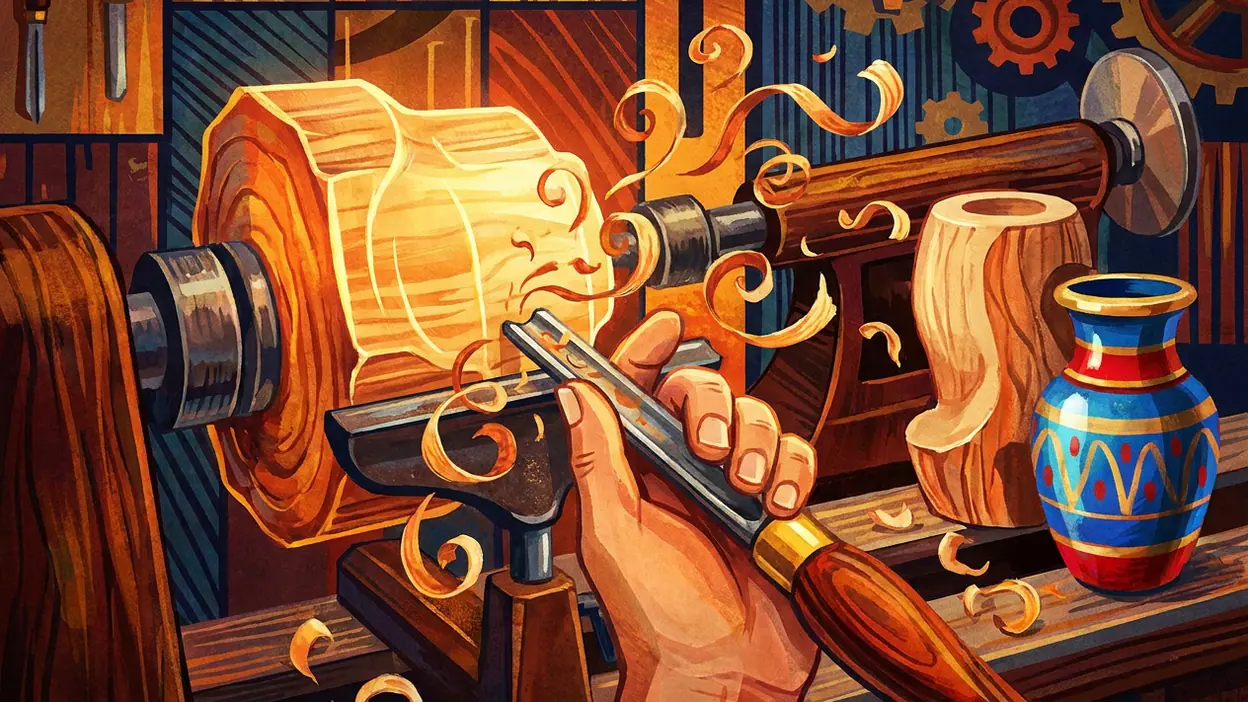
That distinction matters because Woodturning is easy to mistake for a general crafting game. Its pleasure is closer to watching a rough piece become a finished object under your hands. Each job gives you a form to pursue, and the tools make the progress visible: a cut removes material, a sanding pass softens the shape, and paint gives the object its final character. The game turns small changes into a steady rhythm. It is less about inventing a project than about making a given one feel right.
Why make the switch?
The strongest reason is a change of pace. In Craftsman: Building Craft, the basic pleasure comes from moving through a world and assembling structures from blocks. Acrylic Nails! centers its appeal on styling and presentation, while Tie Dye is built around color and transformation. Those games reward broader choices about what to make or how to decorate it. Woodturning narrows the focus to one object and one sequence of craft: shape, refine, finish.
That narrowness can feel like a relief. There is no sprawling space to organize and no long list of design decisions before the fun starts. A job puts the material in front of you, and the first cut is already a meaningful choice. The loop is quick to understand but tactile enough to hold attention: remove too much and the shape drifts; take measured passes and the silhouette gradually comes into view. It is a good fit for short sessions when you want to do something with your hands, even if those hands are operating a screen.


Switching is less compelling if your favorite part of a familiar alternative is unrestricted expression. Woodturning gives you room to shape and finish, but the commission sets the destination. The satisfaction comes from execution rather than from deciding what the object should be in the first place. That is a real change in creative authorship, not a minor difference in controls.
The first habit that changes
Your first adjustment is to stop thinking in terms of placement and start thinking in terms of restraint. A builder tends to add: another wall, another block, another detail. A woodturner often needs to remove only enough material to approach the target. The best move is not necessarily the most dramatic one. A controlled pass can preserve the contour; an impatient cut can take away the chance to correct it.
That makes the game feel unusually readable. You can see the workpiece rotating, and every tool pass has a clear visual consequence. Instead of scanning a large environment for the next task, you keep your attention on the profile and compare it with the intended form. The loop has a gentle pulse: inspect, cut, inspect again. Once you settle into it, a short job can be calming. If you want constant novelty, though, the repeated sequence may begin to feel more like a routine than a craft.
Latest News



Setup and migration facts
There is no creative archive to assume will move with you. Treat a switch as starting a separate game, not as transferring a workshop, projects, or progress from Craftsman: Building Craft, Acrylic Nails!, or Tie Dye. The games are different products with different core activities, and no shared project format is part of the Woodturning experience described here. Before changing devices or uninstalling anything, check the current store listing and the relevant platform’s own account and save guidance; do not count on a cross-game import or a conversion of creations.
In practical terms, the setup burden is small because the game’s premise is self-contained. You do not need to rebuild a familiar world or recreate a collection of elaborate designs before you can enjoy the central loop. But simplicity should not be confused with portability. If the work you value is saved progress or a particular set of unlocked content, verify how that is handled for your device before making a move. The safe expectation is that your habits can carry over, while your old projects cannot simply be assumed to.
A low-risk test is to install and play Woodturning alongside your current favorite for a few sessions. Keep your existing game in place while you find out whether the carving loop suits you. That avoids turning a taste experiment into an irreversible decision, and it gives you a fair comparison based on actual play rather than on a store-page impression.
The relearning cost
Woodturning is easy to pick up, but there is still a small skill to learn: how much to remove, when to stop, and how carefully to follow the target shape. The controls are not the main obstacle. The judgment is. Early on, you may make broad cuts because they produce a satisfying change quickly. Better results come from slowing down and treating each pass as a commitment.
There is also a shift in how you evaluate success. In a building game, a project may feel complete because it is yours, even if it departs from a plan. Here, the requested form matters more. You can enjoy experimenting with the surface and finish, but the underlying task asks you to respect a particular outline. Players who take pleasure in precision will learn that language quickly. Players who prefer to ignore prompts and follow an unplanned idea may find the game gently pushing back.
The good news is that this relearning happens in the loop itself. You do not need to master a complicated management system before the core activity becomes rewarding. Each object gives you another chance to refine your touch, and the visible result makes mistakes legible. The less good news is that repetition is part of the design. Mastering the basic rhythm does not suddenly reveal a second, radically different game underneath it.
What improves immediately, and what may be lost
The immediate gain is focus. Woodturning gets to its main event quickly: a block on the lathe, a tool, and a form taking shape. You spend less time navigating a broad world or planning a large project and more time seeing one object change. The tactile feedback is the game’s strongest asset. Even a simple cut feels purposeful because the material visibly responds, and the finishing stage gives the work a clear sense of completion.
You also gain a more contained session. A single job has a natural beginning and end, which makes the game easy to pick up without committing to a long building run. Its replay value comes from repeating the craft loop with new shapes and finishes, and from trying to improve the execution. That is a quieter kind of replay value than exploring a big sandbox. It works best when the process itself is the reward, not merely a route to unlock the next thing.
What you may lose is breadth. Compared with a building game, there is no equivalent feeling of walking through a world you have constructed. Compared with a styling game, the creative choices are more tightly framed around the object and its finish. The visual changes are satisfying, but the repeated cut, sand, and paint rhythm can flatten out if you need every session to introduce a fresh mechanic. Woodturning is focused by design; for some players, that focus is the whole point, and for others it is a ceiling.
Use both before choosing
A parallel-use strategy is sensible because the games answer different moods. Keep Craftsman: Building Craft for open-ended construction or exploration, and open Woodturning when you want a compact making session with a clear target. If Acrylic Nails! or Tie Dye is your usual creative outlet, compare how much you miss choosing the overall concept against how much you enjoy shaping and finishing a single object. This is a more useful test than asking which game is better in the abstract.
Give the new game several sessions, not just one. The first job tells you whether the premise appeals; repeated jobs tell you whether the rhythm sticks. Notice whether you begin to make more careful cuts, whether the finish stage feels rewarding, and whether you want to take on another object once one is done. Those are better signs of a genuine fit than a brief burst of novelty.
There are good reasons to stay with your current game. Stay with Craftsman: Building Craft if exploration, construction, and the freedom to expand a project are what keep you playing. Stay with Acrylic Nails! or Tie Dye if your favorite part is broad visual styling and the chance to make many expressive choices. Stay put, too, if you dislike repetition or if you would rather improvise a whole design than meet a specific shape. Woodturning does not replace those pleasures; it offers a different one.
Who should switch?
The best candidate is someone who already enjoys creative games but wants less planning and more hands-on feedback. If you like watching a rough object become cleaner through small, deliberate actions, the lathe is a persuasive hook. If you often find yourself abandoning large projects halfway through, the short commission structure may feel refreshingly manageable. And if you enjoy improving through repetition, there is enough visible craft in the routine to make familiar actions satisfying rather than empty.
Someone who mainly wants an open canvas should not switch outright. Try Woodturning as a companion first, and let it earn more of your time. The clearest evidence for a full switch is not that the first object looks pleasing; it is that you want to start another one after the novelty wears off. If the work feels meditative, the cuts feel deliberate, and the limited scope suits your available time, then it has found a role your other games may not fill.
Verdict: switch for the craft loop, not for a bigger creative world. Woodturning is a strong change of habit when you want focused, tactile making with a visible finish and a clean stopping point. It is not a like-for-like replacement for building, decorating, or freeform design, and there is no reason to discard a familiar favorite just to try it. Keep both at first. If shaping one object at a time becomes the part of your creative routine you look forward to, make the switch in your play habits; otherwise, let Woodturning remain a satisfying side project.