Numberzilla: Number Match Game
- 12.98K
- 4.3
- Installs
- 10.00M
- Price
- Free

Screenshots
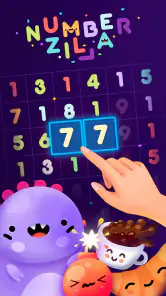
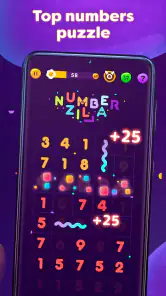
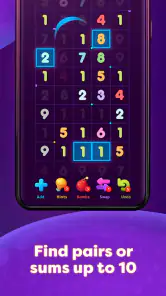

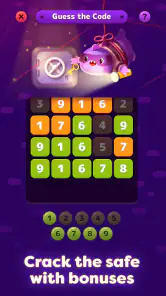



Analysis by Reviewed
I found Numberzilla to be a pleasantly focused number-matching game: simple enough to understand in a few seconds, but thoughtful enough to keep my attention when I wanted a quiet break. The basic idea is to pair matching numbers or numbers that add up to ten, then clear them from the board. That sounds modest, and it is, but the appeal comes from deciding which pair to remove before the remaining layout becomes awkward.
In my experience, this is less about fast reflexes and more about visual scanning, patience, and avoiding short-term choices that make the next move harder. It works well when I want something calmer than an action game and more involved than endlessly scrolling. Still, it is not a full replacement for a traditional board game, a competitive puzzle app, or a deeply strategic number game. Its strength is the small, repeatable decision loop.
A familiar rule set with more thought than it first suggests
The board presents numbers that can be matched when they are identical or when their total is ten. The challenge is finding legal pairs while keeping track of how clearing one area changes the opportunities around it. I quickly learned that the obvious move is not always the best move. Removing a convenient pair can expose a better combination, but it can also leave isolated numbers that are difficult to use later.
That makes the game approachable for casual players without making every round feel automatic. I can start playing without reading a long tutorial, yet I still have reasons to pause and inspect the board. The rules are easy to explain to someone else, which makes it suitable for short shared sessions, although the experience itself is primarily designed around individual play.
The board-based presentation also gives the game a different rhythm from falling-block puzzles. I am not reacting to pieces dropping in real time. Instead, I am examining the current arrangement and planning a few moves ahead. That distinction matters: players who enjoy calm logic puzzles may appreciate it, while anyone looking for speed, dramatic turns, or direct competition may find it too restrained.
Why the matching mechanic kept me coming back
The most satisfying part is the gradual change in the board. A successful pair does more than increase progress; it alters what I can see and which numbers can be connected. I often began by looking for obvious identical pairs, then switched to combinations that total ten when the easy options ran out. This creates a useful mental routine: scan, test, remove, and scan again.
One practical technique helped me avoid careless moves. Rather than immediately selecting the first valid pair, I checked whether the same number appeared elsewhere and whether a ten-pair could be made after a neighboring section was cleared. This small pause made a noticeable difference in difficult positions. It is an example of the kind of extra value the game offers beyond simply spotting two numbers that look compatible.
More From Our News Desk

Weather by Xiaomi Review: Clear at a Glance, Less Clear Up Close

X Under Pressure: Can It Recover When Posting Goes Wrong?

Clash of Clans Is Won Between the Battles

Android Auto Makes the Case for Quieter Car Software

MobiOffice: Transforming Mobile Productivity with Seamless Integration

EA SPORTS FC™ Mobile Soccer: Redefining Mobile Sports Gaming
I also found it useful to work from crowded areas toward numbers that were becoming isolated. A pair in an open section may remain available later, while a number trapped behind an awkward arrangement can become the real problem. Thinking about future access instead of only current matches gives the game more depth without making the rules complicated.
Another useful habit is to treat the board as a changing set of routes rather than a fixed grid. After a removal, I reassessed the surrounding numbers before making another choice. This prevented me from following a plan that had stopped making sense. Players who enjoy visual organization and small planning exercises will likely notice this layer quickly.
Good for short breaks, but not completely mindless
Numberzilla fits naturally into everyday gaps. I could imagine playing a few rounds while waiting for an appointment, winding down before bed, or taking a break from work that did not require the intensity of a competitive game. Because the central action is turn-like rather than time-pressured, I did not feel punished for putting the phone down and returning later.
A realistic use case is a commute with unreliable attention. If I have only a few minutes, I can inspect the board and make a handful of decisions without needing to remember a complicated story or maintain a long multiplayer session. If the journey becomes distracting, the game is easy to leave. That flexibility is one of its quiet strengths.
It can also suit families looking for a basic number activity, especially because the content rating is Everyone and the rules are accessible. I would not present it as an educational mathematics tool, though. It encourages mental addition and pattern recognition, but its main purpose is entertainment. Someone seeking structured lessons, explanations of mathematical methods, or measurable learning progress should choose a dedicated educational app instead.
The friction that affects longer sessions
The same simplicity that makes the game welcoming can limit its staying power. Once I understood the matching rhythm, some sessions began to feel familiar rather than surprising. The pleasure comes from solving the current arrangement, not from discovering a large world, building a character, or mastering a broad set of mechanics.
That means the game is easier to recommend as a repeatable casual puzzle than as a long-term hobby for every player. If you need constant novelty, a rich campaign, or a strong competitive ladder, this may feel too narrow. A traditional strategy board game offers more varied interaction between players, while a larger puzzle title may provide more distinct modes and challenges.
The free entry point is convenient, but the presence of in-app purchases is worth keeping in mind. Individual purchases range from $0.99 to $59.99, so I would approach optional spending carefully and decide in advance whether I want to keep the experience entirely free. The game is most appealing when I treat purchases as optional rather than as part of the basic reason to install it.
Another limitation is that a calm interface does not automatically mean every board will feel relaxing. When I made several poor choices in succession, the board could become visually demanding, especially when I tried to inspect too many possible pairs at once. My solution was to slow down and divide the layout into smaller sections. That approach made the game more manageable, but players wanting effortless relaxation should know that it still asks for concentration.
How it compares with other board and puzzle choices
Compared with classic card games, Numberzilla feels more solitary and more focused on spatial scanning. There is no need to manage a hand, predict an opponent, or wait through another player's turn. That makes it convenient for a quick personal session, but it also means there is less social tension and less variety in the way a round develops.
Compared with Sudoku, the reasoning is lighter and the rules are faster to learn. Sudoku asks me to maintain several constraints across a larger structure, whereas this game centers on identifying legal pairs and preserving useful options. I would choose Sudoku for a longer, more methodical logic session and Numberzilla when I want a quicker entry point.
Compared with match-three games, the experience is less about chain reactions and visual excitement. I am not chasing cascading effects or rapidly changing patterns. The reward is a clean decision rather than a spectacular sequence. That makes it a better fit for players who prefer deliberate choices, while match-three alternatives may be more satisfying for anyone who wants animation, speed, and immediate feedback.
It also differs from competitive number games because the pressure is mostly self-imposed. I can focus on improving my own decisions instead of comparing every move with another person. That is a benefit for quiet play, but a drawback if rankings, direct challenges, or social interaction are the main reason I play games.
Small habits that improve the experience
I recommend beginning with a broad scan instead of tapping immediately. I looked first for repeated numbers, then for pairs that total ten, and finally for numbers that seemed likely to become stranded. This order reduced impulsive moves and helped me understand the board's shape before committing to a choice.
When several pairs were available, I usually favored the move that opened the most surrounding space rather than the move that was easiest to see. That is not a universal rule, but it worked as a useful tiebreaker. A pair that clears a congested area can reveal more possibilities than one removed from an already open corner.
I also avoided assuming that every available match should be taken immediately. Sometimes preserving a pair gave me a clearer route through the rest of the board. This is where the game becomes more interesting than a basic matching exercise: the question is not only whether a move is legal, but whether it improves the next position.
For a more relaxed session, I played without trying to finish as quickly as possible. For a focused session, I treated each move as a small planning problem and reviewed why the board became difficult. That makes the same game serve two different moods, although neither approach turns it into a large strategy title.
Who should download it, and who should skip it
I would recommend it to anyone who likes number puzzles, quiet board games, or short activities that reward attention without demanding fast reactions. It is especially suitable for players who enjoy spotting patterns and making low-pressure decisions. The age rating of Everyone also makes it a reasonable option for a broad household audience, provided each player is comfortable with the optional purchase model.
It is also a good choice for people who want a game they can understand immediately but revisit when they have more patience. The minimum operating system requirement is Android 8.0, and the current version is 7.7.0.0, so Android users should check compatibility before trying to install it on an older device. On supported phones, the low-complexity format makes it easy to pick up for a short session.
I would skip it if I want a story, character progression, real-time competition, or a wide collection of radically different modes. I would also look elsewhere if I dislike optional purchases in free games, even when I intend not to buy anything. Players who need a demanding logic challenge may outgrow the central mechanic, while players who find number puzzles boring will probably not be converted by its clean presentation.
What the app's popularity tells me
Appsyoulove has built a sizeable audience around this format: the game has passed 10 million installs, with an average rating of 4.3 from around 187 thousand ratings and roughly 13 thousand written reviews. Those figures do not change my personal experience, but they do suggest that the straightforward number-matching idea has broad appeal rather than serving only a tiny puzzle niche.
It has been available since October 24, 2019, which also helps explain why the concept feels established rather than experimental. The game is free to download, and its board-game classification accurately describes the pace and structure. I would still judge it by the type of session it provides, not by its audience size: popularity cannot make a repetitive mechanic suitable for someone who wants constant variety.
My verdict after playing it
Numberzilla: Number Match Game succeeds because it keeps its promise narrow and understandable. I open it, examine a board, find matching numbers or pairs that make ten, and decide how to clear space without creating a worse problem. That loop is not revolutionary, but it is polished enough in concept to make short breaks feel purposeful.
Its best quality is the balance between accessibility and modest strategy. Beginners can make progress by spotting obvious pairs, while more careful players can think about access, congestion, and future options. The main trade-off is equally clear: after the novelty fades, the limited central mechanic may not provide enough variety for long sessions.
My recommendation is therefore specific. Install it if you want a free, calm number puzzle for brief solo play and you enjoy improving through better choices rather than faster reactions. Keep your spending boundaries clear, and use the scanning habits above to get more from each board. Choose Sudoku, a traditional multiplayer board game, or a richer puzzle collection instead if you need deeper systems, social play, or more dramatic variety. For the right player, this is a dependable little brain break rather than an all-purpose game.
Numberzilla: Number Match Game Frequently Asked Questions
Can I play Numberzilla in short sessions, or does it require long periods of attention?
Numberzilla is designed around thoughtful number matching rather than fast reactions, so it can suit a quick puzzle break as well as a longer session. You can focus on the available pairs and decide how to clear the board at your own pace. The challenge may call for more patience as a board develops, but the basic play does not depend on keeping up with a rapid timer.
Is Numberzilla a competitive game, or can I enjoy it on my own?
Numberzilla is a number puzzle that you can approach as a solo activity, concentrating on the board and the choices available to you. Its matching and elimination mechanics do not require you to join a community to understand the game. Players who prefer independent puzzles can work through combinations at their own pace, while those looking for a particular competitive or social feature should check the current app experience before downloading.
Who makes Numberzilla, and what kind of game is it?
Numberzilla: Number Match Game is a board-style puzzle game developed by Appsyoulove. Its focus is on matching and removing numbers rather than quick reactions, so it suits players who enjoy working through a puzzle at their own pace. The app is free to download, and its content rating is Everyone.
What is Numberzilla: Number Match Game?
Numberzilla: Number Match Game is a relaxing number puzzle based on classic matching and elimination mechanics. You look for pairs of identical numbers or pairs that add up to ten, then remove them from the board. The goal is to clear as many numbers as possible while planning ahead and using the available boosters carefully. It is easy to learn, but later boards require patience and strategy.
How do you play Numberzilla and what are the main rules?
During a round, you connect or select matching number pairs according to the game’s rules. Valid pairs generally have the same value or a combined value of ten, and they must be positioned in an allowed relationship on the board. When no useful pairs remain, you can often continue by adding or rearranging numbers. The challenge is to remove numbers efficiently without blocking future combinations.
Pros
- Simple number-matching rules are easy to learn.
- Short rounds make it suitable for quick breaks.
- Multiple game modes add variety beyond the main puzzle.
- Helpful boosters can rescue difficult board situations.
- Offline play works well for travel or limited connectivity.
Cons
- Frequent ads can interrupt the flow between rounds.
- Some boosters may require watching ads or spending coins.
- Later levels can feel repetitive after extended play.
- Small numbers may be harder to read on compact screens.
- Progress and rewards can encourage repetitive grinding.
- Category
- Board
- Version
- 7.7.0.0