Mobile Legends: Adventure-idle
- 306.00
- 4.0
- Installs
- 10.00K
- Price
- Free

Screenshots





Analysis by Reviewed
Mobile Legends: Adventure-idle is a role-playing game built around a simple promise: you arrange a team, send your heroes into battle, collect what they earn, and return later to make the next improvement. I found that its appeal is less about constant tapping and more about watching small decisions turn into a stronger lineup over time. It is a comfortable fit for short sessions, especially when I want progress without committing to a long, uninterrupted play period.
That relaxed structure also explains its limits. This is not the best choice if you want a combat system where every second depends on manual movement, precise timing, or direct control of individual attacks. The game puts more weight on preparation and progression than on hands-on action. Once I understood that, the experience became much easier to judge: the fun comes from choosing what to improve, seeing the result, and deciding whether one more adjustment is worth another run.
How the idle loop feels from the first action to the next session
Starting with a lineup instead of a long tutorial
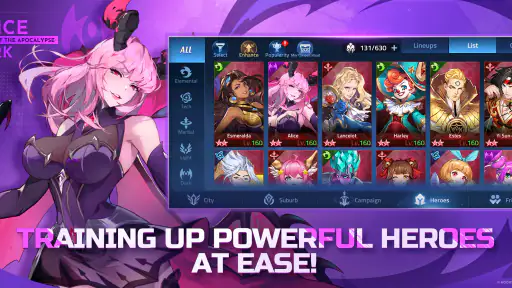
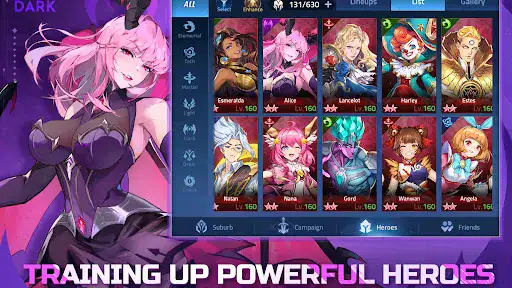
The first meaningful action is building a team. Rather than treating each battle as a completely separate challenge, the game asks me to think about the group as a whole. A hero who looks impressive alone may not be the best choice if the rest of the formation does not support that role. I quickly began looking at the lineup as a small puzzle: who should take pressure, who should provide damage, and which character deserves the next investment?
That makes the opening minutes more approachable than a traditional role-playing game with a large number of menus and complicated systems introduced all at once. The basic rhythm is easy to understand. I choose heroes, enter a fight, watch the result, collect progress, and use the outcome to prepare for the next obstacle. The game’s short description calls it “Mobile Legends,” but the actual experience I found here is much more specifically focused on an idle role-playing loop rather than a direct-control multiplayer match.
For a new player, the important decision is not to spend every early resource immediately. I had better results by treating upgrades as a response to a clear problem. If the front of the formation collapsed first, strengthening a damage dealer did not solve the real issue. If the battle lasted too long, adding durability alone was not enough. This sounds obvious, but the idle format can tempt you to press every available upgrade button simply because the game presents one.
The first useful habit is to identify why a battle was lost before investing. A failed attempt is feedback, not automatically a signal to raise the most visible number. That approach helped me avoid scattering improvements across too many heroes and made each successful change easier to notice.
Action creates feedback even when the player is not attacking
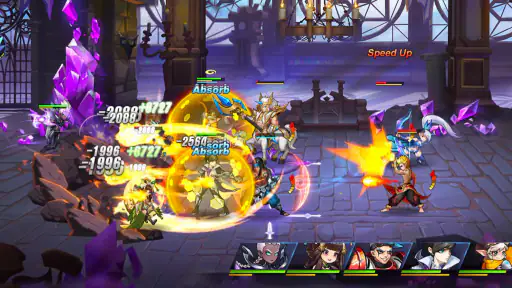
Combat is the visible action, but the player’s real work happens around it. I set the lineup, begin the encounter, and then read the result. The feedback arrives through whether the team survives, how far it progresses, and which part of the formation appears to be holding it back. Because the game is idle-oriented, the satisfaction comes from connecting those results to a decision I made before the fight.
This is a different kind of engagement from an action role-playing game. There is no need to keep a finger moving across the screen to dodge every threat or manually trigger every attack. That makes the game suitable for a commute, a short break, or an evening when I want something lighter. It also means that a player looking for constant input may feel that the battles are too passive. The game cannot provide the same sense of control as a title built around real-time commands.
I found the feedback rhythm strongest when I made one or two changes at a time. Changing the entire lineup, upgrading several characters, and then retrying makes it difficult to understand what actually helped. A more deliberate loop is better: test the current group, inspect the weak point, change one position or investment, and test again. That small discipline turns an apparently automatic game into something more thoughtful.
The rhythm is also why the title works well for uneven schedules. I can make a decision in a few minutes, leave the game, and return when I have time. The game does not demand that every session become a full playthrough. On the other hand, the same convenience can make a session feel repetitive if I am not interested in comparing formations or planning the next upgrade.
Idle rewards are the reason to come back
The reward stage is where the game earns its name. Progress continues while I am away, so returning to the app has a clear purpose: collect what accumulated, use it to improve the roster, and see whether the stronger team can move farther. I like this because it gives even a short visit a defined beginning and end. I am not opening the game merely to wander through menus; I am checking the result of time spent away.
The best way to use those rewards is to connect them to a near-term goal. If I was close to clearing a difficult stage, I preferred to reserve enough resources for the hero or role most likely to address that barrier. Spending everything as soon as it appeared created a pleasant burst of activity but did not always produce meaningful progress. Saving for a targeted improvement made the next battle feel more intentional.
There is a trade-off here. Idle rewards reduce the pressure to play constantly, but they also shift some excitement away from the fight itself and toward the upgrade screen. Players who enjoy collecting materials, comparing potential improvements, and gradually shaping a squad will understand the appeal. Players who want rewards to come mainly from skillful execution may find the loop less satisfying.
The game is free to download, with optional in-app purchases ranging from $0.99 to $99.99 per item. That matters because the progression loop is designed to make upgrades feel useful, and a player who wants faster movement through the game may be tempted to spend. I recommend treating purchases as entirely optional and deciding on a personal limit before playing. The most comfortable experience, in my view, comes from using the idle cycle as the main source of progress rather than turning every delay into a reason to buy something.
Resetting the session gives progress a shape
After collecting rewards and applying an improvement, the session naturally resets. I return to the next challenge with a slightly different team, a new question about formation, or a reason to wait for more resources. This reset is important because it prevents the game from feeling like one endless battle. Each visit has a compact arc: act, inspect, collect, improve, and leave with a plan.
My everyday use case was opening the game during a short pause, collecting the accumulated rewards, and checking whether the latest upgrade changed the point where my team failed. If it did, I continued for a little while. If it did not, I stopped rather than repeatedly pushing the same unsuccessful setup. That made the game feel less demanding and kept the idle structure from becoming background noise.
A useful session-ending habit is to leave the team in a deliberate state instead of making a rushed change just before closing the app. If I had enough resources for a meaningful upgrade, I applied it and tested the result. If I was still short, I left the lineup alone and returned later. This reduces the chance of forgetting why I changed something and makes the next session easier to understand.
The reset also reveals who should skip this game. If you dislike waiting for resources, repeating a challenge after a modest improvement, or watching a progression system do much of the work, the idle format may feel slow. A conventional role-playing game with direct exploration or active combat would be a better match. Likewise, anyone seeking a competitive arena experience should not assume that the “Mobile Legends” name means this is the same kind of game as a real-time multiplayer battle title.
Roster decisions matter more than simply having more heroes
The most interesting strategic layer is not collecting a large number of characters by itself. It is deciding which group deserves attention. A broad roster can be useful, but spreading upgrades too thinly makes the team look busy without becoming reliable. I preferred creating a dependable core and changing the surrounding pieces only when a stage exposed a clear weakness.
This is one of the less obvious lessons of the idle structure: a lower-cost adjustment can sometimes be more valuable than a larger upgrade on the strongest-looking hero. Moving the order of the lineup, replacing a vulnerable member, or supporting the team’s weakest role can change the feedback from a battle without requiring a complete rebuild. I would not judge a hero only by its individual power display; I would judge whether it improves the group’s ability to survive and finish the encounter.
Another practical tip is to keep notes mentally simple. I used three questions after a failed attempt: did the team lose too quickly, did it lack damage, or did the fight seem close enough that a small investment might solve it? That framework is more useful than chasing every available upgrade. It also helps prevent the common idle-game problem of making progress feel random.
The game is developed by Skystone Games Pte. Ltd. and is rated Teen. That age guidance is worth considering for families choosing a role-playing game, particularly because the progression model includes optional purchases. I would explain the purchase system to younger players and use the device’s normal purchasing controls rather than assuming the free entry point means there can be no spending pressure.
What the numbers suggest about its current place
The game has an average rating of 4.0 from around 500 ratings, with over 300 written reviews, and it has passed 10 thousand installs. Those figures suggest a small but real audience rather than a massive, established community. I would read that as a reason to approach it on its own terms: the core loop is easy to sample, but I would not choose it expecting the breadth or polish associated with the biggest role-playing games on mobile.
It was released on March 22, 2025, and the current version is 1.1.684. On Android, it requires version 6.0 or later, so compatibility should be comfortable for many devices that are still in regular use. The more important practical question is whether the phone’s owner enjoys idle progression. Technical access alone does not make the game a good fit; the design is quite specific about the kind of attention it asks for.
The rating also matches my impression of the experience: appealing enough to support a steady audience, but not automatically perfect for every role-playing fan. I can understand why someone would enjoy the low-pressure collection loop, while another player might consider the combat too hands-off. Both reactions are reasonable because the game’s central choice is between preparation and direct control.
Where it stands beside other mobile role-playing games
Compared with an action-focused role-playing game, this one is easier to fit into fragmented time. I do not need to remember a complex control scheme after a long break, and I can make progress without finishing a large quest in one sitting. Compared with a fully passive idle title, however, it still gives me decisions to make through lineup building and upgrade priorities. That middle position is its clearest strength.
It is less suitable than a traditional story-driven role-playing game for someone who wants exploration, dialogue, and a strong sense of traveling through a world. It is also less suitable than a direct-control battle game for someone who measures enjoyment by reflexes and moment-to-moment mastery. The better alternative depends on what you want your hands to do: if you want to plan briefly and check results later, this game makes sense; if you want to play continuously, another category will probably serve you better.
I also would not recommend approaching it as a game that must be played for hours every day. Its design works best when the player accepts the pause between sessions. The reward is not only what happens on screen, but the feeling that the next visit has a reason. Trying to force constant activity can make the repeated battles and upgrade checks feel more mechanical than they need to be.
Who will enjoy it, and who should leave it alone?
I recommend it to players who enjoy team building, gradual improvement, and short check-in sessions. It is especially convenient for someone who wants a role-playing game that can sit alongside a busy routine. A few minutes in the morning, another check during lunch, and a short evening review can form a complete pattern without requiring a long uninterrupted block of time.
It is also a good choice for players who like solving progression problems. When a team stalls, the answer is not always “wait for a bigger number.” Sometimes the better response is to reconsider the lineup, focus resources, or test a different balance. That gives the idle format enough decision-making to keep it from being completely automatic.
I would skip it if your priority is manual combat, deep exploration, or a clearly competitive multiplayer experience. I would also be cautious if optional purchases tend to undermine your enjoyment of free-to-play progression. The game can be played as a free title, but the presence of items priced up to $99.99 means spending boundaries are a sensible part of the decision.
My verdict on the action, feedback, reward, and reset
After using the game as intended, I see its loop as a series of small, readable exchanges. I take action by arranging a lineup and starting a challenge. I receive feedback through the point where the team succeeds or breaks down. I collect idle rewards, turn them into a focused improvement, and reset the session with a new target. The reason to begin again is not a dramatic new event every time; it is the possibility that one thoughtful change will move the team a little farther.
That is a modest promise, but it is delivered clearly. The game does not replace a hands-on action role-playing experience, and it will not satisfy players who need constant novelty. For me, its value is in making progression easy to revisit without making every visit meaningless. If you enjoy building a squad more than controlling every attack, this is a free role-playing game worth trying.
My final recommendation is to play it patiently, keep upgrades focused, and judge each return by what changed rather than by how long you stayed. Skystone Games Pte. Ltd. has created an accessible idle format with enough lineup planning to reward attention, while still keeping the basic routine simple. It is not a universal recommendation, but for the right player, the next session begins naturally because the last one left a clear question to answer.
Pros
- Heroes progress and earn rewards even when you are not actively playing.
- Simple auto-battle system makes the game easy to learn on mobile devices.
- Large roster offers many team combinations and collection goals.
- Frequent events provide extra resources and limited-time rewards.
- Story stages and multiple modes give players varied daily activities.
Cons
- Progress can become heavily dependent on random hero summons.
- Higher stages may require long upgrade times or repeated grinding.
- Duplicate heroes are often needed to unlock stronger upgrades.
- Competitive modes can favor players who spend money on resources.
- The game may use substantial storage space after updates and extra downloads.

- Category
- Role Playing
- Version
- 1.1.684