Knife Hit Master: Arcade Game
- 6.00
- 4.7
- Installs
- 10.00K
- Price
- Free

Screenshots




Analysis by Reviewed
I spent time with Knife Hit Master as a quick arcade game built around one simple action: tapping to throw knives at targets. That sounds easy, and the opening moments are easy to understand, but the appeal comes from how quickly a harmless-looking tap turns into a test of timing, patience, and attention. I found it most enjoyable in short sessions, especially when I wanted something I could start immediately without learning a complicated control scheme.
Playoff Games Co. has kept the idea focused. You are not managing a large character build, following a long story, or sorting through a crowded menu of systems. The experience is about reading the target, choosing the right moment, and trying to move through fast arcade stages without wasting an attempt. That narrow focus is also the game’s biggest strength and its clearest limitation: it is easy to pick up, but players looking for depth beyond repeated timing challenges may reach its boundaries quickly.
How the current version feels in everyday play
The current release is version 0.5.1, and that number matters because it gives the game a distinctly early-stage feel. I approached it as a compact arcade title rather than a finished, all-purpose mobile game. The basic loop is immediately readable, which makes it suitable for a quick break, a commute, or a few minutes while waiting for an appointment. I could open it, play a handful of levels, and stop without feeling that I had abandoned a complicated session.
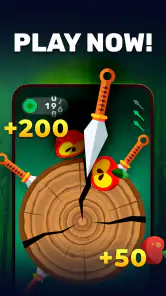
The controls are deliberately direct. Tapping sends a knife toward the target, so the challenge is not learning a virtual joystick or combining several buttons. Instead, the important skill is recognizing the rhythm of the target and resisting the urge to tap too quickly. That distinction is useful: the game rewards deliberate reactions more than frantic finger movement. If you tend to enjoy arcade games where one small mistake comes from poor timing rather than an unclear control layout, this approach makes sense.
In a realistic everyday situation, I would use it as a five-minute reset between tasks. After answering messages or finishing a short chore, I could play a few rounds without needing sound, a long explanation, or a large time commitment. The fast-level format works well for that kind of use. It does not demand the attention of a story game, but it still gives me a small objective to focus on instead of asking me to scroll through another feed.
The best way to play is to treat each target as a timing exercise rather than a race. I found that watching the movement for a moment before tapping helped more than trying to build speed immediately. A useful habit is to keep my attention on the open space around the target, not on the knife itself. That makes it easier to judge whether the next throw has a safe path. It is a small adjustment, but it turns random-looking failures into mistakes I can understand and correct.
The real test is controlled timing, not rapid tapping. Players who approach every stage by tapping as fast as possible will probably create avoidable failures. I had better results when I paused briefly, identified the next opening, and then committed to the throw. This also gives the game a little more personality than its one-touch premise suggests. The action is simple, but the player’s discipline determines whether the simplicity feels satisfying or repetitive.
Why the compact arcade format works
Many mobile arcade games compete for attention with layers of upgrades, missions, currencies, and unlock screens. Knife Hit Master takes a lighter route. Its central interaction is understandable almost immediately, so it is friendly to someone who does not normally play games. The Everyone content rating also fits that accessible presentation, making it a reasonable choice for families who want a straightforward reflex game rather than something built around mature themes.
That accessibility does not mean every player will enjoy it equally. Someone who likes improving a personal technique can find a clear reason to replay a stage. Someone who needs a strong narrative, exploration, or a large collection of mechanics may see the same simplicity as a lack of substance. I would recommend it to a friend who wants a focused time-killer, but I would not present it as a replacement for a deeper arcade collection or a progression-heavy action game.
The game is free, which lowers the barrier to trying it. That matters for this particular format because the main question is not whether the concept is understandable; it is whether the repeated timing loop holds your attention. Being able to test that for yourself without paying first makes the decision easier. I would still suggest giving it a short, honest trial rather than assuming a free game will automatically provide long-term variety.
What the release information suggests about its evolution
The game was released on December 5, 2025, and the current version remains 0.5.1. I read those details as a sign that the project is still establishing its identity. The core idea is already clear, but an early version can change in ways that affect how long the game remains interesting. New stage patterns, smoother difficulty progression, or more reasons to return could strengthen the experience over time, but those are possibilities rather than promises I would treat as present features.
For now, I would judge the game by what is available today: a free, compact arcade loop from Playoff Games Co. that emphasizes tapping accuracy and quick progress. That is a fair basis for trying it, especially if you prefer small games that do not require a major commitment. I would not download it expecting a broad content roadmap or a complex system based only on the version number. The sensible approach is to enjoy the current loop and view future development as something to watch.
The release stage also affects how I interpret the average rating. The game has a 4.7 average from around 263 ratings, which is encouraging, but a rating alone cannot tell me whether the strongest appeal is the control feel, the short levels, or the novelty of the concept. I see it as a positive signal rather than a guarantee that every player will find enough variety. My own reaction was similarly specific: I liked the immediacy and the timing focus, while remaining aware that repetition could become the deciding issue for longer sessions.
Its reach is still modest, with over 10 thousand installs. That does not determine quality, but it does place the game in a different position from a huge, established arcade franchise. A smaller audience can make the experience feel like a less obvious discovery, yet it also means I would be cautious about assuming a large ecosystem, a broad community, or years of accumulated content. The practical takeaway is simple: try it for the mechanic, not for a reputation built over a long history.
How existing players may experience the current build
If you already enjoy the game, the current build’s strongest benefit is consistency of purpose. You can return to the same central skill without relearning a complicated system. That makes it useful for practicing reaction control. I found it helpful to set a small personal goal before playing, such as completing a short run without rushing, because that gave each attempt a clearer purpose than simply tapping until I became frustrated.
Another useful routine is to stop after a few careless misses instead of forcing a long session. This is not a feature of the game; it is a way to work with its design. Because the action is repetitive, tired attention can make the game feel unfair even when the problem is my own impatience. A short pause often helped me return with better timing. Players who treat each failure as information will likely get more from it than players who only chase speed.
The game is also a good fit for sharing a quick challenge with someone nearby. One person can watch another attempt a stage and immediately understand what went wrong, because the rules are not hidden behind a complicated interface. That makes it more approachable than arcade games that require a tutorial before an observer can follow the action. At the same time, its simplicity means it may not support the kind of long-term competition that comes from extensive rankings, character builds, or strategic team play.
Device compatibility is another practical point. The minimum operating-system requirement is Android 9, so players using older Android devices should check compatibility before planning to install it. For supported users, the uncomplicated control model should be comfortable on a touchscreen, but comfort still depends on the size and responsiveness of the device. I preferred holding the phone securely and using one finger consistently, since changing grip mid-attempt made my timing less reliable.
Where the game still leaves room for improvement
The central limitation is variety. A focused mechanic can be satisfying, but it needs enough changing situations to keep repeated attempts meaningful. Knife Hit Master has a strong foundation for short play, yet I would hesitate to recommend it as someone’s only mobile game. If your ideal arcade title offers several modes, extensive customization, or a deep long-term progression system, this is probably not the right first choice.
Difficulty can also feel personal in a way that divides players. A carefully tuned timing challenge is rewarding when I understand why I failed. It becomes less enjoyable if a stage feels like it demands a reaction I cannot read clearly. My advice is to judge the game by whether its failures teach you something. If you can identify a late tap, a rushed decision, or a poor reading of the target, the retry loop has value. If every miss feels arbitrary, a more forgiving casual game may suit you better.
The free format is convenient, but it also changes how I evaluate commitment. I am happy to try a short arcade game at no cost, yet I do not want to spend a long evening repeating the same action simply because I have already invested time. The right expectation is a light, repeatable diversion. Players should skip it if they want a substantial campaign, a rich social experience, or a game that keeps revealing new systems after many hours.
I would also avoid treating the current version as the final word on the project. Version 0.5.1 suggests room for refinement, but it does not tell me exactly what will change. The most useful improvements would be ones that preserve the clean tap-to-throw identity while making progression feel more varied and failures easier to learn from. More content would help, but thoughtful pacing would matter just as much as a larger level count.
What I would watch before recommending it for the long term
For future development, I would pay attention to how Playoff Games Co. expands the game without burying its best quality under unnecessary systems. The appeal is its immediacy. Any addition should make the timing challenges more interesting, not turn a quick arcade game into a menu-heavy routine. New patterns, clearer progression, and meaningful reasons to revisit earlier stages would be more valuable to me than features that merely increase the amount of tapping.
I would also watch how the difficulty curve develops. A good early experience should welcome newcomers while giving experienced players a reason to refine their timing. The challenge needs to rise in a way that feels readable, because the whole game depends on trust between the player and the target. If later stages become difficult but understandable, the replay loop could remain compelling. If difficulty grows mainly through surprise, the game may lose the fairness that makes short failures enjoyable.
Another point is how well the game serves different session lengths. Right now, its strongest use case is a brief break. That is not a criticism by itself; many players specifically want that. But if the developers want stronger retention, they will need to give longer sessions a purpose without weakening the quick-start appeal. I would welcome progress that lets me play for a few minutes or settle into a longer practice session, depending on my available time.
My final recommendation is therefore fairly clear. Try it if you want a free arcade game with one-touch controls, fast attempts, and a focus on timing targets accurately. It is especially suitable for casual players, younger audiences covered by the Everyone rating, and anyone who likes improving through repeated short challenges. Skip it if you need a story, extensive strategy, or a wide selection of gameplay modes from the beginning.
After playing the current release, I see Knife Hit Master as a promising small-scale arcade experience rather than a complete replacement for every other game on a phone. Its best moments come from slowing down, reading the opening, and making one confident tap. That is a modest idea, but it works when I want a clean distraction with an immediate goal. If future updates add variety while protecting that precise, uncomplicated feel, the game will have a stronger reason to stay installed.
Pros
- Simple one-touch controls are easy to learn and play.
- Short rounds make it ideal for quick gaming sessions.
- Increasing difficulty keeps the gameplay challenging.
- Bright visuals and satisfying hit effects add arcade appeal.
- Works well for players who enjoy timing-based reflex games.
Cons
- Gameplay can become repetitive after extended sessions.
- Precision timing may feel frustrating on harder levels.
- Frequent ads may interrupt the flow for free players.
- Progression may feel limited without much gameplay variety.
- Requires patience
- as failed attempts can quickly become discouraging.

- Category
- Arcade
- Version
- 0.5.1