Madoka Magica Magia Exedra
- 1.80K
- 4.2
- Installs
- 100.00K
- Price
- Free

Screenshots







Analysis by Reviewed
I spent time with Madoka Magica Magia Exedra as a role-playing game built around the Madoka Magica universe, and my first impression was that it is much more interested in atmosphere and character attachment than in being a quick, disposable mobile game. The presentation has a dramatic, story-focused feel, while the battles give the experience a steady rhythm of preparing a team, choosing actions and improving characters. It is free to start, but it is also the kind of game that deserves a little thought before it becomes a regular part of a shared phone or tablet.
That matters in a household because a game can be suitable for a younger player and still need adult guidance around spending, screen time and account ownership. The age label is Everyone 10+, and I think that is a useful starting point rather than a complete answer. The themes, character drama and fantasy combat may appeal to children, teenagers and adults in different ways. I would be comfortable introducing it to a family member who already enjoys anime-style role-playing games, but I would first agree on who owns the account and who is allowed to make purchases.
How it feels when one device is shared
On a shared device, the game works best when one person is clearly the main player. I would not treat it like a simple puzzle game that anyone can open for a few minutes without affecting anything. Progress, character development and the way resources are used all make the player’s decisions matter over time. A younger sibling can watch the story or try a battle, but taking over the main save without asking could easily change the direction of the account.
My preferred household arrangement would be simple: one person plays the campaign, while others can watch, discuss team choices or take turns with clearly agreed battles. This avoids the common problem where several people spend resources differently and then blame one another when a favorite character is not developed as expected. The game encourages attachment to its cast, so those decisions can feel more personal than they would in a generic fantasy RPG.
A realistic example would be a teenager playing after school on a family tablet. A parent might use the same tablet later, and a younger child may want to try the combat. I would let the younger player experiment only after checking that the correct account is open and that no important progress is about to be overwritten. Even without inventing special family tools, that small habit creates a useful boundary: the device is shared, but the game account and its progress belong to one agreed player.
The game’s free entry also makes it easy for someone in the household to install it out of curiosity. That convenience is helpful, especially for fans who want to see whether the role-playing format suits them, but it can make the game feel harmless when it is actually a continuing service with optional purchases. I would explain that “free” means there is no purchase required to begin, not that every part of the experience is financially invisible.
Who should control the account
I recommend deciding this before the first serious session. If the player is a child or young teenager, an adult should know which account is being used and how purchases are handled. If the player is an adult sharing a device with family, keeping the game tied to that person’s own login is the cleaner option. The developer is Aniplex Inc., and the game is available for Android devices running at least Android 9, so checking the device and account setup before downloading can prevent avoidable confusion.
I would also avoid passing the device around during the opening setup. Story-driven games often establish their tone and progression through early scenes, and a second person may accidentally skip something the main player wanted to see. More importantly, the first person to start the game may become the unofficial owner of the save. A short conversation about this is more reliable than trying to repair a mixed-up household routine later.
For a shared tablet, I would use a personal device profile if the operating system already supports one, but I would not assume that switching device users automatically transfers or separates game progress. The safer approach is to regard the game account as its own boundary. Before changing devices, reinstalling or handing the tablet to someone else, I would make sure the player understands how their progress is connected to the account they selected.
This is also where the game differs from a casual offline title. A family can pass around a simple arcade game with little consequence, while a character-focused RPG creates a longer-running record of choices and improvements. If your household wants something that everyone can pick up without explanation, this may feel too personal and too structured. If one player wants a continuing anime-style adventure and the others are happy to respect that ownership, it fits much better.
Coordinating play without turning it into homework
Coordination does not need to become a formal schedule. In my experience, a few practical rules are enough. The main player should decide when story progress happens, while short battles can be offered to another family member if everyone understands that the result still belongs to the main account. I would also avoid letting someone spend accumulated resources as a joke or experiment. In a collectible role-playing game, that kind of moment can have a longer effect than the person expects.
One useful routine is to separate “watching” from “managing.” A parent or sibling can watch a story scene, discuss which character seems useful or help compare battle options, but the account owner makes the final decisions about upgrades and spending. This keeps the social part enjoyable without creating arguments over who changed the team. It is especially helpful for children who want to involve the whole family but are not yet ready to manage a long-term game account alone.
I also found that the game is easier to enjoy when sessions have a purpose. Instead of opening it repeatedly with no plan, I would decide whether the goal is to continue the story, improve a team or simply play a few battles. That approach reduces aimless scrolling and makes the game a better fit for a shared evening. It also helps a parent notice whether a child is engaging with the story and strategy or only reacting to the pressure to keep collecting and improving.
For adults, the same method prevents the game from becoming a constant background task. Mobile RPGs can encourage frequent checking, but I prefer treating this one as a focused entertainment session. If you have only a few minutes, a short battle may be suitable; if you want to understand the narrative or make careful development choices, you will get more from a quieter session without other family members waiting for the device.
What the battle and story balance gets right
The strongest part of the experience for me is the combination of recognizable Madoka Magica flavor with a role-playing structure that gives the cast room to matter. The game is not merely using the characters as decorative labels around unrelated combat. Its appeal comes from seeing the magical girls within a larger adventure and then taking responsibility for how the team develops. That connection is likely to be much stronger for existing fans than for someone who has never encountered the series.
At the same time, newcomers are not automatically excluded. I could imagine a player enjoying the visual style and battle loop first, then becoming curious about the setting. Still, I would not recommend it as the ideal introduction for someone who dislikes anime drama, character-heavy storytelling or games that ask for ongoing attention. A straightforward action game would be a better choice for a child who wants immediate movement and simple controls, while a traditional single-player console RPG may suit someone who wants a complete, self-contained journey without mobile-game interruptions.
The role-playing format also makes team decisions more meaningful than simply choosing the character with the highest visible strength. I recommend paying attention to how a character fits the group rather than improving everyone equally. Even without chasing an advanced competitive setup, concentrating resources on a dependable core team is usually a more sensible household strategy than scattering everything across the entire roster. This is one of the less obvious ways to avoid frustration: a shared account becomes easier to manage when its development has a clear direction.
Another practical tip is to read before tapping through important screens. Players who are excited to see the next scene may rush past descriptions, but those details can explain what a battle option or improvement actually does. On a device shared with a child, I would make this a joint activity rather than treating it as a test. Discussing why a choice is useful teaches better habits than simply telling the younger player which button to press.
Spending, trust and the age context
The game is free, but its in-app purchases range from $0.99 to $59.99 per item. That is the point where household coordination becomes essential. I would not leave a child to interpret the purchase screens alone, and I would not assume that a family member understands the difference between an attractive offer and a necessary part of progress. Before installing, I would agree that no purchase happens without the account owner and an adult discussing it first.
This is not an accusation against the game; it is simply the normal responsibility that comes with a free role-playing title offering optional purchases. The temptation is stronger when the player cares about the characters and has already invested time in the story. A useful rule is to treat every purchase as a separate decision, not as a reward for finishing a difficult battle or as a way to recover from an unlucky result.
The Everyone 10+ rating makes the game a plausible choice for older children, but maturity is not only about whether a player can understand the fantasy setting. It also includes patience, emotional response to character stories and the ability to stop without arguing. I would choose it for a child who can follow spending rules and accept that progress may take time. I would skip it for a child who becomes upset when a preferred character is unavailable or who tends to press through menus without reading.
Trust works both ways. Parents should explain the household rules clearly instead of silently hoping the child will know what not to do. Players should be honest about what they have tapped and whether they have started a purchase. For teenagers and adults sharing a device, the same principle applies: do not use another person’s account as a sandbox, and do not assume that a purchase or upgrade is harmless because it appears inside a game.
The game’s audience rating is also not a guarantee that every family will like its tone. Madoka Magica has a distinctive emotional identity, and some households may find the dramatic material heavier than the age label suggests. I would preview the early story with a younger player or play alongside them. That gives the adult a chance to judge the atmosphere directly instead of relying on a single rating category.
Performance expectations and everyday friction
The listed minimum is Android 9, which keeps the entry point reasonably broad for Android users, but minimum compatibility is not the same as a perfect experience on every supported device. On an older phone, I would expect longer loading or less comfortable multitasking than on a newer model, especially if the device is already crowded with apps. I would install it when the phone has enough free storage and a stable connection, rather than beginning the process during a rushed family outing.
The current version is 3.16.1, so keeping the installation updated is sensible when the device allows it. In a shared household, updates can also create confusion if one person assumes the game is ready while another is still using the device. I would let the main player know before starting a long session after an update, particularly if the family shares limited mobile data or the tablet is needed for schoolwork.
One limitation I noticed in the overall design is that the game asks for more commitment than its mobile format may suggest. It is easy to imagine opening it casually, but the story, character development and purchase choices reward attention. That is good news for fans who want a substantial companion game, yet less appealing for someone searching for a five-minute distraction with no ongoing decisions.
Compared with a conventional console role-playing game, this is more convenient to keep nearby and easier to fit around daily routines, but it may feel less controlled because it lives on a personal device and includes optional spending. Compared with a simple gacha-style character collector, its Madoka Magica identity gives it a clearer emotional center, though that same focus makes it a poor match for players who want a broad fantasy world unrelated to one specific series.
Who will enjoy it, and who should choose something else
I would recommend it to Madoka Magica fans who want a battle RPG rather than another passive story experience. It is also a good fit for players who enjoy building a small team, following character-driven scenes and making gradual progress over repeated sessions. The free starting point makes it practical to try before deciding whether the style and pacing suit you.
I would be more cautious with someone who has never liked mobile role-playing games. The anime presentation may attract them, but the long-term structure can still feel demanding. A traditional premium RPG may be better for a player who wants one purchase, a clearly bounded adventure and no need to think about optional items. A fast action game is preferable for a child who wants direct control and little reading. A cooperative game may be the better household choice if the main goal is for everyone to play together rather than watch one person manage a personal account.
Fans should also be honest about their priorities. If your favorite part of Madoka Magica is its narrative and you dislike combat repetition, the battles may interrupt the experience for you. If you mainly want strategic team building, the story scenes may feel like a slower route to the next decision. I think the game works best for people who want both sides, even if one side is occasionally more appealing than the other.
The audience response is encouraging without making the game universally suitable: it holds a 4.2 average from around 7.7 thousand ratings, with more than 100 thousand installs. I read those figures as signs of a healthy early audience, not as proof that every player will connect with the pacing or spending model. The game has also accumulated around 1.8 thousand written reviews, which reflects active interest, but personal fit still matters more than popularity when a family is deciding what belongs on a shared device.
My household verdict
After using it as a role-playing game and considering how it would work around family members, I see Madoka Magica Magia Exedra as a strong choice for one clearly identified player who enjoys anime storytelling and steady character progression. I would install it on a shared device only after setting account boundaries, agreeing on purchase rules and deciding who controls meaningful progress. Those steps are small, but they prevent most of the avoidable tension that can turn an enjoyable game into a household argument.
Its free price makes trying it easy, while the age label and Android 9 requirement give families a straightforward starting point for deciding whether a device and player are suitable. The more important questions are personal: does the player enjoy the Madoka Magica tone, can they handle a continuing RPG without rushing decisions, and can everyone respect the account owner? If the answers are yes, the game has enough character and structure to become a satisfying regular activity.
I would skip it when the household wants a completely shared, consequence-free game, or when spending boundaries cannot be discussed openly. I would also look elsewhere for a self-contained premium adventure or a quick action title. For the right player, though, this is more than a themed download. It is a character-led mobile RPG that rewards patience, careful resource choices and a little coordination around the device.
Pros
- Faithful character designs and story presentation for Madoka Magica fans.
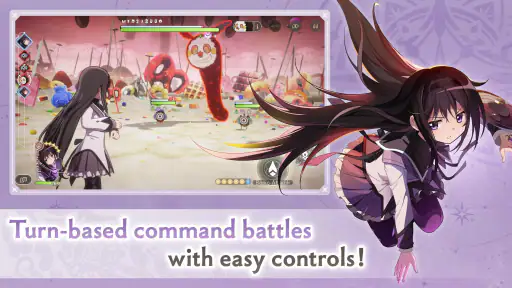
- Turn-based battles are easy to learn but offer useful team-building choices.
- Frequent event content gives players new stories and rewards to pursue.
- Portrait and landscape play options suit different mobile gaming preferences.
- Voice acting and music add atmosphere during key story and combat scenes.
Cons
- Gacha progression can make obtaining favorite characters unpredictable.
- High-rarity units may be important for harder late-game content.
- Energy limits can interrupt longer play sessions.
- Menus and upgrade systems may feel overwhelming for new players.
- Large updates can consume considerable storage and mobile data.

- Category
- Role Playing
- Version
- 3.16.1