Fallout Shelter
- 308.57K
- 4.6
- Installs
- 50.00M
- Price
- Free

Screenshots





Analysis by Reviewed
I enjoy management games most when they give me a clear next step without turning every spare moment into a checklist. Fallout Shelter gets that balance right more often than not: I can make a small decision, watch it affect my Vault, and put the game down. Its appeal comes less from a grand story than from the practical rhythm of keeping a community going.
Small goals make the opening easy to grasp
The early appeal is practical: keep the essential rooms running, put Dwellers where their strengths fit, and respond when trouble interrupts the routine. I like that these short-term jobs give a new Overseer something clear to focus on without demanding a long strategy session. The trade-off is that the opening can feel simple if you want a simulation that gives you a complicated plan to solve from the first minute.
A useful habit is to check the Vault before expanding it. More rooms create more to manage, so I would first make sure the basics are covered and the current workforce is doing useful jobs. That small pause helps avoid building for the sake of building, and makes each expansion feel like a decision rather than a reflex.
What a check-in can realistically accomplish
For a casual player, the most useful question is not “How much can I build right now?” but “What needs attention first?” I’d start by looking for a current problem, then review whether the essential rooms and their assigned Dwellers are in a sensible state. Only after that would I spend time on optional development. This order makes a short session feel purposeful and reduces the temptation to expand simply because the game allows it.
That routine also suits people who play in small pockets of time. A commuter waiting for a train, for example, can make a quick pass through the Vault, handle an interruption, and leave with one clear next move. The game does not need to be treated like a demanding appointment. On the other hand, if you prefer a simulation that carefully plans your session for you, its open-ended cycle may feel less guided than you want.
Welcome to the Wasteland
At first glance, Fallout Shelter looks like your typical management game, but it’s got a lot more personality. You start off as the Overseer of your own Vault. Your job? Keep your Dwellers happy, healthy, and productive. Sounds easy, right? Well, not quite.
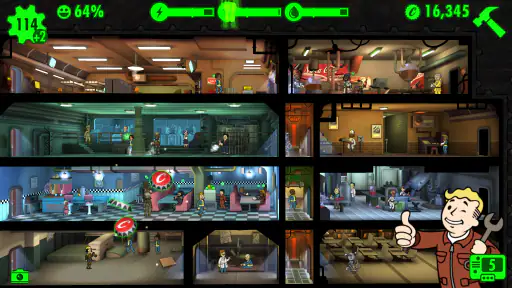
The game kicks off with a brief tutorial, which is super helpful. You learn how to build rooms, assign Dwellers to jobs, and even defend against the occasional Radroach attack. The graphics are colorful and reminiscent of the classic Fallout aesthetic. It's a charming mix of retro-futurism and cartoonish fun that sets the tone perfectly.
More From Our News Desk

Weather by Xiaomi Review: Clear at a Glance, Less Clear Up Close

X Under Pressure: Can It Recover When Posting Goes Wrong?

Clash of Clans Is Won Between the Battles

Android Auto Makes the Case for Quieter Car Software

MobiOffice: Transforming Mobile Productivity with Seamless Integration

EA SPORTS FC™ Mobile Soccer: Redefining Mobile Sports Gaming
Building Your Vault
Building and expanding your Vault is the main chunk of the game. You start with the basics: power, water, and food. Each Dweller has specific strengths, which you can use to your advantage. Need more power? Assign your brainiest Dwellers to the power plant. It’s like running a tiny, underground city, and it’s as addictive as it sounds.
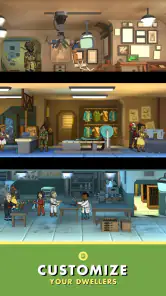
One thing I loved was the ability to customize rooms and characters. You can upgrade your rooms to make them more efficient, and even outfit your Dwellers with new gear and weapons. It’s these little touches that make the game feel personal and engaging.
Turning growth into useful progress
Progress is easy to read because the Vault itself changes as you build, upgrade rooms, and develop your community. I find that visual growth more satisfying than a distant score: a new room has a direct purpose, and a better-equipped Dweller gives you a practical reason to revisit assignments. Still, expansion is not automatically progress. If you spread your attention too thin, the extra space can become another demand rather than a reward.
A practical way to judge an upgrade is to connect it to a need you have already noticed. If a room is not helping the current balance of the Vault, building more of it may add upkeep without making the daily routine easier. I prefer to pause after a change and see whether it actually improves the way I manage the community. That habit is especially useful for players who tend to click every available construction option as soon as it appears.
The difficulty comes from balancing routine upkeep with interruptions. A calm stretch lets me sort jobs and think about the next improvement; an incident can pull attention back to immediate needs. That rhythm suits someone who enjoys checking in and making small adjustments. If you want a demanding, uninterrupted tactical challenge, the lighter management and occasional bursts of urgency may not be enough.
When the routine becomes a challenge
The challenge here is more about prioritizing than mastering a long chain of complicated commands. When several needs compete for attention, I find it helpful to deal with the immediate disruption first, then return to room assignments and longer-term plans. Trying to optimize every detail at once can make a playful simulation feel like work, while a simple order of operations keeps the pressure manageable.
This also explains why the difficulty curve can feel uneven. The opening teaches a small set of actions clearly, but familiarity can make those actions feel repetitive; then an incident briefly makes the same Vault demand more attention. Players who enjoy a gentle loop with occasional urgency may find that change engaging. Players looking for a steadily rising tactical test may find that the challenge does not develop in the way a dedicated strategy game would.
Challenges and Quests
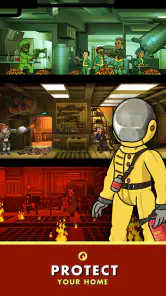
What’s a good game without a bit of challenge? Fallout Shelter throws in random events to keep you on your toes. Fires, raids, and infestations can happen at any time, pushing you to act quickly and strategically.
Then there are the quests. You can send Dwellers out into the Wasteland to explore and bring back loot. These missions add another layer of excitement, as you never know what they’ll encounter. Plus, the rewards are usually worth the risk.
Choosing between staying in and sending someone out
Exploration gives a session a different shape from routine Vault management. Before sending someone out, I’d take a moment to consider whether the community at home is in a stable enough state to spare that Dweller. It is a small planning trade-off, but it stops exploration from feeling like a separate activity pasted onto the simulation. The strongest use of a quest is when it gives me a reason to think about who can leave and what the Vault still needs while they are away.
That choice also helps keep the game from being only about adding rooms. If I want a change of pace, I can focus on a mission; if I want a calmer session, I can stay with assignments and improvements. The two modes offer variety, though neither turns this into a plot-heavy adventure. Someone looking mainly for a character-driven campaign may be better served by a role-playing game rather than a Vault-management loop.
Keeping it Fresh
One of the things that stood out to me was how Fallout Shelter keeps things interesting over time. The developers frequently update the game with new content, events, and challenges. This keeps the experience fresh and gives players a reason to come back for more.
Social interactions are also a big part of the game. You can pair up Dwellers to start families and grow your population. Watching your community expand and thrive adds a satisfying element to the gameplay.
How the long-term loop holds up
The game’s retention pressure is gentle but real: there is usually another room to improve, another assignment to reconsider, or another mission to send out. I like having a visible project waiting when I return, but I would not mistake that for a deep campaign with a fixed ending. The loop works best when I set my own stopping point, such as finishing one task or getting the Vault back into a comfortable state.
That self-imposed limit matters because a steady sequence of small improvements can make time slip by. If I’m playing late or only meant to take a short break, I try to choose one objective before opening the game. Without that boundary, the next little task can keep appearing more appealing than putting the phone down. The design is inviting, but players who dislike persistent, incremental progression may prefer a game with clearly separated levels and sessions.
How it fits into an ordinary day
For an everyday session, I would open the Vault during a short break, check the essentials, handle any active incident, and then decide whether to improve a room or send a Dweller exploring. That makes it easy to enjoy in brief visits, while longer play gives more room to arrange the community and follow missions. It is a better fit for flexible check-ins than for someone who wants a story-led game to occupy a whole evening.
Compared with other simulation games, its appeal is the mix of room management, character assignment, and the Fallout setting rather than a broad, realistic city-building toolkit. I would choose it over a more elaborate simulator when I want a friendly, compact project with recognizable personality. I would choose a deeper strategy game instead if I wanted extensive planning, layered economic systems, or a sustained campaign built around difficult decisions.
New players may wonder whether they need to know the Fallout series first. I don’t think so: the tutorial introduces the basic Vault tasks, and the colorful presentation makes the setup approachable on its own. The game is free to play, though in-app purchases range from $0.99 to $99.99 per item, so I’d treat spending as optional and decide for myself whether any purchase is worth it. Its Teen age rating is also worth considering for younger players and families.
Spending, suitability, and practical expectations
Because the game is free to play, it is easy to try without committing money at the outset. The presence of in-app purchases is still worth keeping in mind, especially if a child will be playing or if you prefer games with no optional spending at all. I would begin by deciding what I want from the experience before considering a purchase; the core appeal is the ongoing management, not the act of buying something.
It is also a better match for players comfortable with a playful presentation of post-apocalyptic trouble than for anyone seeking a serious survival simulation. The Teen rating is a useful signal for families deciding whether the tone fits. I’d recommend it to someone who likes arranging people and rooms, but I would steer a player who wants realistic resource modeling, extensive narrative choices, or high-pressure tactical control toward a different kind of game.
Who will enjoy the pace
Bethesda Softworks LLC developed this simulation game, which has a 4.6 average from around 3.9 million ratings and over 50 million installs. It first arrived on August 12, 2015, and version 2.1.2 supports Android 7.0 and up. Those details place it as an established free-to-play option, but the numbers alone do not tell you whether its steady routine will suit you.
I think it is best for players who enjoy nurturing a small community, making practical choices, and returning to see how their plans have worked. It is less suitable if you dislike resource management, interruptions, or games that invite repeated check-ins. The strongest reason to stay is the connection between a simple assignment and a visible change in the Vault; the main reason to leave is that the cycle can feel repetitive once the basic jobs stop feeling new.
My progression verdict
For me, the goals and unlocks sustain play when they create a useful choice rather than just another reason to expand. The satisfying part is seeing a decision take shape in the Vault and adjusting when the routine is disrupted. The weaker part is that the same management pattern can lose its novelty, so enthusiasm depends on enjoying gradual upkeep more than chasing a dramatic finish.
I’d start with a modest plan: learn the basic room and assignment loop, keep the essential needs in view, and expand only when the current setup gives you a reason to. If that kind of measured progress feels rewarding, there is plenty to enjoy in checking back on a community you have shaped. If you need a strong narrative arc or increasingly complex strategic puzzles, this is probably not the simulation I’d pick first.
Final Thoughts
Overall, Fallout Shelter is a delightful mix of strategy, management, and charm. It’s easy to pick up and play, but offers enough depth to keep you hooked. Whether you’re a fan of the Fallout series or just love a good simulation game, this one’s worth a download.
So, if you’re ready to dive into the Wasteland and build the most efficient Vault out there, give Fallout Shelter a try. It’s free to play, so there’s nothing to lose—except maybe a few hours of your day!
Fallout Shelter Frequently Asked Questions
What devices and software are needed to play Fallout Shelter?
Fallout Shelter is available for Android and iOS, and the Android version requires Android 7.0 or later. Before downloading, check that your device meets the minimum software requirement and has enough available storage for the game. It is a simulation game designed around managing an underground Vault, so expect to spend time planning rooms, assigning dwellers, and keeping supplies in balance.
Does Fallout Shelter have a story, or is it mainly about managing a Vault?
Fallout Shelter is centered on building and running an underground Vault, with the player acting as its Overseer. The ongoing management is the main draw: you develop rooms, look after dwellers, and respond to challenges as the Vault grows. Exploration outside the Vault adds another layer, but the experience is primarily about making decisions and maintaining a settlement rather than following a single linear story.
Is Fallout Shelter free to download, and what does it offer?
Fallout Shelter is a free simulation game from Bethesda Softworks LLC. It puts you in control of an underground Vault, where you take the role of Overseer and make decisions about its growth and daily needs. Optional in-app purchases are available, but the central experience is building and managing your Vault rather than paying to download the game.
Is Fallout Shelter suitable for younger players?
Fallout Shelter has a Teen content rating. Its post-apocalyptic setting includes dangers and conflict as dwellers defend the Vault and explore outside it, alongside the lighter task of organizing rooms and resources. Parents and players should consider that rating when deciding whether the game is a suitable fit, especially if they are looking for a title intended for younger children.
What is the main objective of Fallout Shelter?
In Fallout Shelter, your primary goal is to build and manage a thriving underground vault. As the Overseer, you must ensure the well-being of your dwellers by providing them with food, water, and power. You’ll also need to explore the wasteland, fend off dangers, and expand your vault to accommodate more dwellers.
Pros
- Engaging simulation gameplay.
- No internet connection required.
- Expansive vault customization.
- Regular updates with new content.
- Free-to-play with optional purchases.
Cons
- Can become repetitive over time.
- In-app purchases can be pricey.
- Requires patience for progression.
- Occasional bugs and glitches.
- Limited social interaction features.
- Category
- Simulation
- Version
- 2.1.2








