Dice Attack : Roguelike Battle
- 155.00
- 4.0
- Installs
- 100.00K
- Price
- Free

Screenshots






Analysis by Reviewed
Dice Attack: Roguelike Battle caught my attention because it turns a familiar strategy idea into something more immediate: every decision is tied to a dice roll, and every roll can change the shape of a battle. I found it easy to understand at first, but not completely mindless. The appeal comes from weighing a promising move against the risk of wasting a turn, weakening an army, or missing the chance to press an advantage.
This is a free strategy game from Fun Games Teknoloji, aimed at players who enjoy short tactical sessions rather than a long, story-heavy campaign. Its store summary points to armies, dice, and conquest, but the more useful way to think about it is as a compact decision-making game. You are not simply rolling and watching results happen; you are learning when a roll is worth pursuing and when caution is the stronger play.
The game is available to an Everyone audience, and it runs on devices using Android 11 or later. It was released on June 4, 2024, and the current version is 1.6.1. With a 4.0 average from around 2.8 thousand ratings and more than 100 thousand installs, it has found a modest but noticeable audience. I would not treat those figures as a guarantee that it will suit everyone, but they do suggest that the basic dice-and-army concept has connected with a reasonable number of players.
Why the first few battles work
My first impression was that Dice Attack is built for quick understanding. The central idea is visible almost immediately: roll, assess the result, and use your available strength to attack or expand. That clarity matters because strategy games can sometimes bury their best idea under menus, currencies, tutorials, and layers of explanation. Here, the dice provide a clear point of focus.
The random element also gives the opening battles a useful sense of tension. A strong roll feels like an invitation to take initiative, while a poor result encourages me to reconsider whether I should spend resources immediately. That small pause before committing is where the game becomes more interesting than a simple luck-based toy. The roll creates uncertainty, but my response to it still matters.
I especially liked the way the game encourages flexible thinking. A plan that looks sensible before the roll may need to change afterward, and that keeps repeated encounters from feeling completely scripted. The best moments are not necessarily the biggest victories. They are the turns in which I recover from an awkward result by choosing a smaller, safer action instead of chasing an unrealistic comeback.
There is a trade-off here. Players who want precise control over every unit may find the dice frustrating, particularly when a carefully prepared plan is disrupted by chance. Dice Attack is more comfortable with uncertainty than traditional turn-based strategy games. If you prefer deterministic puzzles where the correct answer can be calculated in advance, this may feel too unpredictable.
For me, the randomness works best when I treat each round as a short problem rather than a test of perfect planning. I do not ask, “What is the strongest move in theory?” I ask, “What can this result realistically support?” That change in mindset made the game more enjoyable and is one of the first practical tips I would give a new player.
A setting built from visual shorthand
The world of the game is communicated through its battle presentation rather than through long narrative passages. Armies, territory, attacks, and dice establish the setting quickly. I did not need a large amount of exposition to understand what I was doing, and that suits the compact format. The game’s identity comes from the contrast between the familiar seriousness of conquest and the playful unpredictability of dice.
That contrast gives the presentation a coherent mood. The military framing makes each decision feel meaningful, while the dice keep the experience from becoming overly grim or formal. Instead of presenting strategy as a heavy simulation, the game treats it as a brisk contest in which fortunes can shift quickly. I found that tone easier to return to than a more demanding war game when I only wanted a short session.
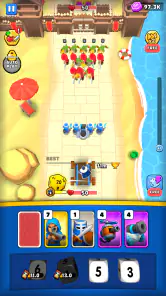
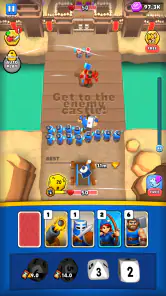
The art direction supports readability more than spectacle. The important information needs to be understood at a glance: where pressure is building, which area is vulnerable, and whether the current roll creates an opportunity. That practical focus is valuable on a phone screen. I would rather have a clean visual hierarchy than elaborate effects that make the battlefield harder to read.
At the same time, players looking for a rich fantasy setting, detailed character personalities, or a deep campaign narrative should adjust their expectations. The atmosphere comes from the interaction of the battlefield and the dice, not from extensive world-building. This is a game about making a decision inside a compact strategic frame, not about following an elaborate story.
One useful way to approach the visual language is to use it as a quick planning aid. Before rolling, I look at the overall shape of the conflict rather than focusing only on the most obvious target. Afterward, I check whether the new result changes the safest route forward. This two-step glance helps prevent the common mistake of reacting to the roll without reconsidering the wider position.
How sound and pacing shape the mood
The pacing is one of the strongest parts of the experience. Dice Attack does not require the same mental commitment as a long strategy match, yet it still gives individual turns enough weight to make them feel purposeful. The rhythm moves from anticipation to resolution and then back to planning. That cycle is simple, but it gives the game a recognizable pulse.
The sound design contributes to that pulse by emphasizing actions and outcomes rather than trying to dominate the session. In a game centered on rolling, a result should feel like an event, but the presentation also needs to leave room for thought. I found the balance more suitable for quick mobile play than a constantly noisy presentation would have been.
This makes the game fit naturally into everyday gaps. I could imagine playing a few rounds while waiting for an appointment, taking a short break, or relaxing after finishing a task. The sessions do not demand the same uninterrupted attention as a complex multiplayer strategy game. However, I would still avoid treating it as something to play carelessly. A single impulsive decision can turn a promising position into a difficult recovery.
The pacing also affects how I respond to losing. Because the game moves quickly, a failed attempt does not feel like a major time investment. I can identify what went wrong, start again, and try a different approach. That is an important advantage over slower strategy games, where a mistake near the beginning may only become obvious much later.
There is a limit to this brisk rhythm. Players who enjoy slow planning, extensive preparation, and long-form empire management may find the game too compressed. It creates tension through repeated short decisions rather than through a large strategic arc. I would choose a more traditional strategy title when I want to build a detailed plan over a long session, but I prefer Dice Attack when I want the pressure to arrive quickly.
Where the dice fit the strategy
The central mechanical question is not whether luck exists; it is how well I manage my response to it. A roll can open a path, but it does not automatically tell me whether taking that path is wise. The strongest habit I developed was separating opportunity from obligation. A good result may make an attack possible without making it necessary.
That distinction creates several useful trade-offs. Pushing aggressively can produce fast progress, but it may also leave fewer options after an unfavorable outcome. Holding back can protect a position, yet excessive caution may allow the opponent or the battlefield to become harder to control. The game is most satisfying when I am balancing those risks instead of repeating the same action every turn.
New players should resist spending every favorable roll immediately. I found it more reliable to consider what the next poor result would leave me with. If an aggressive move would make the whole position collapse when luck turns, I prefer a smaller gain that preserves flexibility. This is not always the most exciting choice, but it tends to produce more consistent runs.
Another useful approach is to identify a priority before the roll. That does not mean locking myself into one move. It means knowing whether I am trying to expand, defend, or create a better setup. Without that priority, the dice can make each turn feel reactive. With it, the same result becomes easier to interpret because I already know what kind of opportunity I am looking for.
The roguelike structure suggested by the title also makes adaptation important. I cannot rely on one perfect sequence every time. I need to work with the situation in front of me, accept that some attempts will be less favorable, and learn which risks are worth repeating. That replay loop is a good fit for players who enjoy improving through experience rather than unlocking a single fixed solution.
I would not recommend the game to someone who dislikes repeated attempts or who expects every loss to be caused by a clear tactical mistake. Randomness can influence the outcome, and that can feel unfair if you are looking for complete control. The game is better for players who see uncertainty as part of the puzzle and enjoy making the best decision available rather than guaranteeing success.
Free access and the practical mobile trade-off
The game is free to play, which makes it easy to try without committing money at the start. It includes in-app purchases ranging from $0.99 to $99.99 per item. That range is worth keeping in mind before spending, especially if you are the kind of player who can get drawn into repeated attempts or convenience purchases.
My advice is to play long enough to decide whether the dice-based loop itself is enjoyable before considering any purchase. A payment should not be used to solve the basic question of whether you like the game’s pacing and level of control. If the random outcomes already bother you, spending more will not change the core identity of the experience.
The free entry point is particularly useful for casual players, families looking for an Everyone-rated strategy title, and people who want to test a new game during short breaks. It is less appealing for anyone who wants a fully predictable progression model or a premium experience with no purchase considerations. The right choice depends less on the price of entry than on your comfort with the game’s repeatable, chance-driven structure.
When comparing it with usual alternatives in strategy games, I see Dice Attack occupying a middle ground. It is more interactive than a passive dice roller because your choices shape the consequences, but it is less controlled than a classic grid-based tactics game. It is also faster and more approachable than a large empire-management title, though it cannot offer the same depth of diplomacy, economy, or long-term planning.
Who will enjoy the atmosphere most
I think the best audience is someone who wants strategy in compact portions and enjoys a little unpredictability. The game works well for players who like to make a plan, see that plan disrupted, and then improvise. It also suits people who enjoy replaying a familiar framework while trying to make better decisions each time.
It is a good match for a short evening routine. I might play a few rounds after dinner, stop when I notice that I am taking risks just to extend a run, and return later with a clearer head. That stopping point matters. Because the battles move quickly, it is easy to continue after a loss simply to recover the previous result. Setting a natural session limit keeps the experience strategic rather than compulsive.
I would suggest skipping it if your ideal strategy game is built around extensive customization, a detailed campaign, or complete control over combat outcomes. It is also not the best option for someone who wants a purely relaxing game with no pressure, since the need to react to changing rolls can become tense. In those cases, a slower puzzle game or a more deterministic tactics title would likely be a better fit.
For players using an older device, the Android 11 minimum requirement is an important practical consideration. Devices that meet that requirement should be the natural starting point for installation, while anyone below it will need to look elsewhere. The current version, 1.6.1, is the version I would use when judging the present experience rather than relying on impressions from an earlier release.
My final take on the playable mood
Dice Attack: Roguelike Battle succeeds because its parts point in the same direction. The army theme gives the rolls context, the visual presentation keeps the battlefield understandable, and the pacing turns each result into a small moment of suspense. None of these elements needs to overwhelm the others. Together, they create a focused mood that feels playful, tactical, and slightly risky.
Its greatest strength is the way it makes adaptation feel like the main skill. I am not rewarded for pretending the dice will follow my plan. I am rewarded for recognizing what the current situation allows and choosing a response that keeps the next decision open. That is a more interesting loop than simply hoping for a high roll.
Its main limitation is equally clear: chance remains central, and players who want total precision may never feel comfortable with it. The compact design also means that it should not be mistaken for a full-scale strategy simulator. It offers a concentrated version of tactical decision-making, not a replacement for games built around deep economies, campaigns, or detailed unit control.
Overall, I would recommend it to anyone who wants a free mobile strategy game with a clear identity and a quick, replayable rhythm. The 4.0 average reflects a generally positive reception without suggesting universal appeal, and that feels fair to me. The best reason to try it is not the promise of winning every roll, but the satisfaction of making a sensible move when the roll gives you less than you wanted.
After spending time with it, my recommendation is simple: approach each battle with a priority, keep a backup plan, and do not confuse a lucky result with a requirement to attack. Those habits reveal what the game does well. It turns uncertainty into a playable mood, then asks you to find strategy inside it.
Pros
- Quick battles fit well into short gaming sessions.
- Randomized runs make each attempt feel different.
- Dice mechanics add strategy beyond simple tap-based combat.
- Runs offer satisfying progression and replay value.
- Bright visuals and clear effects make combat easy to follow.
Cons
- Luck can sometimes outweigh careful planning during battles.
- Higher difficulty may feel punishing for casual players.
- Repeated encounters can become familiar after extended play.
- Some upgrades may require considerable time to unlock.
- The interface can feel crowded during complex combat turns.

- Category
- Strategy
- Version
- 1.6.1