Dark Aesthetic Color by Number
- 296.00
- 4.8
- Installs
- 100.00K
- Version
- 1.1.8
Screenshots

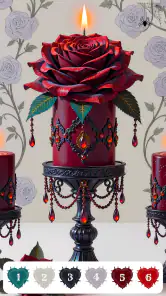
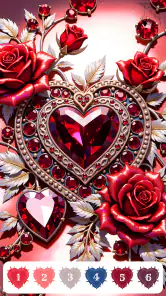
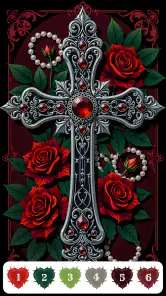

Analysis by Reviewed
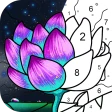
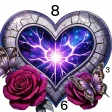
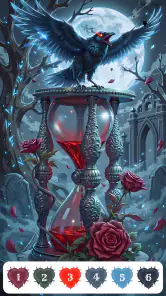
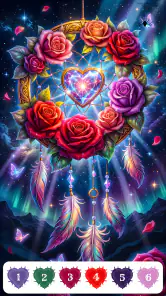
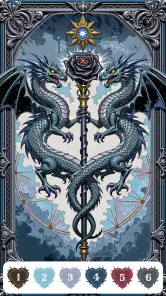
I went into Dark Aesthetic Color by Number expecting a familiar paint-by-number game with a darker visual theme. That is exactly where it starts, but the mood changes the experience more than I first expected. Instead of bright flowers, cheerful animals, or soft landscapes, the focus is on shadowy objects, symbols, and ornaments arranged around a gothic-inspired color palette. The result feels calmer, more decorative, and slightly more mysterious than the usual board games in this style.
The basic action is simple: choose an illustration, select a numbered color, and tap the matching spaces until the picture gradually comes together. There is no complicated rulebook to learn, which makes it easy to open during a short break. At the same time, the darker artwork gives each completed image a stronger identity than a generic coloring page. I found myself paying attention not only to filling spaces correctly, but also to how the contrast between dark backgrounds and brighter details changed the final result.
How the coloring loop feels from the first tap to the next session
The first action is easy, but the artwork sets the tone
The first useful thing to understand is that this is a board game built around visual completion, not a traditional board game with opponents, turns, or strategic moves. The numbered coloring format does the teaching for you. I did not need a tutorial to understand what to do: I picked a color, looked for the highlighted spaces, and began filling them.
That simplicity works especially well for people who want a low-pressure activity. I can imagine opening it while waiting for an appointment, winding down before sleep, or taking a few minutes away from a more demanding task. The gothic presentation gives those moments a different atmosphere from the bright, playful presentation used by many competing coloring apps. It feels more suited to someone who likes dark decorative art, mysterious symbols, and ornamental designs.
The strongest early impression comes from the subject matter. The pictures are not merely recolored versions of ordinary scenes; the emphasis on dark aesthetic objects and symbols makes the choice of image important. If you enjoy gothic fashion, fantasy decoration, occult-inspired visual motifs, or simply black-and-purple style artwork, the theme is likely to feel more personal than a standard coloring collection.
There is also a small trade-off here. A dark theme can be appealing precisely because it is distinctive, but it will not suit everyone. If you prefer sunny landscapes, realistic scenery, cute characters, or a broad mixture of subjects, this focused identity may feel narrow. I would not install it expecting a general-purpose coloring library. Its appeal depends on wanting this particular mood.
The feedback rhythm keeps the task moving
Once I began tapping, the game settled into a clear rhythm. I chose a color, searched for its matching areas, filled them, and moved on to another shade. Each correct tap gave immediate visual confirmation because another piece of the illustration became complete. That feedback is the main reason the simple mechanic remains engaging: the screen keeps changing in response to small actions.
The rhythm is most satisfying when I work from larger areas toward smaller decorative details. Broad sections make visible progress quickly, while tiny spaces near the end create a more careful finishing phase. I found that alternating between those two types of work helped prevent the session from feeling like a repetitive hunt for isolated pixels. Starting with a noticeable color also makes the picture reveal itself sooner, which gives the early part of a drawing more momentum.
A practical tip is to avoid treating every number as equally important. When several colors are available, I usually begin with the one that appears in the most obvious or largest sections. This lets me understand the composition before dealing with the fussy details. Later, I switch to the colors that appear only in small ornaments. That approach makes the image feel like it is being constructed rather than randomly filled.
The darker art style affects the feedback too. On a bright, colorful picture, progress can look cheerful immediately. Here, the pleasure often comes from contrast: a symbol emerges from a shadowed background, a metallic-looking accent gains definition, or a decorative edge becomes easier to read. The game rewards attention to small visual changes instead of relying entirely on loud animation or constant novelty.
That said, the loop can become repetitive if you want active gameplay. There are no tactical decisions in the usual board-game sense, and the numbered system limits creative freedom. I am not choosing my own palette or painting outside the suggested spaces. The satisfaction comes from accuracy and completion, not artistic experimentation. Someone looking for drawing tools, freehand coloring, or competitive challenges will probably find the interaction too controlled.
The reward is the completed image, not a complex progression system
The main reward is seeing a dark illustration become whole. That sounds modest, but it is enough when the goal is relaxation rather than achievement chasing. I liked the transition from a partially obscured design to a finished ornament because the final image makes the earlier tapping feel purposeful. The reward is visual and immediate: the picture is clearer, more balanced, and ready to appreciate.
This makes the game useful for short sessions with a defined endpoint. Instead of entering an endless feed, I can focus on one illustration and stop when it is complete. That sense of closure is valuable if you are trying to avoid games that encourage constant checking. It also works well as a small routine: finish a picture, enjoy the result, and decide whether you actually want to continue.
My advice is to look at the finished image before rushing into the next one. The final stage often contains the details that explain the composition. A dark background can make early progress look sparse, while the last accents provide the visual balance. Taking a moment to inspect the completed work makes the reward feel less like a checkbox and more like a small piece of decorative artwork.
The free entry point is another part of the reward structure. The game is free to download, so trying the core idea does not require an upfront purchase. Optional in-app purchases range from $0.99 to $39.99 per item, which is a wide enough spread that I would pay attention before buying anything. For me, the sensible approach is to use the free experience first and decide whether the artwork and pacing justify spending money. A relaxing coloring game should not become an impulse-purchase habit.
The public response suggests that the concept has found an audience. It has an average rating of 4.8 from around 1.7 thousand ratings, with 296 written reviews and over 100 thousand installs. Those figures do not replace personal taste, especially with such a specific visual style, but they do indicate that the dark presentation is not merely a novelty with no staying power.
Resetting after a picture is what makes another session possible
After completing an illustration, the natural question is whether I want to begin another one. The answer depends on what I need from the app. If I am using it to fill a few quiet minutes, one completed picture is a clean stopping point. If I am in the mood for more, the same action-feedback-reward pattern makes it easy to start again without learning anything new.
This reset is both the strength and the limitation of the design. There is no mental cost when moving to another image because the rules remain familiar. I can return after a day away and immediately know how to play. However, the absence of a deeper change in mechanics means the motivation for another session comes mainly from wanting to see a new gothic design, not from unlocking a new style of play.
I found that setting a personal stopping rule improves the experience. For example, I might finish one image during a break and leave the next for later, rather than continuing until the repetition becomes tiring. This is particularly useful for people who enjoy completion but do not want a game to absorb an entire evening. The visual theme encourages lingering, yet the simple loop is best enjoyed in measured portions.
The app is also a reasonable fit for users who want something accessible across older devices. It supports Android 7.0 and later, so it is not restricted to only the newest phones and tablets. Its content rating is Everyone, which matches the non-competitive, low-pressure nature of the activity. Families should still consider whether the gothic symbols and darker imagery fit their own preferences, but the game is designed as a broadly accessible coloring experience rather than an adult-only title.
Where it stands beside ordinary coloring alternatives
Compared with a conventional coloring app, this game’s biggest advantage is its committed aesthetic. Many coloring apps try to serve every taste with animals, mandalas, scenery, food, and characters. That variety is useful, but it can also make the experience feel like browsing a large catalog without a clear personality. Here, the visual direction is the reason to choose it: the illustrations are built around dark ornaments, symbols, and objects rather than treating gothic art as one category among many.
Compared with a freehand drawing app, it is much easier to start and much less expressive. I do not need to choose brush sizes, mix colors, or worry about staying inside a line because the numbered structure guides each move. The trade-off is that my personal creativity has less room to show. If I want to make an image uniquely mine, a drawing app is better. If I want a reliable path from blank design to finished picture, this game is more comfortable.
Compared with competitive board games, it is deliberately quiet. There are no opponents to outthink and no pressure to optimize a move. That makes it suitable for decompression, but unsuitable if I want suspense, social play, or strategic depth. Calling it a board game describes its store category, yet the actual experience is closer to a themed digital coloring activity with a puzzle-like structure.
One non-obvious advantage is that the fixed color-by-number workflow can help when creative decisions feel tiring. After a long day, choosing a palette may be one decision too many. Here, the next useful action is always visible. The game turns coloring into a sequence of small, manageable instructions, which is why it can work as a mental reset even for someone who does not consider themselves artistic.
Another trade-off is that the same guidance can feel restrictive after repeated sessions. I would choose this app for predictable relaxation, not for learning illustration techniques. It teaches attention and completion more than color theory or composition. If your goal is to practice drawing, paint freely, or produce work for sharing, another category of app will serve you better.
Who will enjoy it, and who should skip it
I would recommend it to anyone who specifically likes a gothic color-by-number atmosphere and wants a calm game that can be played in short bursts. It is a good match for people who enjoy decorative symbols, dark palettes, and the gradual reveal of a finished image. It also suits users who prefer a clear objective instead of an open-ended canvas.
A realistic everyday use case would be a quiet ten-minute break after work. I could open the game, choose a picture, fill the larger sections while listening to something in the background, and stop once the session reaches a satisfying point. The activity occupies my hands without demanding the same concentration as a strategy game, while the dark artwork feels less visually noisy than many bright casual games.
I would skip it if I need multiplayer interaction, deep board-game strategy, freehand creativity, or a constantly changing set of mechanics. I would also hesitate if gothic imagery is not appealing, because the theme is not a small decoration placed over an otherwise neutral game. It shapes the entire identity. People seeking a broad collection of cheerful coloring subjects may find a more varied alternative a better long-term choice.
The developer, Joyarc Coloring Games, has kept the concept focused rather than trying to turn it into several unrelated experiences. The current version is 1.1.8, and the straightforward design makes it easy to understand what the app is offering. My main caution is simply to keep expectations realistic: the value is in the mood, the artwork, and the satisfying completion loop, not in a large collection of advanced game systems.
My verdict on the complete loop
Dark Aesthetic Color by Number works because every stage connects cleanly. The first action is obvious, the feedback arrives with each correct fill, the reward is a completed dark illustration, and the reset is effortless when I want another session. That loop is uncomplicated, but it has enough visual character to avoid feeling entirely anonymous.
I especially appreciate that the game knows what it wants to be. It is not trying to compete with drawing software or replace a strategic board game. It offers a narrow, coherent form of relaxation for people who enjoy gothic decoration and structured coloring. The limitations are real: the interaction can become repetitive, the color choices are not truly free, and the focused theme will not appeal to every player. Optional purchases also deserve a thoughtful approach rather than automatic spending.
For me, the deciding question is not whether the mechanic is original. It is whether the dark aesthetic makes a familiar mechanic more enjoyable. In this case, it does. If that visual mood matches your taste, the free download is an easy way to test the experience, and the accessible age rating and Android 7.0 support make it approachable for a wide range of users. Choose it for calm, themed completion rather than depth, competition, or artistic freedom.
Pros
- Relaxing coloring sessions suitable for short breaks.
- Dark-themed artwork creates a distinctive visual style.
- Simple tap-to-color controls are easy for beginners.
- Works well for users who enjoy gothic and mysterious designs.
- Progressive coloring gives each picture a satisfying finish.
Cons
- Some detailed images may require considerable time to complete.
- Small numbered areas can be difficult to select on smaller screens.
- The dark theme may not appeal to users seeking bright artwork.
- Repeated coloring tasks can feel monotonous after extended play.
- Certain content or tools may be limited without optional purchases.