Connections Word Game
- 295.00
- 4.6
- Installs
- 100.00K
- Price
- Free
Screenshots
Analysis by Reviewed
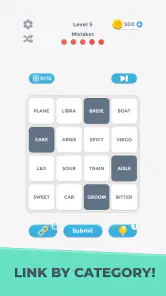
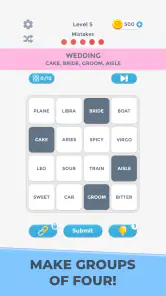
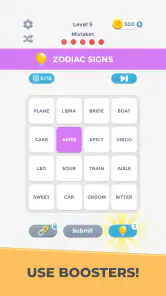
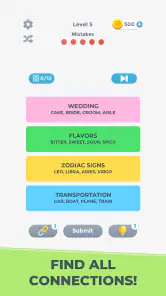
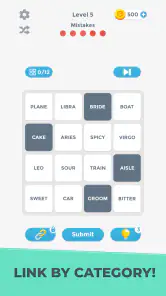
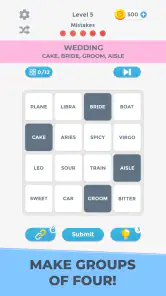
I enjoy trivia games that make me pause before answering, and Connections Word Game fits that mood better than a fast multiple-choice quiz. Its central challenge is simple to understand: sort words that share a topic. The difficulty comes from deciding which relationship is intentional and which one is merely tempting. That small distinction gives each round a satisfying puzzle quality.
I reviewed it as a free trivia game from Wixot Games, aimed at Everyone and available for devices running Android 7.1 or newer. It is easy to start, but it is not mindless. The best moments come when several words seem to belong together and I have to test my assumptions instead of tapping the first pattern I notice.
How the game feels in everyday use
The most natural way to play is in short sessions. I can open it while waiting for coffee, take a few minutes during a commute, or use it as a small mental break between tasks. It does not demand the long commitment of a story game, and the puzzle format makes it more engaging than simply scrolling through a list of facts.
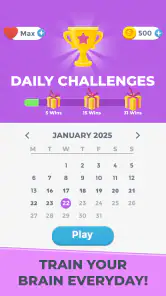
The store summary presents it as a daily brain challenge, and that description matches the general appeal without explaining the real tension. The game is not only asking whether I know a word. It is asking whether I can recognize the intended connection among several plausible choices. That makes vocabulary, general knowledge, concentration, and careful elimination equally important.
A typical session works well for someone who likes to think aloud. I might spot a group that appears related, then notice that one word could also fit another category. Removing that uncertain choice often reveals a stronger group elsewhere. The useful habit is to avoid locking in the first connection that looks reasonable. I get better results by treating every group as a hypothesis and checking whether the remaining words still make sense.
Why the format is more demanding than a normal quiz
Traditional trivia usually rewards quick recall: choose the correct answer and move on. Here, the challenge is more layered. Even when I understand what a word means, I may still need to work out how the puzzle designer intends it to function beside the others. A familiar word can be a distraction, while a less obvious one may be the key to solving the board.
That design makes the game approachable for casual players but still interesting for people who enjoy word puzzles. It also means that a player who dislikes ambiguity may find some rounds irritating. The satisfaction is highest when I discover a clean, defensible group. It is lower when I feel I am guessing what the puzzle wants rather than reasoning toward it.
What the free version means for value
The game is free to download, so the initial decision is uncomplicated: I can try it without paying upfront. That matters for a casual trivia title because the format is easy to judge quickly. After a few sessions, I can decide whether the puzzle style suits me before considering any optional spending.
There are in-app purchases priced from $1.99 to $79.99 per item. I would treat that range as a reason to check the purchase screen carefully rather than assume every player needs to spend money. Free access gives the game a low barrier to entry, while the presence of optional purchases means the long-term value depends on how much content, convenience, or assistance a particular player wants from those items.
I would not describe the paid side as automatically good value for everyone. A person who only wants an occasional word puzzle can enjoy the free starting point and stop there. A dedicated daily player may see more reason to consider a purchase, but should still compare the benefit offered with actual play habits. If I am already satisfied by short sessions, paying for more is harder to justify than it would be for someone who returns every day.
The average rating is 4.6 from around 7,300 ratings, and the game has roughly 300 written reviews. Those figures suggest that many players enjoy the format, but they do not replace personal testing. Puzzle difficulty is subjective: a board that feels clever to one player may feel vague to another. I would use the strong reception as encouragement to try it, not as proof that every round will suit me.
Small habits that improve the solving experience
My first useful tip is to separate certainty from possibility. If three words clearly belong together but the fourth is questionable, I do not immediately submit the group. I scan the rest of the board first. This often exposes a more convincing relationship and prevents a promising answer from consuming an attempt.
A second tip is to look for grammatical or functional links, not only broad subjects. Words may connect because they are used in a familiar phrase, belong to the same type of expression, or serve a similar role. Searching only for obvious themes such as food, animals, or places can make a board harder than it needs to be. The strongest solution may depend on how a word is used rather than what it describes.
A third habit is to use the final few words as evidence. When I narrow the board down, I ask whether the remaining set forms a precise group or merely a loose association. If the connection could describe dozens of words, it is probably not specific enough. This is especially helpful when two possible categories overlap.
I also recommend taking a short break instead of repeatedly forcing the same idea. Because the game is built around recognition, staring at the same arrangement can make a weak pattern feel convincing. Returning with fresh attention is often more useful than tapping randomly. That is a practical advantage of the short-session format: I can pause without abandoning a long campaign.
Where it fits beside other trivia games
Compared with multiple-choice trivia, this game feels less like a knowledge test and more like a classification puzzle. A player who enjoys rapid questions about history, science, or entertainment may miss the variety and immediate feedback of a conventional quiz. In return, Connections Word Game offers more room for deduction and word association.
It also differs from a crossword. A crossword usually gives me clues, a grid, and intersecting letters that gradually confirm or reject an answer. Here, the words are visible from the start, but the relationships are hidden. That makes the experience more social and discussable: two people can look at the same board and debate which grouping is intended.
Compared with a broad word game focused on spelling or vocabulary building, this title is less about producing words and more about interpreting them. Someone who wants practice with definitions may prefer a dictionary-based quiz. Someone who enjoys spotting patterns among familiar terms will probably find this format more rewarding.
Limitations I noticed in the format
The biggest limitation is the possibility of ambiguity. A word can belong naturally to more than one imagined category, and that can make a failed attempt feel unfair even when the intended answer becomes clear afterward. Players who want completely objective answers may prefer a quiz with one plainly correct response.
The game can also become repetitive for people who need constant changes of pace. Its appeal comes from refining the same core activity: identify related words, test the grouping, and eliminate distractions. That focus is a strength for puzzle fans, but a weakness for anyone looking for mini-games, character progression, or a larger variety of mechanics.
Another tradeoff is that the game rewards patience more than speed. If I am looking for a quick competitive rush, a timed trivia game may provide stronger excitement. Connections Word Game is better when I want to think carefully and enjoy the moment of seeing the board click into place.
The age rating of Everyone makes it suitable as a general-audience choice, but suitability does not guarantee equal enjoyment across ages. Younger players may need enough vocabulary and background knowledge to recognize the intended links, while adults may occasionally be challenged by references outside their experience. The accessible rating describes the audience, not the difficulty of every puzzle.
Who is most likely to get good value
I would recommend it to people who enjoy word association, category puzzles, and quiet daily challenges. It is especially appealing if you like discussing possible answers with a friend or family member. One person can suggest a connection while the other looks for a trap, making the game work as a light shared activity even when only one device is being used.
It is also a good fit for players who want a free game that can be sampled without a long tutorial or complicated setup. The current version is 1.6.7, and the broad device requirement makes it accessible on older compatible systems as well as newer ones. I appreciate that the entry point is straightforward: install it, understand the word-grouping premise, and decide from actual play whether it deserves a regular place on the phone.
The strongest value comes from repeat players. If I enjoy returning to a daily puzzle and thinking about language in a slightly different way each time, the free access has clear practical value. The game can fill small gaps in the day without asking for a major time investment, which is more useful to me than a title that requires a large uninterrupted session.
Who should probably skip it
I would skip it if I want a trivia game built around factual recall, rapid rounds, or a broad collection of question types. This is not the best choice for someone who wants to test detailed knowledge with clear right-or-wrong questions. The word-connection structure is the whole point, so there is little reason to choose it if that style does not sound enjoyable.
I would also be cautious if ambiguous categories quickly become frustrating. The game asks me to tolerate uncertainty and revise a theory when the remaining words do not support it. That is satisfying for a puzzle-minded player, but tiring for someone who prefers direct instructions and immediate confirmation.
Finally, players who are uncomfortable with optional purchase prompts should pay attention during setup and play. The game itself is free, but the listed purchase range reaches from small items to a much higher-priced option. I would not spend simply because a puzzle is difficult. I would first decide whether the free experience already delivers enough entertainment and whether any paid option solves a real problem for me.
My final recommendation
After spending time with it, I see Connections Word Game as a focused trivia choice rather than an all-purpose brain-training app. Its best quality is the way it turns ordinary words into a test of judgment. I enjoy the point where an apparently obvious group falls apart and a more precise connection emerges.
The free entry point makes it easy to try, while the real value depends on whether you enjoy returning to this specific kind of word puzzle. I would start without paying, play several sessions, and notice whether the challenge feels clever or merely vague. That simple test tells me more than a rating can.
Wixot Games has made a game with a clear identity: it is for finding relationships, questioning first impressions, and solving in short bursts. I recommend it to casual puzzle fans, word-game players, and anyone who likes a daily mental reset. I would choose a conventional trivia title instead if my priority were speed, factual breadth, or a wider range of game modes.
For me, the verdict is positive but specific. Connections Word Game is worth trying for free, especially when I want a thoughtful break rather than a frantic contest. I would only consider an in-app purchase after confirming that the game has become a regular habit and that the particular paid option offers value I can actually use.
Pros
- Simple rules make it easy to start playing immediately.
- Daily puzzles offer a satisfying routine for word-game fans.
- Grouping words by hidden themes feels rewarding when solved.
- Clean interface keeps attention focused on the puzzle.
- Short sessions fit well into commutes or quick breaks.
Cons
- Some word connections can feel subjective or open to debate.
- Difficulty may vary noticeably between puzzles.
- Limited daily content can feel restrictive for frequent players.
- A single mistaken group may make the remaining words confusing.
- Players seeking action or variety may find the format repetitive.
- Category
- Trivia
- Version
- 1.6.7