Bible Games: Trivia & Puzzles
- 28.00
- 4.7
- Installs
- 100.00K
- Price
- Free
Screenshots
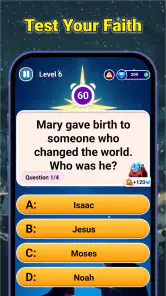
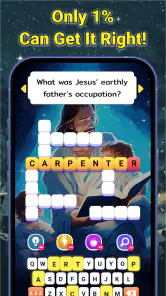
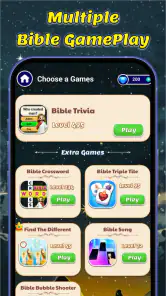
Analysis by Reviewed
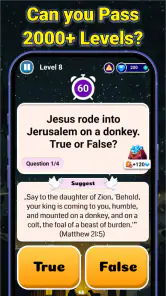
I approached Bible Games: Trivia & Puzzles as a quick-play trivia game rather than as a replacement for a study Bible or a structured learning course. That distinction matters. The app is built for people who want to test their knowledge of Scripture through quizzes, word games, puzzles, and other Christian-themed challenges, with enough variety to make a short break feel more purposeful than ordinary mobile entertainment.
My first impression is that its appeal comes from the combination of subject and format. Instead of asking you to sit down for a long reading session, it turns biblical knowledge into small, approachable rounds. That makes it easy to use alone, with family, or as a light activity in a church or study-group setting. At the same time, the game is most enjoyable when you already like trivia and are comfortable learning through repetition, because the experience is centered on answering questions rather than offering deep explanations.
How I would decide whether this Bible trivia game fits
The first decision point is your reason for downloading it. If you want a friendly way to revisit familiar names, events, teachings, and vocabulary, this game makes sense. If you are looking for a complete Bible reference tool, detailed commentary, or a carefully sequenced course for beginners, I would look elsewhere. The app’s value is in active recall and casual practice, not in replacing serious reading.
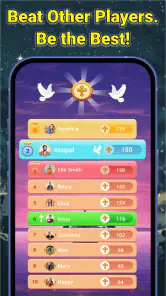
I would also consider how you normally play on a phone. The format suits short sessions: a few questions while waiting, a puzzle before bed, or a family challenge after dinner. It is less suitable if you only enjoy games with long stories, elaborate strategy, competitive rankings, or a strong sense of character progression. This is a trivia-focused experience, and its Christian theme is the central reason to choose it.
The game is free to download, which lowers the barrier to trying it. Optional purchases range from $0.99 to $49.99 per item, so I would pay attention to any purchase prompts and decide in advance whether I want to keep the experience entirely free. The free entry is useful for testing the question style and variety before spending anything, especially because trivia games can feel very different depending on how challenging their content is.
It is listed for Everyone, making it a reasonable candidate for households that want an age-friendly religious game. I would still treat that label as a starting point rather than a substitute for parental judgment. Younger players may need help with reading, while mixed-age groups may find that adults who already know the Bible have a noticeable advantage.
What makes the format more useful than passive reading
Trivia encourages a different kind of attention from simply scrolling through verses. When I try to recall an answer without looking it up, I notice which parts of my knowledge are solid and which are only vaguely familiar. That makes the app useful as a personal check-in after reading a passage or attending a lesson. I would not use every question as proof that I understand a subject fully, but I would use a missed answer as a prompt to open the Bible and investigate.
A practical routine is to play first and read afterward. Rather than searching for answers immediately, I would note the questions that caused hesitation, finish a short session, and then review those topics separately. This turns the game into a study trigger instead of letting it become a guessing exercise. It is one of the better ways to get more value from a casual quiz app without expecting it to provide all the context itself.
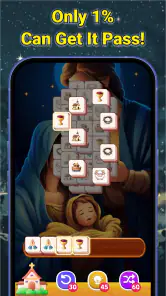
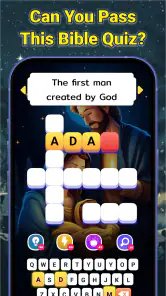
Another useful approach is to treat the different formats as different kinds of practice. Trivia questions are better for recall, word games can reinforce names and terms, and puzzles may be more comfortable when I want a slower, less test-like activity. Switching formats when concentration drops helps prevent the app from feeling like the same quiz repeated endlessly.
Where Bible Games: Trivia & Puzzles stands out
The strongest advantage is focus. Many general trivia games jump from geography to celebrities to science, which can be fun but does not serve someone who specifically wants Christian content. Here, the theme is consistent. I can open the game with a clear expectation that the questions and activities will relate to the Bible or Christian knowledge rather than requiring me to filter out unrelated categories.
That focus also gives it a natural place in group settings. A family could use it as a relaxed conversation starter, while a small group might play a few rounds before discussing a related passage. I would not present the scores as a measure of faith or spiritual maturity, because knowledge and belief are not the same thing. Used lightly, though, the game can create an easy opening for people who might not know how to begin a discussion.
The variety implied by the combination of quizzes, word games, and puzzles is important. If I am in the mood for direct questions, I can approach it as trivia. If I want something less demanding, a word-based challenge may feel more inviting. That range is more useful than a single question-and-answer mode, particularly for households where one person enjoys testing knowledge and another prefers casual puzzle play.
The app also has a clear audience signal through its developer, Dove Game Studios. I would expect the experience to be judged primarily on how well it delivers accessible Christian game content, not on the production scale of a major entertainment release. That is a fair trade for players who care more about subject matter and ease of use than cinematic presentation.
Its reception is encouraging: it holds a 4.7 average from around 2.4 thousand ratings, and the listing shows over 100 thousand installs. Those figures suggest that the concept has found an audience, although they do not tell me whether every question matches my preferred difficulty or whether the app will remain engaging over a long period. I see them as a reason to try it, not as a guarantee that it will suit everyone.
How I would use it in everyday life
Imagine having ten minutes before leaving for work or school. I could play a short round instead of opening a general social feed, then stop without feeling that I need to commit to a full gaming session. The same works during a lunch break, provided I am comfortable with a game that asks for attention rather than offering background entertainment.
For a family, I would suggest using one device and answering aloud before tapping. That changes the activity from solitary screen time into a small conversation. Younger players can guess, older players can explain, and nobody has to treat the score too seriously. If a question leads to disagreement, the best next step is to check the relevant passage rather than arguing from memory.
For personal study, I would keep a simple note of recurring mistakes. If I repeatedly confuse people, places, or events, that pattern tells me where a focused reading session would help. This is a more effective workflow than playing dozens of rounds without reflecting on the results. The game supplies the prompt; the deeper learning still comes from the source material.
Limits that may change your decision
The main limitation is the boundary between trivia and understanding. A correct answer can show that I remember a fact, but it does not necessarily show that I understand its historical setting, literary purpose, or theological significance. A player who wants explanations attached to every answer may find the experience too shallow unless they are willing to do additional reading outside the game.
Difficulty can also be uneven from one player to another. Someone who has attended Bible classes for years may find introductory questions comfortable, while a newcomer may need time to recognize names and terminology. That makes the app easy to share, but it can also make group scoring feel unfair. I would use cooperation or discussion instead of turning every session into a strict competition between people with very different backgrounds.
There is another trade-off in the free-to-play model. The ability to begin without paying is convenient, but optional purchases can affect how comfortable the experience feels for people who want a completely uninterrupted session. Since individual items can cost as much as $49.99, I would review each prompt carefully and avoid assuming that every extra is necessary. The sensible approach is to play the free portion first and only consider spending if the app has already become part of your routine.
I would also avoid expecting the game to replace a dedicated Bible app. A study app is usually better when I need searchable passages, reading plans, cross-references, or sustained context. A printed Bible or a trusted digital edition is better when I want to slow down and read without game mechanics. This title is strongest when it adds a playful layer around learning, not when I ask it to perform every religious or educational task.
When another category may be the better choice
If your priority is memorizing verses, a flashcard-style tool may fit better because its entire workflow can be organized around repetition and recall. If you want to understand a book of the Bible in context, a reading or commentary app is the more appropriate choice. If you want broad general knowledge, a conventional trivia game will offer a wider subject range. Choosing one of those alternatives would not mean this game is poor; it would simply mean your goal is different.
The switching cost is fairly low because the app is free to start and does not require me to abandon another tool. I can use it alongside a Bible reader, a study group, or a family activity. The real cost is attention: if I spend all my time chasing answers and never follow up on them, I may get the satisfaction of a score without gaining much understanding. I would keep the game in a supporting role and switch to a more focused resource whenever I need depth.
There is also no need to choose between fun and seriousness. A short quiz can be a useful warm-up before reading, a review after a lesson, or a way to help a child become curious about a passage. The important distinction is whether I use the questions as an endpoint or as an invitation to learn more. The second approach makes the app considerably more valuable.
Practical details before installing
The game was released on December 8, 2024, and its current version is 2.3.1. It requires Android 7.1 or later, so I would check the operating system on an older phone before trying to install it. Those details make it accessible to many existing devices, while still giving users a simple compatibility check before they begin.
Because it is a mobile game rather than a formal classroom product, I would keep expectations realistic about structure. It is best approached as an accessible collection of Christian quizzes and puzzles that can fit around daily life. Someone seeking a carefully graded curriculum should compare it with educational software designed specifically for that purpose.
My recommendation is straightforward: I would suggest Bible Games: Trivia & Puzzles to a player who wants free, approachable Bible-themed entertainment, especially for short solo sessions or relaxed family use. The combination of trivia, word activities, and puzzles gives it more flexibility than a single-mode quiz, and its strong average rating makes it worth trying.
I would skip it if I wanted detailed explanations, a comprehensive reference library, or a broad trivia catalog unrelated to Christianity. I would also be cautious about purchases until I had tested the free experience and decided whether the game genuinely fits my routine. For casual biblical recall and conversation, it is a good choice; for deep study, it works best as a companion rather than the main tool.
Pros
- Covers trivia
- word games
- and puzzles for varied gameplay.
- Helpful hints make difficult questions less frustrating.
- Simple controls are suitable for casual players of all ages.
- Short rounds work well for quick play sessions.
- Can encourage players to revisit and learn Bible passages.
Cons
- Some questions may depend on a specific Bible translation.
- Difficulty can feel uneven between different game modes.
- Repeated questions may reduce long-term replay value.
- Ads may interrupt gameplay unless an ad-free option is available.
- Religious content may not appeal to users seeking general trivia.
- Category
- Trivia
- Version
- 2.3.1