50 US States - American Quiz
- 795.00
- 4.5
- Installs
- 500.00K
- Price
- Free
Screenshots
Analysis by Reviewed
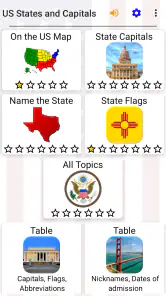
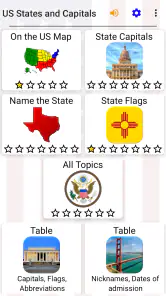
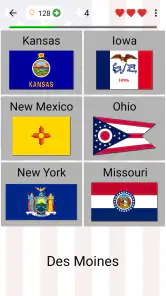
Learning the fifty states can feel surprisingly difficult when the information is presented as a flat list. I know the state names, yet I still mix up capitals, forget which flag belongs to which state, and hesitate when looking at an outline on a map. 50 US States - American Quiz takes that familiar problem and turns it into a focused trivia game built around state names, capitals, flags, and maps.
After spending time with it, I see the game as a practical study companion rather than a broad general-knowledge quiz. It stays tightly focused on the United States, which is exactly why it can be useful for students, travelers, families, and anyone who wants to strengthen basic geography without opening a textbook. The experience is free, suitable for Everyone, and developed by Andrey Solovyev. It has also been available since September 2, 2014, so this is an established learning game rather than a newly introduced experiment.
What to consider before choosing a state geography quiz
The first question is not whether the subject is interesting; it is whether you learn better through repeated questions than through reading. This game makes the most sense for someone who wants active recall. Instead of simply seeing that the capital of Vermont is Montpelier, you have to retrieve the answer when prompted. That small difference matters because it exposes the gaps that a quick reading session can hide.
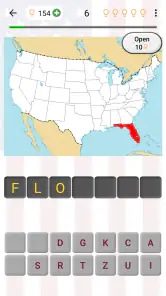
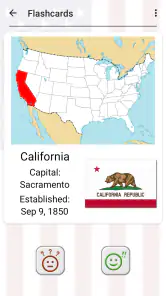
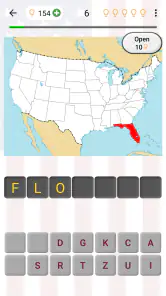
I would also decide which type of recognition you need. Some people can identify a state by name but cannot place it on a map. Others recognize a flag but forget the capital. The value here comes from working across those connected pieces rather than treating state knowledge as one single skill. If your goal is specifically to improve map awareness, pay close attention to the map-based questions instead of rushing through the easier name questions.
Another useful decision criterion is session length. This is not a substitute for a full geography course, and I would not choose it if I wanted detailed explanations of regional history, population, government, or culture. Its strength is narrower: it gives you a compact way to test what you remember. That makes it suitable for short practice sessions, but less suitable for someone looking for a rich reference guide.
The game is rated for Everyone, which fits the straightforward educational subject and simple trivia format. I can imagine using it with a child who is beginning to learn the states, but adults can benefit too. In fact, the questions are especially handy for adults who learned the material years ago and want a low-pressure refresher without feeling as if they are studying for an exam.
How I would use it for actual learning
I would not treat every round as a test of intelligence. A wrong answer is most useful when it identifies a pair that needs extra attention. For example, if I repeatedly confuse a state with its capital, I would pause after the question and say both aloud. Connecting “state, capital, location” as one small group is more effective than memorizing isolated answers.
A realistic everyday use case is a ten-minute session during a commute, a lunch break, or while waiting for an appointment. I might begin with the questions that feel easy, then deliberately slow down when flags or outlines appear. The goal would not be to finish as quickly as possible. It would be to notice patterns: neighboring states that look similar on a map, capitals that are less familiar than the state names, and flags that are easy to confuse when viewed briefly.
For a family, the app can work as a quick shared challenge. One person can answer while another checks the choice, then everyone can discuss why an answer was difficult. That approach turns a solitary quiz into a small conversation about geography. I would avoid making it a high-pressure competition with younger players, though. The educational benefit is stronger when mistakes become prompts for memory rather than reasons to stop playing.
Where the focused format wins
The biggest advantage is concentration. Many trivia apps jump between science, entertainment, history, sports, and geography. That variety can be fun, but it also makes it difficult to build a specific skill. Here, every question supports one clear learning goal: becoming more comfortable with the states and the information attached to them.
That focus also makes the game easier to return to. If I have five minutes and want to revise state capitals, I do not need to wait for a geography question to appear among unrelated topics. The subject is always present. This is a meaningful advantage over broad quiz apps when the user has a defined reason for practicing.
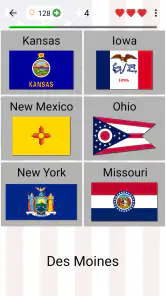
The combination of capitals, flags, and maps is another strong point. Memorizing names alone can create a false sense of progress. A person may recognize “Oregon” in text but struggle to identify its position or flag. Moving between these forms of recognition gives the material more than one mental entry point. The best way to use this game is to treat each question type as a different layer of the same map, not as separate trivia categories.
I also appreciate that the game does not require the subject to feel academic. The quiz structure lowers the barrier to starting. Someone who would postpone reading a geography chapter may be willing to answer a few questions. That repeated exposure can gradually make unfamiliar capitals and flag designs feel ordinary.
The public response suggests that many players find the format worthwhile: it holds an average rating of 4.5 from around 5.4 thousand ratings, with roughly 795 written reviews and more than 500 thousand installs. Those figures do not guarantee that every learner will enjoy it, but they do indicate that the game has attracted a substantial audience beyond a handful of early users.
Small techniques that make the questions more useful
One technique I recommend is separating recognition from recall. If a flag looks familiar, do not immediately assume you truly know it. Try naming the state before checking the answer, then ask yourself what detail made it recognizable. Was it the colors, the emblem, or simply the shape of the design? This turns a lucky guess into a more reliable memory.
With maps, I would mentally anchor each state to a nearby region. Instead of remembering a state as an isolated outline, connect it to its neighbors or to a broad area such as the Pacific Northwest, the Great Plains, or the Southeast. The game supplies the prompt, but this extra mental step is what helps the information transfer outside the app.
For capitals, I would keep a short “trouble list” in my head rather than trying to review everything equally. After a session, remember the few answers that caused hesitation. On the next visit, give those items more attention. This is more efficient than repeatedly answering questions you already know and mistaking a high score on familiar material for complete mastery.
There is also a useful distinction between speed and accuracy. Answering quickly can make the game feel satisfying, but speed is not the same as learning. If I am using it for study, I would accept a slower pace and explain the answer to myself. If I am using it for casual entertainment, I might prioritize momentum. The same app supports both approaches, but the result depends on how deliberately I play.
How it compares with other ways to learn US geography
When a broad trivia app is the better fit
A general trivia game is a better choice if I want constant variety and do not have a specific geography goal. It may keep me entertained longer because every question can lead to a different subject. That variety is valuable for social play or for people who lose interest when a topic stays narrow.
The trade-off is consistency. A broad app may introduce state questions only occasionally, so it is harder to build a routine around capitals, flags, and maps. If I want to prepare for a school unit or refresh my knowledge before traveling around the country, the specialized format here is more efficient. If I simply want unpredictable trivia, a general alternative may feel less repetitive.
When a map or reference app is preferable
A dedicated map tool can be better when visual exploration is the priority. If I want to zoom around borders, inspect regions, or look up information while planning a trip, a reference-style product will usually be more appropriate. This game is about answering questions, not replacing a detailed atlas.
The important difference is active testing. A reference app helps me find information; this quiz asks me to retrieve it. I would use a map resource when I need context and this game when I need practice. Using both in sequence can work well: check a region in a reference source, then return to the quiz and see whether the location remains in memory.
When flashcards or a classroom resource may win
Flashcards can offer more control because I can create a custom deck for exactly the items I keep missing. A teacher’s materials may also include explanations, regional themes, and assignments that this focused game does not attempt to provide. For formal study, those tools may be the stronger foundation.
Still, flashcards can become tedious, especially when I have to prepare them myself. This game removes that setup step and makes practice feel lighter. I would choose it for repetition and motivation, then use notes or class materials when I need deeper explanation. It is a useful supplement, not an all-purpose curriculum.
What switching away would cost
Because the game is free, trying it does not require a financial commitment. There are in-app purchases ranging from $0.99 to $5.99 per item, so I would begin with the free experience and decide later whether any optional purchase is worthwhile for my habits. I would not pay simply because I wanted more information; I would first check whether the existing question flow already supports my learning goal.
The larger cost of switching is routine. Once I have started recognizing which capitals or flags give me trouble, moving to another tool means rebuilding that personal study pattern. A different app may offer richer explanations, but it may not provide the same direct practice across state names, capitals, flags, and maps. Before leaving, I would ask whether my frustration comes from a genuine limitation or from needing a more deliberate way to use the quiz.
There is also a device consideration. The current version is 3.6.0 and requires Android 6.0 or later. For someone using an older Android device, that requirement is worth checking before planning a study routine. On a compatible phone, the game is easy to keep available for short sessions; on an incompatible device, another learning method may be the practical answer.
Who should choose it, and who should skip it
I would recommend it to students reviewing the states, adults rebuilding forgotten geography knowledge, parents looking for a simple learning activity, and trivia fans who enjoy improving one narrow subject. It is particularly well suited to people who learn through repeated questions and who want a clear distinction between “I have seen this fact” and “I can recall it myself.”
I would be more cautious if you need detailed explanations, current civic information, travel planning, or a complete visual atlas. The game’s focused trivia approach is not a weakness for its intended purpose, but it becomes a limitation when the learning goal expands beyond identification and recall. Someone who dislikes repetition may also prefer a broader interactive geography experience.
My final recommendation is straightforward: try it if your immediate goal is to learn or refresh US states, capitals, flags, and map recognition without paying upfront. I would use it in short, intentional sessions, slow down on uncertain answers, and keep a mental list of recurring mistakes. For focused state geography practice, this is a sensible free starting point; for deeper geography, pair it with a map or reference resource rather than expecting the quiz to do everything.
That balance is what makes the game worthwhile to me. It does not try to become a complete encyclopedia or a sprawling trivia platform. Instead, it gives one subject enough repetition to become familiar, while leaving room for other tools when context and explanation matter. If that focused approach matches what you need, Andrey Solovyev’s game is an easy recommendation for a phone-based study habit.
Pros
- Covers all 50 states with focused
- easy-to-follow quiz rounds.
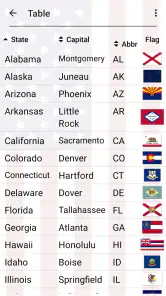
- Helpful for memorizing capitals
- flags
- abbreviations
- and state facts.
- Short questions make it convenient for quick practice sessions.
- Simple interface is accessible for both children and adults.
- Replayable quizzes encourage learning through repeated attempts.
Cons
- Some questions may feel too basic for users with strong U.S. geography knowledge.
- Limited subject scope may reduce long-term appeal after completing all rounds.
- Repeated questions can make later playthroughs feel predictable.
- Accuracy and freshness depend on how often the app updates its content.
- May offer less value to users seeking maps or detailed historical information.
- Category
- Trivia
- Version
- 3.6.0