Yachty Dice Game – Yatzy
- 3.01K
- 4.2
- Installs
- 500.00K
- Version
- 1.3.2

Screenshots






Analysis by Reviewed
I found Yachty Dice Game – Yatzy easy to understand within a few minutes, mainly because its central idea is familiar: roll dice, choose useful combinations, and build the best score you can. It is a free board game from Cessabit Games, and its simple presentation makes it a natural choice for short sessions rather than a game that demands a long tutorial or a large time commitment.
What interested me most was not the basic dice mechanic itself, but how well that mechanic works in different everyday situations. I can imagine opening it while waiting for an appointment, passing a phone around during a relaxed evening, or playing offline when there is no dependable connection. The experience is deliberately compact, though, and that simplicity will appeal more to people who enjoy classic dice games than to players looking for a large collection of modes or a highly animated interface.
How clearly the game communicates what to do
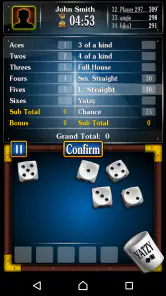
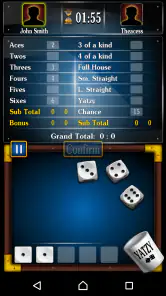
The strongest part of the design is its readable objective. You do not need to learn a complicated ruleset before making your first move. The dice are the focus, and the scoring decisions give each turn a small but meaningful question: should I protect a useful result now, or take a chance on a better combination?
That clarity matters for players who prefer straightforward navigation. A board-game app can become tiring when menus, decorative effects, and unclear icons get in the way of the turn. Here, the classic Yatzy structure gives the interface a familiar mental map. Even if you have not played this particular version before, the flow is much easier to grasp than a strategy game with several layers of resources and menus.
I also think this makes it suitable for mixed-age groups, within its Everyone 10+ content rating. A parent, younger player, or older relative can understand the purpose without having to study a long guide. That does not mean every person will find every control equally comfortable, but the rules themselves are not the main obstacle.
One useful approach is to treat the first few rounds as a practice in reading the scoring choices rather than trying to play perfectly. The best decision is not always the largest number immediately available. Sometimes accepting a modest score keeps the rest of the sheet flexible. That small trade-off gives the game more depth than a simple “roll and pick the biggest total” activity.
The presentation is also helpful when attention is divided. If I were playing during a conversation, I could pause mentally between turns and return to the visible dice and score options without reconstructing a complicated game state. This is a practical strength for casual play, especially when the phone is being shared or the session is interrupted.
Reading the board without rushing
For a clearer experience, I would avoid playing in a place with strong glare or a very small display if reading the scoring area is difficult. Dice games depend on distinguishing symbols and numbers quickly, and screen reflections can make a simple choice more frustrating than it should be.
I would also recommend taking a moment before confirming a scoring choice. The pressure in this type of game is usually self-imposed, so there is value in checking whether the selected category matches the result you actually want to record. That habit is especially useful for new players and anyone who finds rapid tapping uncomfortable.
The game’s current version is 1.3.2, and it runs on devices using Android 6.0 or later. That gives it a broad place among older Android phones and tablets, although the experience will still depend on the physical screen, touch response, and system settings of the device being used.
Different abilities, hands, and senses
From a motor perspective, a dice game is less demanding than an action title. There is no need for continuous movement, rapid aiming, or repeated complex gestures. Turns are naturally separated, which gives players time to decide and tap. Someone who prefers deliberate interaction may find that much more comfortable than a game built around reflexes.
That said, low physical intensity does not automatically mean perfect access. The player still needs to select dice or scoring choices accurately, and a small touch target can be troublesome for people with limited dexterity or involuntary movement. I would be more confident recommending it to someone who can reliably make individual taps than to someone who needs switch control, voice input, or unusually large controls.
A helpful personal routine is to hold the device in a stable position and use one deliberate finger movement at a time. Playing while walking, riding in a moving vehicle, or balancing the phone in one hand can turn a calm board game into a series of accidental selections. A stand or a table can make a noticeable difference, even though that is a general device adjustment rather than a feature of the game.
For players with visual differences, the basic dice format has one advantage: the information is concentrated in a small number of familiar elements. There are not dozens of animated objects competing for attention. However, visual clarity still depends on contrast, text size, and the way the particular device renders the interface. I would not assume that every player with low vision will find it comfortable without trying it first.
People who are sensitive to motion or visual distraction may prefer the calmer rhythm of turn-based dice play over a fast arcade game. On the other hand, anyone who relies heavily on audio cues may find the experience less suitable if visual confirmation is needed for most decisions. I would approach it as a visually led game and choose it accordingly.
Hearing-related needs are less central here than in a music or multiplayer action game because the core decision is based on the visible dice and score area. That makes it easier to enjoy without depending on spoken instructions or constant sound feedback. I still would not describe it as universally accessible, because the important question is whether the visual controls and labels can be read and selected comfortably.
Why the turn structure helps some players
The turn-based format creates natural pauses, which can help players who need extra processing time. You can consider the current roll, compare possible scoring choices, and decide without the constant urgency found in real-time games. This is also useful for someone learning the rules or playing in a second language, since the game’s logic is easier to revisit between actions.
Those pauses can support social play too. When I imagine using it with friends, the phone can move from one person to another, and each player can explain a choice aloud if the group wants a more conversational experience. That makes the game feel less like a private screen activity and more like a compact tabletop substitute.
There is a trade-off, however. Players who need very long breaks or who find repeated visual checking tiring may still lose interest because the game revolves around making many related decisions over a session. Its accessibility benefit comes from the slow pace of each turn, not from a specially designed support system for every possible need.
Playing at home, offline, or with other people
The store summary presents the game as suitable for rolling dice with buddies or playing offline, and that combination is central to its usefulness. Offline play removes one common source of friction: you can use it in places where a connection is unreliable or unavailable. That makes it practical for travel, waiting rooms, cabins, or a quiet evening when you simply do not want to depend on online services.
A realistic scenario would be a family sitting at a café while waiting for food. Instead of carrying a physical dice cup and score sheet, one person can start a round and pass the device around. The game is small enough to fit into that gap, and the familiar rules mean the group can begin without a long explanation. It works particularly well when everyone is comfortable taking turns on one screen.
For solo use, the appeal is different. I would open it when I want a short mental break but do not want the commitment of a full puzzle campaign. The random dice create variety, while the scoring categories encourage a little planning. It is not the same as solving a carefully constructed logic puzzle; luck remains important. That makes it relaxing for some people and unsatisfying for others.
Playing with buddies is best when the group enjoys light competition rather than a serious tournament atmosphere. Dice outcomes can overturn a careful plan, so the result does not always reflect skill alone. If your friends dislike luck deciding an important match, a traditional strategy board game may be a better choice. If everyone accepts the randomness, the uncertainty becomes part of the fun.
Offline availability is also valuable for players who want to reduce distractions. A simple local session does not require coordinating accounts, waiting for opponents, or maintaining a long-term online match. That can make it easier for an older family member or a casual player to join without learning a broader platform.
Where it fits beside physical dice and other apps
Compared with physical Yatzy, this version is more convenient because it keeps the dice and score handling on the phone. You do not need a table, a pencil, or someone to remember how to total every category. That convenience is especially useful when space is limited or when a group wants to start quickly.
The physical version still has advantages. Real dice are tactile, visible to everyone, and naturally social. A phone can feel less communal if players are not comfortable sharing a screen. Physical play also avoids concerns about tapping accuracy and makes the activity easier to see from different seats around a table.
Compared with larger digital board-game collections, this title is more focused. You are not opening it for a huge variety of themes or a long campaign. I see that as a strength when I want one familiar activity, but a weakness if I expect constant novelty. People who frequently switch between chess, card games, word games, and strategy titles may prefer an app built around multiple board experiences.
It is free to install, with optional in-app purchases ranging from $1.99 to $29.99 per item. That means I would start without paying and decide whether the basic experience suits me before considering any purchase. For a child or shared family device, I would make sure the device’s purchase controls are set appropriately, since the presence of optional purchases is worth remembering even in a simple game.
Barriers that may change the recommendation
The biggest limitation is that simplicity can become repetition. Once the scoring pattern feels familiar, the game may no longer provide enough variety for players who need new challenges every few sessions. I would recommend it more confidently as a dependable casual pastime than as someone’s only board game.
Luck is another important consideration. Good decisions improve your chances, but a poor roll can still shape the outcome. That is ideal for relaxed competition and less ideal for players who want complete control over success. If you prefer chess-like planning, where every result comes from a deliberate move, this will probably feel too unpredictable.
Screen size can also affect the shared experience. On a compact phone, one player may need to hold it close while others wait to see the result. A tablet or a stable surface would be more comfortable for a group, but the game’s usefulness should not be confused with a guarantee of large, highly adjustable controls.
Another practical barrier is the difference between “offline” and “social.” Offline play is convenient, but passing one device around is not the same as each person playing on a separate screen. If your group wants remote competition or independent devices, I would look for a game that clearly centers those features instead. This title makes the most sense when the players are physically together or when solo play is enough.
People who need screen readers, alternative input methods, or carefully documented accessibility settings should test the game on their own device before relying on it. I would not choose it for a user whose access depends on a specific assistive setup unless that setup has already been confirmed to work comfortably. The straightforward rules help, but they do not remove the need for usable controls and readable visual information.
There is also a social consideration for players who dislike competition. Even a friendly score can create pressure, especially when the group compares every turn. In that situation, a cooperative board game or a noncompetitive puzzle may be a kinder fit. Yachty’s charm comes from weighing risk and watching the score develop, so competition is part of its identity rather than an easily ignored detail.
My inclusive verdict on this compact dice game
After spending time with it, I see Yachty Dice Game – Yatzy as a good option for people who want familiar board-game decisions in a small, low-pressure format. The turn-based pace supports thoughtful play, the rules are approachable, and offline use makes it practical in places where a larger or more connected game would be inconvenient.
Its accessibility is strongest at the level of pace and complexity. Players who benefit from pauses, simple objectives, and limited physical interaction may find it comfortable. Players with visual, motor, or input needs that require adjustable controls should be more cautious, because the experience still depends on reading the screen and making accurate taps.
The game has earned a 4.2 average from around 16 thousand ratings, with more than 500 thousand installs, so it has clearly found an audience beyond a tiny group of enthusiasts. Those figures do not change my main advice: popularity is not a substitute for checking whether the interface suits your hands, eyes, and preferred way of playing.
As a free board game from Cessabit Games, it is easy to try without turning the decision into a major commitment. The Everyone 10+ rating also makes it a reasonable candidate for family settings where the group wants something uncomplicated, provided the device is comfortable for the person using it and purchase controls are handled responsibly.
My recommendation is simple: choose it for short, familiar, offline-friendly dice sessions, especially with friends or family who enjoy gentle competition. I would skip it if you need extensive accessibility customization, remote multiplayer as the main attraction, or a steady stream of new systems and challenges. For everyone else, it is a pleasantly focused way to fill a few spare minutes without asking the player to learn an entire new world.
Pros
- Quick rounds make it easy to play during short breaks.
- Simple dice-rolling rules are suitable for casual players.
- Multiple scoring categories add variety to each game.
- Works well for relaxed solo play without requiring constant attention.
- Familiar Yatzy format makes the game easy to understand quickly.
Cons
- Random dice rolls can make results feel more luck-based than strategic.
- Repeated games may become predictable after extended play.
- Some advanced scoring choices are not clearly explained to beginners.
- Ads may interrupt the experience
- depending on the version and device.
- Limited appeal for players seeking complex strategy or competitive depth.