Touchdown Manager
- 381.00
- 3.9
- Installs
- 100.00K
- Price
- Free

Screenshots

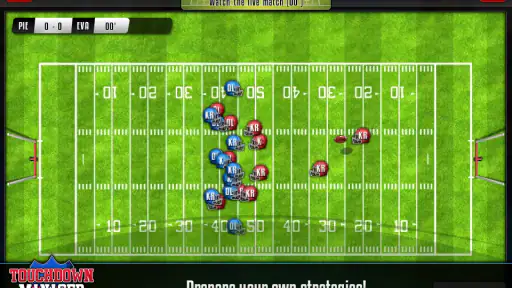
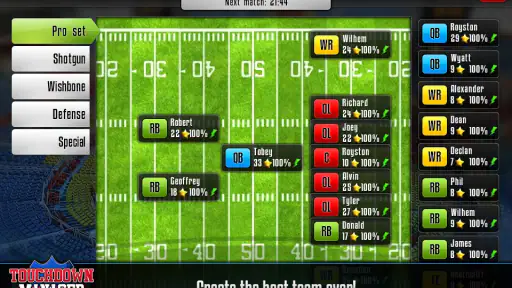
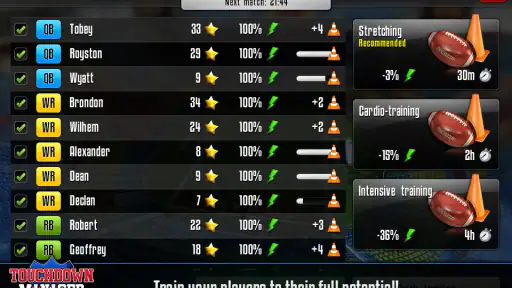
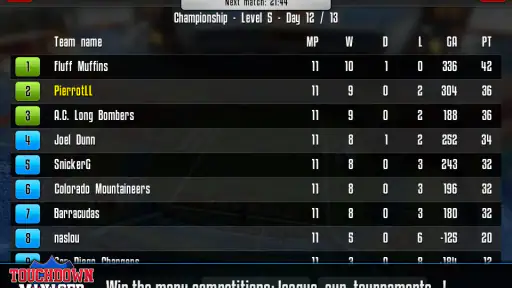

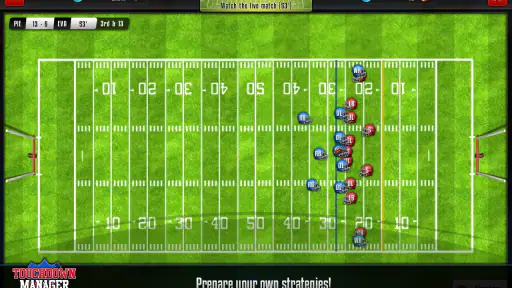
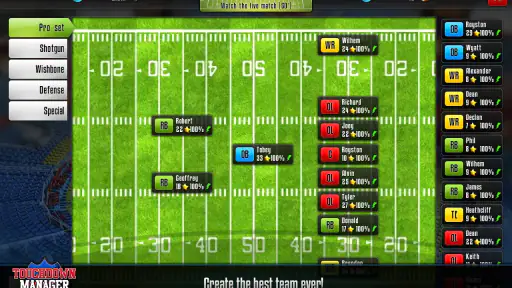
Analysis by Reviewed
I approached Touchdown Manager as a compact football management game rather than a match-action title. Its central appeal is the chance to think like a coach: shape a team, make decisions, and try to guide it toward better results. That makes it a very different proposition from games built around direct control, reflexes, or realistic on-field movement. My enjoyment came from the planning side, especially when I wanted a sports game I could dip into without needing the intensity of a full match.
Developed by Sweet Nitro SL, this free sports game has been available since October 5, 2016, and it remains an accessible option for players using Android 6.0 or later. The current version is 8.10. Its Everyone age rating also makes it an easy recommendation for households looking for a straightforward football-themed game without an older-audience label. The store summary promises the role of a football coach, and that is the right way to understand the experience: your interest needs to come from managing a team, not from expecting a console-style football simulation.
How the free model affects the experience
The most important cost detail is simple: the game can be downloaded and played for free. That gives curious players a low-risk way to test whether the management format suits them. You do not have to commit money before discovering whether making coaching decisions is more enjoyable to you than controlling players directly.
There are in-app purchases ranging from $4.99 to $99.99 per item. That is a wide span, so I would treat the free entry point and the optional spending as two separate questions. The free access is useful for sampling the game and deciding whether its rhythm fits your habits. The purchase options matter only if you later decide that paying for additional value is worthwhile. I would not install it assuming that spending is necessary, and I would also avoid treating the highest-priced item as part of the normal cost of playing.
This distinction is especially important for a management game. A player who enjoys gradual progress can often get more satisfaction from learning the game’s decisions than from immediately looking for shortcuts. If you prefer to spend nothing, set that expectation before playing and judge the experience on what the free version offers. If you are comfortable with optional purchases, keep a personal limit in mind rather than allowing the presence of a large top-end item to define the game’s value.
In practical terms, the free price makes Touchdown Manager easier to recommend than a paid game when you are unsure about the genre. It is also convenient for a short trial during a commute or a quiet break. The trade-off is that free-to-play design can make players more conscious of progression and optional spending than they would be in a single-payment sports title. That is not automatically a deal-breaker, but it changes how I evaluate each session: I focus on the coaching decisions rather than on the temptation to accelerate anything.
What I found rewarding in the coaching format
The strongest value comes from the shift in perspective. Instead of asking whether I can personally score, I ask whether I can make sensible choices for a whole team. That creates a different kind of involvement. A good result feels like the consequence of preparation and judgement, while a poor result gives me something to reconsider rather than simply blaming a missed input.
That format works well when I want a sports game that leaves room for thought. I can play with a more deliberate mindset, looking at the broader situation rather than reacting to every moment. It is also a useful choice for football fans who enjoy the idea of leadership but do not want the complexity of a heavyweight management simulation. The game’s identity is easier to approach than a large, intimidating database-driven title.
One practical tip is to avoid treating every decision as an isolated event. I found the experience more satisfying when I used each result as feedback about the way I was managing the team. A disappointing outcome is more useful if it changes what I try next time. That habit turns short sessions into a continuing experiment: make a choice, observe the consequence, and adjust instead of repeating the same approach automatically.
Another useful approach is to play according to the amount of attention you actually have. When I only have a few minutes, I focus on the immediate coaching task and accept that I am not going to analyse everything. When I have more time, I can think about patterns across several decisions. This makes the game more flexible than a football title that demands constant concentration from the opening whistle to the final play.
The game’s age is also worth considering in a fair way. Having first appeared in 2016 means it is not the newest football management option on the market, but that can be a positive for players who want a familiar, established style rather than a constantly changing presentation. At the same time, anyone searching for the latest visual standards, the deepest modern simulation, or a highly detailed professional-sports database should keep expectations modest.
Where the trade-offs become noticeable
Touchdown Manager is not the right choice if your main goal is direct football control. You will probably be happier with a game built around passing, shooting, movement, and real-time matches if the physical act of playing is what keeps you engaged. Here, the coach’s viewpoint is the point, so players who need immediate action may find the decision-led structure too restrained.
It may also disappoint people who want a highly detailed management sandbox. A serious management fan may expect extensive tactical layers, deep squad administration, long-term club economics, and a large amount of information to study. This game is better approached as an approachable sports-management experience than as a replacement for the most elaborate desktop-style football managers.
The purchase range creates another trade-off. Free access is a genuine advantage for trying the game, but optional items can affect how different players judge progression and value. Someone who wants a completely uniform experience with no spending prompts may prefer a paid sports game with one clear price. Someone else may appreciate being able to start for free and decide later. Neither reaction is unreasonable; it depends on how strongly you value predictable pricing over a no-cost trial.
I would also avoid assuming that a good rating means universal approval. The game holds a 3.9 average from around 2.5 thousand ratings, alongside 381 written reviews. That suggests a reasonably positive reception with enough room for mixed opinions. I read that as a useful signal to keep the expectations balanced: there is an audience for the concept, but it is not a guarantee that every football fan will enjoy a coaching-focused game.
The install figure tells a similar story. With over 100 thousand installs, it has reached a meaningful number of players, but that audience size does not make it a substitute for every type of football game. Popularity can show that the idea is discoverable and appealing to some users; it cannot remove the basic genre trade-off between managing a team and controlling the action.
Small habits that improve the way I play
My first recommendation is to give the game a short, focused trial rather than judging it after a single rushed session. Management games often become clearer once you understand their rhythm. Use the early sessions to decide whether you enjoy thinking in terms of team outcomes and coaching choices. If that perspective does not appeal to you, more time or optional spending is unlikely to solve the underlying mismatch.
Second, separate curiosity from commitment. Because the download is free, you can explore the basic experience before deciding whether any purchase deserves consideration. I would only spend after identifying a specific reason, such as wanting to support the game or obtain an option that genuinely improves your preferred way to play. Buying simply because a progression moment feels slow is a weaker test of value than deciding deliberately.
Third, use it as a secondary sports game rather than demanding that it replace every other football experience. I can imagine playing it after a fast action game when I want something calmer, or opening it during a short break when I do not want to start a full match. That contrast is one of its practical strengths. It gives football fans another way to engage with the sport without asking them to perform every movement themselves.
There is also a useful audience distinction for families. The Everyone rating makes the game easier to consider for a broad age range, but younger players may still need guidance around optional purchases. The age label describes suitability; it does not mean every spending decision should be left unattended. If the device is shared, setting a clear household rule about purchases is sensible before anyone begins.
For Android users, the minimum requirement of version 6.0 or later keeps the technical entry point relatively broad. That is helpful if you are using an older compatible device, although compatibility alone does not guarantee that the experience will feel equally smooth on every handset. I would try the free version first, particularly if your phone is older, and judge its comfort in actual use rather than relying only on the operating-system requirement.
Who is likely to get the most value?
I would recommend it first to football fans who enjoy the idea of being responsible for a team rather than being one player on the field. It suits people who like making choices, watching how those choices affect results, and improving through reflection. It is also a reasonable pick for casual players who want a free starting point and do not need the newest presentation or the deepest possible simulation.
It can work especially well in an everyday scenario such as a short lunch break. I might open it after eating, make a few coaching decisions, and close it before returning to work. That kind of session does not require the same uninterrupted attention as a full action match. Later, when I have more time, I can return with a clearer idea of what I want to change. The game’s value here is not only entertainment; it is the ability to fit a football-management decision into a small gap in the day.
I would be more cautious recommending it to competitive players who want precise control over every play, or to simulation fans who measure value by the number of systems and layers available. Those players may find a more comprehensive paid management game a better use of their time and money. Likewise, if you dislike free-to-play structures or prefer to know the complete cost before downloading, a single-purchase alternative will probably feel more comfortable.
It is also not ideal for someone looking for authentic, current football presentation as the main attraction. The game’s release history places it in a different generation from newer sports products. Its appeal is the coach role and its accessible format, not the promise of being the most modern or visually ambitious football title on a phone.
My final judgement on whether to try it
My verdict is to try Touchdown Manager if you are curious about football management and want to begin without paying an upfront price. The free entry point is its clearest value, and the coach-focused perspective gives it a distinct place among mobile sports games. I like that it can serve as a quieter alternative to direct-control football, especially when I want to make decisions instead of reacting quickly.
I would keep the purchase options in perspective. The available items can cost from $4.99 to $99.99 each, so the game is free to start but not defined by a single all-inclusive price. Play first, decide whether the basic loop holds your attention, and only then consider whether optional spending fits your budget and expectations. That approach protects the main benefit of the game: discovering its style without financial pressure.
Overall, Sweet Nitro SL has made a focused choice with this sports title. It will not satisfy every football fan, and its older release means it should not be judged as the newest simulation on mobile. Still, for a player who enjoys coaching decisions, wants an Everyone-rated game, and values the ability to test a free experience before committing, it is worth a look. If you want to manage the team more than control the match, this is the audience that gets the clearest value from it.
Pros
- Simple interface makes match management easy to learn.
- Useful player statistics help track team performance.
- Season progression adds structure beyond individual matches.
- Works well for quick play sessions on mobile devices.
- Team-building decisions give the game lasting strategic appeal.
Cons
- Some features may feel repetitive after extended play.
- Advanced tactical options are limited for experienced managers.
- Progress can feel slow without investing significant time.
- The interface may feel dated compared with newer sports games.
- Players seeking realistic licensed teams may find the roster limited.

- Category
- Sports
- Version
- 8.10