Mini Golf Club-PvP Multiplayer
- 1.79K
- 4.7
- Installs
- 1.00M
- Price
- Free

Screenshots




Analysis by Reviewed
I went into Mini Golf Club-PvP Multiplayer expecting a quick sports game and came away with something more specific: a compact mini-golf experience that works best when I want short, competitive matches rather than a deep simulation. Its appeal is easy to understand. The courses are built around simple putting decisions, the PvP focus gives every stroke a little pressure, and the leaderboard adds a reason to replay a familiar hole instead of moving on immediately.
That also explains its main limitation. This is not the game I would choose when I want a large career mode, detailed golf strategy, or a calm solo experience with lots of progression to study. I would recommend it to someone who enjoys friendly competition, quick attempts, and the satisfaction of shaving a stroke from a score. I would be more cautious with anyone who dislikes repeated courses, competitive pressure, or the possibility that optional purchases may affect how they prefer to play.
What the core game feels like in practice
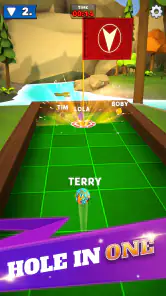
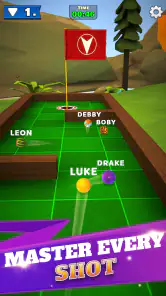
The basic loop is pleasantly direct. I look at the hole, choose a direction, set the strength of the putt, and try to finish with as few strokes as possible. That simplicity makes the game approachable immediately, but it does not make every shot automatic. A strong opening attempt can leave an awkward angle for the next stroke, while a cautious shot may cost time or a chance at a better score. The best results come from treating each putt as part of a route rather than tapping toward the hole without a plan.
The PvP design changes the mood even when the controls remain easy to understand. Against another player, I am not only asking whether a shot will reach the cup. I am also thinking about whether a safe line is better than a risky shortcut, whether an early mistake can be recovered, and how much pressure a close score creates near the end of a course. That competitive layer is the reason this feels more engaging than a standard casual putting game.
I especially like that mini golf naturally creates small decisions with visible consequences. A missed shot is rarely just a failure of reflexes; it usually reveals that I misjudged power, angle, or the order in which I wanted to handle the hole. That makes a rematch useful. I can return with a specific correction instead of simply hoping for better luck.
At the same time, players should understand what kind of competition they are getting. The game is built around mini golf, not a full golf package. I would not install it expecting club selection, long fairways, weather management, or a detailed professional career. Its strength is the concentrated puzzle of getting a ball through a short course efficiently, with other players and rankings making the result matter more.
Why the PvP focus gives short sessions real purpose
Many casual sports games are enjoyable for a few rounds and then become background entertainment. Here, the competitive structure gives me a clear reason to pay attention. A single extra stroke can separate a satisfying result from an ordinary one, so I naturally start remembering which parts of a course cause trouble. That turns an apparently simple match into a small exercise in consistency.
It also suits everyday use. If I have a short break, I can play without committing to a long campaign or a complicated setup. If a friend is available, the same format becomes more social and more unpredictable. I can imagine opening it after dinner and playing a few rounds while comparing scores, or using it as a lightweight contest during a commute break. The game fits those moments better than sports titles that require a long uninterrupted session.
One practical tip is to avoid treating every hole as a race from the first stroke. I found it more useful to identify the dangerous part of the layout first. If a bank, narrow passage, or awkward landing area can ruin the next shot, I would rather position the ball safely than chase a spectacular opening. That habit makes the game less dependent on impulsive power and gives the PvP matches a more thoughtful rhythm.
Another useful approach is to review the reason behind a poor result before immediately replaying. Was the shot too strong, or was the chosen line wrong? Did I reach the target but leave an uncomfortable angle? Separating those problems helps me improve faster than simply repeating the same attempt. The game’s accessible controls make experimentation easy, but the leaderboard rewards players who turn experiments into reliable habits.
The strongest part: readable competition with room to improve
The biggest strength is the balance between accessibility and repeat value. I do not need to learn a complicated control system before I can compete, yet a good score still demands care. That combination is difficult to get right. If the controls were too demanding, the game would lose its casual appeal. If every shot were too forgiving, the leaderboard would feel meaningless. Mini Golf Club sits in the more enjoyable middle ground for players who want quick matches with a little skill behind them.
The leaderboard is important in that balance. It gives a result beyond simply completing a course. I can use it as a personal target, trying to improve my own performance, or as a direct comparison with other players. Those are different motivations, and the game benefits from supporting both. I do not have to be naturally competitive to enjoy it; I can treat the ranking as a record of progress. But if I do enjoy competition, the same feature gives each round more tension.
Its broad reception supports that impression. The game carries a 4.7 average from around 138 thousand ratings, with more than 1 million installs. Those figures do not guarantee that every player will enjoy the same style, but they suggest that the straightforward mini-golf formula has connected with a substantial audience. I would still judge it by its actual design rather than popularity, and in my experience the appeal comes from how quickly it turns a familiar idea into a repeatable contest.
The developer, BoomBit Games, has positioned this as a free sports game, which lowers the barrier to trying it. The age rating is Everyone, so it is an easy recommendation for households looking for a light competitive game rather than something intense or mature. I would still explain the competitive nature to younger players, because a simple game can become surprisingly serious when scores and rankings are involved.
Where the experience can lose momentum
The same repetition that makes the game easy to pick up may eventually limit its appeal. Mini golf is a focused concept, and players who need constant mechanical variety may begin to feel that they are refining the same kind of skill over and over. The leaderboard can extend the life of the courses, but it cannot replace new forms of play for someone who wants a broader sports experience.
I also think the PvP emphasis creates a trade-off for solo players. Competition adds energy, but it can make a session feel less relaxing than a purely personal challenge. If I only want to practice at my own pace, the pressure of comparing results may not be a benefit. Someone who prefers leisurely puzzle games or offline-style progression should consider whether rankings and multiplayer competition are actually what they want from mini golf.
There is also a financial point worth keeping in mind. The game is free to install, but it includes in-app purchases ranging from $0.99 to $99.99 per item. That does not automatically make the design unfair, and I would not judge a purchase simply because it exists. Still, I recommend deciding in advance whether you want to play entirely within the free experience. A clear personal limit is especially sensible when a game is designed around repeated matches and score improvement, because that structure can make optional spending feel tempting.
My other reservation is that a leaderboard can reward persistence as much as skill. If I keep replaying a course, I gain more opportunities to correct small errors, while a newcomer may see an intimidating gap immediately. That is normal for competitive games, but it affects how I interpret the rankings. I would use them as motivation rather than proof that one player is universally better. For many people, the most satisfying target will be beating their previous result.
Small decisions that make a noticeable difference
When I play, I try to separate the first attempt from the improvement attempts. On the first run, I learn the course’s rhythm and identify where a shot can go wrong. On later runs, I focus on one correction at a time. Changing direction, strength, and route all at once makes it difficult to know what actually helped. This method is simple, but it turns casual replay into deliberate practice.
I also avoid spending all my attention on the hole’s final target. The landing position after an early shot often matters more than whether that shot looks impressive. A controlled approach can leave a straightforward finish, while an aggressive line may create a difficult recovery even if it travels farther. In a close PvP match, reducing the chance of a bad second shot is often more valuable than chasing a perfect first one.
For group play, I would suggest agreeing on the mood before starting. If everyone wants a serious contest, the leaderboard and careful shot planning become the focus. If the goal is simply to laugh and pass time, it is better not to turn every missed putt into a judgment of skill. The game supports both attitudes, but the experience changes depending on whether players treat each round as a tournament or as a quick social activity.
Players who are sensitive to spending should also make their plan before the competitive loop becomes familiar. I would begin with the free option, see whether the basic matches hold my interest, and only then consider whether an optional purchase adds enough value for my personal habits. That is more sensible than buying early because a close result made me want an immediate advantage. The game is most enjoyable when the decision to spend remains deliberate rather than emotional.
Who should install it, and who should choose something else
I think this is a strong fit for players who want a sports game that can be understood in moments but still rewards precision. It works particularly well for friends who enjoy comparing results, for casual players who prefer short sessions, and for people who like replaying a course to improve a score. It is also a reasonable choice for families looking for an Everyone-rated game with a competitive hook rather than a complex simulation.
It is less suitable for someone searching for a deep golf career, realistic athletic management, or a large range of sports. A full golf simulation would be the better alternative if you want detailed shot planning across long holes and a more traditional sporting structure. A noncompetitive puzzle game would suit you better if you want to play slowly without rankings or opponent pressure. And if you strongly dislike in-app purchases, the free entry point should be treated as a trial, not as a promise that the entire experience will match your preferred spending style.
Device compatibility is straightforward for many Android users: the game requires Android 8.0 or later. The current version is 1.1.2, so I would check that an older phone meets the operating-system requirement before planning to play. That is a small practical step, but it avoids the common frustration of deciding on a game and only discovering the compatibility issue at installation time.
The game’s release date is Dec 11, 2025, which also helps frame expectations. I would approach it as a relatively recent entry rather than a long-established sports institution. That makes the focused design feel understandable: it is aiming to deliver a clear mini-golf contest instead of trying to cover every possible golfing feature. Whether that is a strength depends on what you want from the genre.
My verdict after weighing the fun against the friction
My overall view is positive, with a clear qualification. Mini Golf Club-PvP Multiplayer succeeds because it makes each stroke readable, competitive, and easy to replay. I enjoy the way a short match can produce a genuine decision: play safely, attempt a better line, or accept a small risk to challenge the score. That is enough to make the game feel more substantial than a disposable time-filler.
Its limitations are equally clear. The focused format may not provide enough variety for players who need a broad progression system, and the competitive structure is not ideal for everyone. The presence of in-app purchases means I would approach the free model thoughtfully, especially if leaderboard pressure encourages repeated play. These are not reasons to dismiss the game, but they are important parts of the decision.
For me, the best way to enjoy it is as a quick competitive sports game with personal goals. I would play a few rounds, identify one weak hole, and return later to improve that specific result rather than treating every session as a demand to dominate the entire leaderboard. Used that way, it offers a satisfying blend of accessibility and precision.
My recommendation is simple: install it if you want friendly PvP mini golf with short, replayable contests and a clear score-chasing hook. Skip it if you are looking for a full golf simulation, extensive variety, or a completely pressure-free experience. As a free game from BoomBit Games, it earns a place on my casual sports list because it gives simple putting decisions enough competitive weight to keep me coming back.
Pros
- Quick matches are ideal for short gaming sessions.
- Physics-based courses make each shot feel satisfying.
- PvP competition adds replay value beyond solo play.
- Simple controls are easy for new players to understand.
- A wide range of holes keeps the gameplay from feeling repetitive.
Cons
- Some courses can feel heavily dependent on luck.
- Online matchmaking may be uneven between player skill levels.
- Progression can become repetitive after extended play.
- Ads may interrupt the experience for free players.
- Limited strategic depth may disappoint serious golf fans.

- Category
- Sports
- Version
- 1.1.2