Kismet - Dice Game
- 409.00
- 4.9
- Installs
- 100.00K
- Version
- 1.2.25077

Screenshots


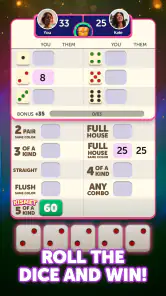


Analysis by Reviewed
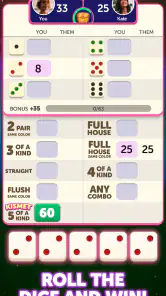
I spent time with Kismet as a colorful dice-based board game, and my first impression was that it aims for quick, approachable play rather than a heavy strategy experience. The basic appeal is easy to understand: roll, react to the result, and keep making decisions without needing to study a long rulebook first. That simplicity makes it suitable for casual sessions, especially when I want something lighter than a traditional strategy board game.
What makes the game worth examining more closely is not just the dice theme, but how well its goals and pacing encourage me to continue. A dice game can become repetitive quickly if every turn feels interchangeable. Kismet works best when I treat each round as a small decision-making exercise instead of expecting a deep campaign or a large competitive system. It is free to start, rated for Everyone, and developed by FunCraft Games, so it is clearly positioned as an accessible choice for a broad audience.
How Kismet turns simple dice play into a repeatable routine
The opening goals are clear, but the game depends on your own sense of progress
When I begin a session, the immediate objective is easy to grasp: understand the dice outcome, decide how to use it, and try to improve the result of the current play. That low barrier is one of the strongest parts of the experience. I do not need to prepare a strategy before opening the game, and I can usually get into the rhythm after only a short introduction to its board-game structure.
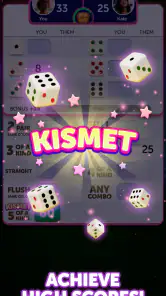
This is particularly useful for players who enjoy classic dice games but do not want a complicated ruleset. Kismet presents its colorful style as a way to make familiar mechanics feel more inviting. The visual presentation gives the game a friendlier personality than a plain digital dice simulator, while the board-game format keeps the focus on turns and outcomes rather than on a long narrative.
My advice is to approach the early rounds as practice for recognizing patterns. Instead of chasing the most obvious result every time, I found it more useful to consider whether a modest gain is safer than waiting for a more favorable combination. That small trade-off gives the rolls more meaning. The game remains luck-driven, but the player still has room to decide how aggressively to respond.
The early goals are therefore effective in a limited but important way. They teach the loop quickly and give me a reason to play another round. They do not, by themselves, create the kind of long-term motivation found in a large campaign. If you need a detailed story, a character build, or a broad map of objectives, this is probably not the right board game for you.
Progress signals come from better decisions as much as from rewards
One subtle strength of Kismet is that improvement can come from learning how to read a situation, not only from reaching a visible milestone. Dice games naturally create uncertainty, so I started paying more attention to risk management: when to accept a useful result, when to aim higher, and when a tempting move could leave me with a poor outcome.
That makes the game more satisfying for short sessions than a purely automatic dice roller. I feel involved because the result is not the entire experience. The roll creates the problem, while my response determines whether the turn feels efficient or wasteful. This is a helpful distinction for anyone wondering whether the game has meaningful interaction despite its simple premise.
At the same time, players should keep their expectations realistic. The available facts identify Kismet as a board game with a colorful dice focus, but they do not justify treating it like a sprawling progression title. I would not download it expecting a complex unlock tree, a large collection of modes, or a carefully structured adventure. Its appeal comes from repeating a compact activity and gradually becoming more comfortable with its choices.
A practical way to play is to set a small personal target before starting. I might focus on making fewer overly risky decisions, finishing a session with a stronger average result, or simply testing whether a conservative approach works better than chasing dramatic rolls. These self-imposed goals help the rounds feel purposeful without pretending that the game offers a deep progression system.
The difficulty curve is gentle at first and becomes more personal than formal
Kismet is easiest to appreciate when I want a game that lets me learn through play. The dice format is familiar, and the colorful presentation reduces the intimidation that sometimes comes with board games full of symbols and exceptions. I can start casually, then refine my choices as I become more aware of the consequences of each move.
The challenge comes mainly from uncertainty and judgment. A lucky roll can help, but luck alone does not make every session satisfying. The more interesting question is how I handle an imperfect result. Do I settle for a dependable outcome, or do I take another chance because the potential benefit is worth the risk? That decision creates a natural curve: the rules may remain approachable, while my standards for a good turn become more demanding.
This kind of difficulty will appeal to players who enjoy improving their own play rather than unlocking increasingly complicated mechanics. It is less suitable for someone who wants a clearly staged ladder of difficulty with new rules introduced at regular intervals. If you prefer games where every chapter adds a new system, Kismet may feel too restrained.
I also noticed that dice-based challenge can feel uneven from one session to another. A run with favorable outcomes may feel smooth, while an unlucky sequence can make progress seem slower even when my decisions are reasonable. That is not necessarily a flaw in this genre, but it does affect who will enjoy the game. Players who dislike losing control to random results may prefer a more deterministic board game where careful planning has a stronger guarantee.
The best way to handle that friction is to judge a session by the quality of the decisions rather than by one unlucky result. I found the game more enjoyable when I treated bad rolls as situations to manage instead of evidence that the whole round was wasted. That mindset makes the challenge feel fairer, although it cannot remove the frustration of repeated poor outcomes.
Pacing makes it convenient, but repetition is the main long-term test
The compact dice format suits everyday use. I can imagine opening Kismet while waiting for an appointment, taking a short break, or sharing a quick game with someone who does not normally play mobile board games. It does not demand the same uninterrupted attention as a long strategy match, and the rules are approachable enough for a casual player to join without extensive explanation.
A realistic scenario would be a family member asking for something simple during a short evening break. Rather than setting up a physical board and explaining several pages of rules, I could use Kismet to get a colorful dice game started quickly. The Everyone age rating also makes it a more natural candidate for mixed-age households, although the enjoyment will still depend on whether each person likes luck-based play.
The trade-off is that a short loop can become familiar very quickly. Once I understand the basic rhythm, the game needs my own goals and willingness to experiment to stay interesting. This is where Kismet differs from a deep strategy alternative: a traditional board game may offer more varied planning, while a larger digital game may provide stronger narrative or collection incentives. Kismet is more convenient, but convenience alone cannot guarantee long-term variety.
Its retention pressure is therefore relatively gentle. I do not see the appeal as being about forcing myself through a huge checklist. Instead, the pull comes from wanting to try one more round after a near miss, test a different approach, or improve on a previous personal result. That can be satisfying, but it is also easy to stop once the short-term curiosity has been answered.
The presence of in-app purchases is worth keeping in mind. The listed purchase range runs from forty-nine cents to forty-nine dollars and ninety-nine cents per item. I would recommend deciding in advance whether you want to spend anything, especially if you are reviewing the game as a family-friendly free download. The game can be approached as a free experience, but optional purchases can change how comfortable the overall experience feels for different players.
Who will enjoy it, and who should choose another board game
I think Kismet is a good fit for players who like dice, short sessions, bright presentation, and decisions that remain understandable from the first play. It is also a sensible choice for someone who wants a casual board game on a phone without committing to a long match. The average rating of 4.9 from around 5.1 thousand ratings suggests that its accessible concept has connected strongly with the audience using it.
The install figure is already above one hundred thousand, which gives the game a useful sense of visibility among casual mobile board games. I would still avoid treating popularity as proof that it will suit everyone. A high rating cannot change the fact that the experience is built around dice uncertainty and a relatively focused loop.
I would skip it if my priority were a highly competitive online environment, a detailed solo campaign, or a board game with many distinct strategic paths. I would also hesitate if I became bored by repeating similar turn structures or if I wanted progress to depend almost entirely on planning rather than chance. In those cases, a more complex tabletop adaptation or a deterministic puzzle game would probably be a better match.
For younger players and families, the Everyone rating makes the game easier to consider, but I would still explain the purchase options before handing over a device. The age label describes the content suitability; it does not automatically mean every player will understand the value of optional spending. Setting expectations early avoids turning a casual game into an argument about purchases.
On a technical level, the current version is 1.2.25077 and the game supports Android starting with version 7.0. That makes it accessible to people using older compatible Android devices, rather than limiting the audience to recent hardware. I would nevertheless keep the app updated when possible, since board-game interfaces benefit from running the latest available build even when the core rules stay familiar.
Small habits that make the experience more rewarding
My first useful habit was to pause briefly after each roll instead of tapping through the obvious choice. That moment is enough to compare a safe result with a riskier possibility. In a game built around dice, the best move is not always the most exciting one, and slowing down helps prevent decisions based purely on frustration or excitement.
My second tip is to use short personal experiments. I might play one session conservatively, then another session with more ambitious choices, and compare how each approach feels. This does not turn Kismet into a statistical research project; it simply gives repeated rounds a purpose. It also helps reveal whether I enjoy the decision-making or only the visual novelty.
A third insight is that the game works better as a social conversation starter than as a substitute for a full tabletop night. Because the rules are easy to approach, I can introduce it to someone who is not a dedicated board-game player. However, if the group wants negotiation, elaborate planning, or a long shared story, I would choose a physical board game or a more feature-rich digital alternative instead.
I also recommend treating a losing round as a prompt to adjust rather than immediately replaying without thought. Repeating the same choices can make the game feel like a slot machine, while changing the way I evaluate risk gives the dice more strategic context. This is one of the clearest ways to get more value from the focused design.
My verdict on Kismet’s progression and staying power
After playing it as a casual board game, I see Kismet as a polished idea for quick dice sessions rather than a full-scale progression adventure. Its early goals are easy to understand, its challenge grows through better judgment, and its pacing makes it convenient to revisit. The colorful style helps the familiar format feel welcoming, especially for players who want something lighter than a complex strategy title.
The limitation is equally clear: the game’s long-term appeal depends heavily on whether I enjoy repeating the core dice routine. The available information does not support promising elaborate unlocks or a large progression structure, so I would judge it on the quality of its moment-to-moment choices instead. That is a fair standard, and under it the game can be enjoyable, but it will not satisfy every kind of board-game fan.
FunCraft Games has made a free, approachable option for Android users who want a colorful twist on dice play. I would recommend trying it if you enjoy short rounds, friendly presentation, and the tension between accepting a decent result and taking a chance on something better. I would not recommend it as your main board-game destination if you need deep variety, a substantial campaign, or complete control over outcomes.
My final view is positive but measured: Kismet is strongest when used as a quick, low-pressure game with room for personal improvement. It gives me enough choice to make each roll feel more meaningful than a passive randomizer, while keeping the rules approachable for casual players. Download it for convenient dice-based entertainment, but go in expecting a focused loop rather than a large progression journey.
Pros
- Simple dice-rolling rules make it easy for new players to start.
- Quick rounds work well for short breaks or casual play.
- Lightweight design should run smoothly on most modern devices.
- Random dice outcomes keep each round unpredictable.
- Suitable for relaxed play without requiring complex strategy.
Cons
- Luck can outweigh decision-making
- which may frustrate strategic players.
- Replay value may feel limited after learning the available mechanics.
- Dice results can create uneven matches between players.
- May lack the depth expected by fans of advanced board games.
- Some features may feel sparse compared with larger tabletop adaptations.