Exposed 2 - Guess who never?
- 1.00
- 4.7
- Installs
- 10.00K
- Price
- Free

Screenshots
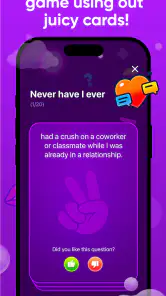
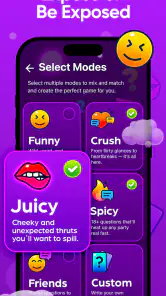
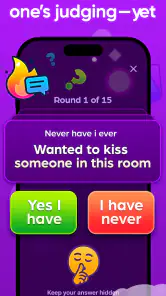
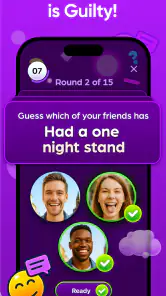
Analysis by Reviewed
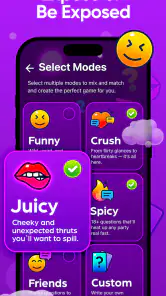
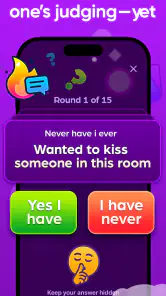
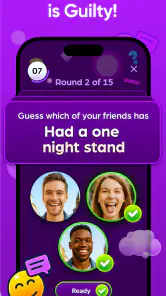
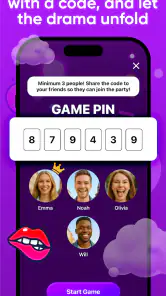
I approached Exposed 2 - Guess who never? as a party game rather than a trivia title meant for quiet, solo study. Its appeal is in the social reaction: someone reads a prompt, the group decides who fits it, and the answer can turn a familiar gathering into a sequence of accusations, laughter, and uncomfortable surprises. That makes the game easy to understand, but the quality of an actual session depends heavily on the people playing and on whether everyone is comfortable with the tone.
My first impression is that this is best treated as a conversation starter with game rules around it. It does not need the preparation associated with a board game, and it is more focused than simply asking friends random “I have never” questions. The developer, MobiStack Digital, has positioned it for quick group entertainment, and the store summary captures that spirit without telling you how much the mood of the room matters. I would recommend it to friends who enjoy teasing one another, while warning more reserved groups that the same prompts may feel intrusive rather than funny.
How Exposed 2 feels during a real party session
Fast to start, but dependent on the room
The strongest speed advantage here is not about demanding action or rapid reflexes. It is the short path from opening the game to getting people involved. A party title succeeds when nobody has to spend several minutes learning controls, choosing complicated settings, or explaining a scoring system. This concept has an immediately recognizable format, so a group can usually understand the purpose after seeing the first few turns.
In a realistic evening scenario, I can imagine opening it after dinner when conversation has slowed down. One person holds the phone, reads a prompt, and passes the attention back to the group. That makes it useful for a small gathering, a casual night with friends, or a break between other activities. It is less suitable when people want a structured competition with a clear winner, because the entertainment comes from reactions and discussion rather than from careful strategy.
The pace also changes according to the group. With outgoing friends, answers and arguments can arrive quickly, creating a lively rhythm. With people who do not know one another well, every prompt may require explanation or reassurance. In that situation, the game itself is not necessarily slow; the social decision-making is. I would begin with the least personal prompts and only move toward sharper material if everybody is clearly enjoying the format.
What happens when the game is used heavily
A short session should be easy to fit into a wider gathering, but repeated use raises a different issue: novelty. A game built around revealing personal habits can be very entertaining the first time a group plays together because every answer feels fresh. Once the same friends have already exposed their obvious stories, later rounds need more imagination from the prompts and more willingness from players to keep participating.
That is why I would not plan an entire party around this title alone. It works better as a social segment of the evening than as an activity that must carry several uninterrupted hours. Use it while people are arriving, after a meal, or when a conversation needs a push. If the group begins repeating the same jokes or skipping turns, switching to another activity is a better choice than forcing another round.
Heavy use can also mean passing the phone around frequently. That sounds minor, but it affects comfort and organization. The host should decide who is responsible for reading the next prompt and make sure everyone gets a fair chance to respond. A simple rotation prevents one person from becoming a permanent moderator and keeps quieter players from disappearing behind the louder personalities.
Stability and the practical side of recovery
For a party game, reliability is mostly about preserving the flow. A small interruption feels more noticeable here than it would in a solitary puzzle because every pause gives the room a chance to lose interest. I would therefore launch the game before the main activity begins, keep the device accessible, and avoid treating it as something that can be configured in the middle of a noisy conversation.
If attention is interrupted, the best recovery is straightforward: identify whose turn it was, repeat the current prompt, and continue without trying to reconstruct every reaction. This kind of game does not need a complicated record of progress for a casual session. The group can usually resume socially, even if the exact order becomes slightly blurred. That is a strength compared with trivia games where losing a question or score can undermine the whole match.
I also like that the format can survive an uneven level of participation. A person can answer briefly, explain a story, or simply react to another player. That flexibility helps when somebody joins late or steps away for a moment. However, it also means the app cannot guarantee a consistent experience by itself. A considerate host still needs to protect people from being pressured into sharing something they would rather keep private.
Device limits and the right environment
The game is available for devices running Android 8.1 or later, which makes it accessible to many older phones and tablets still in circulation. That is useful for a group game because the host does not necessarily need the newest handset. I would still choose the device with the clearest screen and the most comfortable handling, since the phone may be viewed by several people rather than one person at a time.
Screen size matters more than raw power in this setting. A compact phone can work, but a larger display is easier for a circle of friends to share. Brightness is another practical consideration if the game is being used outdoors or in a room with strong lighting. These are not flaws unique to this title; they are part of using any phone-based party activity, but they can determine whether a group remains engaged.
Because the game is rated Teen, I would not treat it as a children’s activity without checking the prompts during play and considering the age and comfort of everyone present. The rating is especially relevant when younger relatives are nearby or when a mixed-age gathering is involved. Adults should also remember that a Teen label does not make every question appropriate for every friendship group.
Where it beats ordinary trivia and where it does not
Compared with conventional trivia, this game removes the pressure of knowing obscure facts. Nobody needs to study beforehand, and a wrong answer is not the main source of entertainment. The focus is personal recognition: who in the group seems most likely to match the prompt, and what happens when that judgment is challenged. That makes it more welcoming for friends who dislike quiz nights because they feel they are competing against general knowledge.
On the other hand, standard trivia is usually better when players want measurable progress, individual achievement, or a fair contest between strangers. A general knowledge quiz can work with people who have never met because the questions do not depend on shared history. Exposed 2 is strongest when the players already have enough familiarity to make the accusations meaningful.
It also differs from a plain conversation card deck. A physical deck can be easier to share across a large table and does not depend on one phone being available. This app is more convenient when you want everything in one place and do not want to carry extra materials. The trade-off is that the device becomes the center of attention, which can feel less natural in groups trying to stay away from screens.
Useful ways to get better sessions from it
My first practical tip is to establish a boundary before starting. Agree that anyone can skip a prompt without having to explain why. That one rule protects the social atmosphere and often makes people more willing to participate, because they know they are not trapped by an uncomfortable question.
My second tip is to give the phone to a rotating reader rather than leaving it with the most talkative person. This changes the energy of the game. Different readers bring different timing and interpretations, and quieter friends get a clear role without needing to compete for attention. It also reduces the risk that one player controls which prompts receive emphasis.
A third useful approach is to use the game as a warm-up rather than an examination. Start with people who know one another well, then invite newer members into the easier rounds. If a prompt creates a genuinely interesting story, let the conversation breathe instead of rushing immediately to the next card. The value of this title is often in the discussion that follows the prompt, not in moving through content as quickly as possible.
Finally, I would keep the phone charged and choose one host for the session. That sounds obvious, but it prevents the awkward moment when nobody knows whether the game should continue, who should read next, or what happened before an interruption. A little organization preserves the relaxed feeling that the app is designed to create.
Cost, version, and expectations
The game is free to download, which makes it easy to suggest for a gathering without asking everyone to buy in first. There are in-app purchases ranging from $7.99 to $34.99 per item, so I would look carefully at what any optional purchase offers before spending money. For a casual group that only wants to test the format, the free starting point is the sensible approach.
The current version is 1.9.0, and the title was released on May 19, 2025. Those details place it among relatively recent party-game options, but they should not be mistaken for a promise that every device or every group will experience it identically. Performance expectations are still shaped by the phone, the room, and the number of people trying to share one screen.
Its average rating is 4.7 from over 300 ratings, while the install count has passed 10 thousand. That suggests a positive early reception and a growing audience, although a party game’s personal value is unusually dependent on whether its tone matches your friends. I would use the rating as encouragement to try it, not as a substitute for considering the age rating and the group’s boundaries.
Who should choose it and who should skip it
I think this is a good fit for friends who enjoy playful suspicion, personal stories, and the kind of humor that comes from recognizing one another’s habits. It is especially useful when a gathering needs an easy activity that does not require equipment, preparation, or specialist knowledge. People who prefer flexible rules will probably appreciate that a session can be short, extended, paused, or abandoned without ruining a tournament.
I would skip it if your group wants a private solo experience, a deep strategic challenge, or a carefully balanced competition. It is also not my first recommendation for strangers who have no shared context. In that case, neutral trivia, cooperative puzzles, or a simple icebreaker can create less pressure and give everyone a fairer starting point.
The game is not ideal for anyone who dislikes being singled out, even in jest. A prompt can feel harmless to one person and pointed to another, particularly in a group where teasing is already uneven. The right response is not to push through for the sake of momentum. If the room becomes tense, put the phone down and return to ordinary conversation.
My performance verdict after weighing the trade-offs
From a performance perspective, I see the main strength as low friction: it is designed for quick social engagement rather than demanding technical effort from the player. Its success does not depend on fast reactions, long-term progression, or a complicated interface. That makes it a practical choice for spontaneous gatherings, provided the host manages the device and the group’s expectations.
The main limitation is equally clear. The app cannot create chemistry where there is none, and repeated sessions with the same people may lose impact once the obvious revelations have already been shared. Its Teen rating and personal-question format also require more judgment than a neutral trivia quiz. These are important trade-offs, not reasons to dismiss it.
I would recommend downloading Exposed 2 - Guess who never? if you want a free, conversation-led party game for friends who are comfortable laughing at themselves. Start with a short round, set a no-pressure rule, and judge the mood rather than chasing a fixed amount of playtime. If your group wants a social spark, this can provide one quickly. If it wants precision, privacy, or a serious contest, a traditional trivia game will probably serve you better.
Overall, my view is positive but selective: the best experience comes from thoughtful hosting, not from treating the app as an automatic party solution. Used with the right people and in the right setting, it turns familiar friendships into playful guesses and stories. Used with the wrong audience, the same design can feel exposing in an unpleasant way. That distinction is the key to deciding whether it belongs on your phone.
Pros
- Quick
- easy-to-learn rounds that work well for groups.
- Large variety of personal and funny questions.
- Encourages conversation and reveals unexpected facts.
- Simple interface makes it accessible during parties.
- Works well as a casual icebreaker with friends.
Cons
- Some questions may feel repetitive after several rounds.
- Requires a comfortable group willing to share personal answers.
- Limited appeal for players who dislike guessing games.
- May become less engaging with very small groups.
- Content can feel subjective depending on the players’ humor.

- Category
- Trivia
- Version
- 1.9.0