Diamondly: Play Win FFDiamonds
- 277.00
- 4.2
- Installs
- 1.00M
- Price
- Free

Screenshots






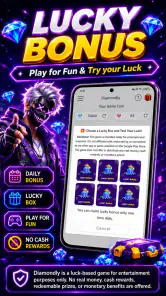

Analysis by Reviewed
Diamondly: Play Win FFDiamonds is a free sports game from App Seba that immediately raises an important question: what kind of experience is it really offering beyond its very short “Diamondly” store description? I spent time looking at it as a player rather than treating the promotional wording as a full explanation, and my honest view is that it is best approached as a lightweight entertainment app with a strong reward-oriented identity, not as a conventional sports simulation.
The central appeal is easy to understand. The game presents play and winning as its main idea, which can attract people who enjoy short sessions and a simple goal. At the same time, that wording means I would not install it expecting the depth of a football manager, racing game, arcade sports title, or competitive multiplayer experience. The most important decision is whether you are comfortable exploring a game whose public description is extremely limited.
What the game offers and what I would check first
Diamondly belongs to the sports section, although its published presentation focuses more on diamonds and winning than on a named sport or detailed match format. That distinction matters. If you are searching for realistic controls, teams, leagues, physical simulation, or a clearly explained season structure, this is not the kind of app I would choose without first examining the in-app experience for myself.
It is free to download, carries an Everyone age rating, and runs on Android devices using version 7.0 or later. Those details make it approachable for families and for people using older phones, but they do not automatically tell me whether the game is equally comfortable for every player. A free entry point can still involve time pressure, repeated tasks, or reward mechanics, so I would begin with a short trial rather than committing to it as my main game.
The developer is App Seba, and the app has reached over a million installs with an average rating of 4.2 from around twenty-five thousand ratings. That level of visibility suggests that many people have been willing to try it, while the rating indicates a generally positive reception rather than universal approval. I see those numbers as a reason to investigate, not as proof that the game will suit my own preferences.
The current version is 1.62, and the game was released on January 8, 2024. For a title built around a simple reward idea, version changes can be especially important because small adjustments may affect menus, tasks, balance, or the way progress is presented. I would therefore make sure the installed build is current before judging the experience, especially if an older phone behaves differently from newer hardware.
The first-session test I recommend
My practical advice is to use the first session as an inspection period. Before trying to maximize anything, I would look for a clear explanation of the objective, the actions that produce progress, and the exact meaning of any diamond-related reward. If the game explains those points plainly, it becomes much easier to decide whether the loop feels enjoyable or merely repetitive.
I would also pay attention to whether the app lets me leave a session naturally. A good casual game should make it obvious when a round, task, or attempt is complete. If I find myself tapping through unclear prompts simply to discover what happens next, that is useful information: the problem is not my patience, but the game’s ability to communicate its rules.
Another useful check is to separate entertainment from expectation. I can enjoy a short game because it gives me something to do during a break, but I should not assume that the word “win” represents cash, a guaranteed prize, or a transferable benefit. The app’s public wording does not establish those outcomes, so I would judge it on the play itself unless the in-app terms clearly explain something more specific.
Progress, repetition, and the pressure to keep playing
Reward-focused games often create a different kind of motivation from ordinary sports games. In a traditional title, I may return because I want to improve a lap time, beat a difficult opponent, or complete a tournament. In Diamondly, the attraction appears to be connected to collecting or winning diamonds. That can make short sessions feel purposeful, but it can also make every tap feel like work if the reward becomes more important than the activity.
I would use a simple rule: decide in advance how long I want to play, then stop when that time is over rather than chasing a target. This is particularly useful when progress is shown through counters, streaks, or repeated opportunities. Even without assuming any particular monetization system, a visible reward can encourage “just one more” behavior. Setting a limit protects the casual nature of the experience.
The game may suit someone who likes compact goals and does not need a large story or complex controls. It can be a reasonable choice for a short commute, a waiting room, or a few spare minutes when I want a game with an immediately understandable reward theme. It is less suitable for someone who wants a rich sports career, detailed strategy, or a long-term competitive ladder with clearly described rules.
One non-obvious trade-off is that simplicity can make the app both accessible and disposable. A small learning curve is helpful when I only have a few minutes, but it also means the game must keep its central loop satisfying. If the actions do not become more interesting after the novelty wears off, a player may reach the limits of the experience quickly. I would not treat the install count as evidence that the loop has enough depth for months of play.
How I would manage progress without overspending
Because the app is free to download, I would not assume that every part of the experience is free in the same sense. The available public facts establish the download price, but they do not establish a purchase catalog, item prices, subscriptions, or any particular payment requirement. That means the sensible approach is to inspect the game’s own purchase notices and platform confirmation screens before accepting anything.
I would never enter payment details merely to test whether a reward is real or to accelerate progress. If the app presents an offer, I would read what is being purchased, whether it is optional, and whether the result is permanent or temporary. If those details are not clear, I would close the offer and continue only with the free portion, assuming that option is available.
This is also where the game’s age rating matters in practical terms. An Everyone rating makes the app broadly accessible, but younger players may not distinguish between an in-game diamond and something with real-world value. If a child uses the device, I would review the device’s purchase protections and explain that “win” does not automatically mean money or a guaranteed prize.
Fairness, competition, and what can actually be judged
I am cautious about calling any reward-centered game competitive until I understand how outcomes are decided. A fair sports game normally gives me a visible connection between skill and result: better timing, smarter choices, or stronger tactics should improve performance. With Diamondly, the public description does not explain enough about the underlying activity for me to make a confident claim about skill balance.
That does not make the game unfair. It simply means fairness should be evaluated through what the app shows during play. I would look for understandable rules, consistent scoring, and a clear explanation of why a reward was granted or withheld. If the result changes without an obvious reason, the experience will feel arbitrary even if the app is technically functioning as designed.
There is an important difference between a personal reward loop and a contest against other players. If I am only trying to improve my own total, the main fairness issue is whether the rules stay consistent. If other people, rankings, or competitive outcomes are involved, I would also want to know how ties, attempts, and advantages are handled. I would not assume the existence of leaderboards or multiplayer features simply because the game uses the language of winning.
Compared with a familiar sports alternative, Diamondly appears easier to approach but less transparent as a sport. A conventional arcade game usually tells me what I am controlling within seconds. A management game explains its resources and decisions. A reward-oriented title needs to work harder to show that the activity itself is worthwhile. If the diamonds are removed from the picture, I would ask whether I still enjoy the basic interaction. That is my best test for genuine value.
A useful fairness habit is to record my own expectations before playing: am I looking for a skill challenge, a distraction, or a reward experiment? If I expect a full sports game and receive a simple reward loop, I may judge it harshly for the wrong reason. If I expect a casual diversion and the controls are clear, I may find it perfectly adequate. The app’s fit depends heavily on that starting expectation.
Where I would choose another game instead
I would choose a conventional sports title instead if I wanted named teams, realistic competition, tactical decisions, or a strong sense of mastery. I would also choose another option if I needed a clearly documented prize system, because the short public description does not provide enough detail for me to treat the reward language as a financial promise.
Diamondly makes more sense for someone curious about a compact “play and win” concept who is willing to inspect the rules and keep expectations modest. It is not my recommendation for a player who dislikes ambiguous objectives, dislikes reward counters, or wants a game that explains its complete structure before the first tap.
Trust, transparency, and my final recommendation
Trust here comes from separating what I can observe from what I might hope the app does. I can identify it as a free sports game by App Seba, available for a broad audience and compatible with Android 7.0 or newer. I can also see that it has attracted a substantial audience and a solid average rating. Those are useful signals, but they do not replace clear explanations inside the game.
The biggest friction is the lack of detail in the public presentation. The one-word short description, “Diamondly,” gives almost no help with the actual play loop. The longer summary points toward playing and winning with diamonds, but it still leaves important practical questions for the first session. I would prefer to see the objective, the nature of the sports activity, and the meaning of rewards explained before installation.
That uncertainty does not automatically make the app a poor choice. It changes how I recommend using it. Treat the download as a low-commitment trial, not as a promise of income, prizes, or deep sports gameplay. Spend a few minutes checking the rules, watching for purchase prompts, and deciding whether the basic interaction is enjoyable without chasing the reward.
My verdict is cautiously positive for curious casual players, especially those who like short sessions and simple goals. I would recommend it to a friend with the warning that the reward theme should remain a bonus rather than the reason to expect something valuable. The safest way to enjoy Diamondly is to judge the play first, keep spending optional, and treat every “win” as an in-game result unless the app clearly proves otherwise.
For families, the Everyone rating is reassuring as a starting point, but I would still supervise purchases and explain the difference between virtual diamonds and real-world value. For serious sports fans, I would skip it in favor of a game with named mechanics and a more explicit competitive structure. For everyone else, the decision is simple: try the free experience briefly, read each reward or purchase message carefully, and continue only if the activity itself—not just the promise of diamonds—earns your time.
Pros
- Simple interface makes diamond-related tasks easy to navigate.
- Lightweight design should run smoothly on many Android devices.
- Short activities are convenient for quick sessions.
- Reward progress is easy to understand from the main screen.
- May appeal to Free Fire players seeking an extra entertainment app.
Cons
- Rewards are not guaranteed and may depend on availability or conditions.
- Frequent ads can interrupt navigation and reward collection.
- You may need to complete several tasks before receiving benefits.
- Avoid sharing sensitive account details with third-party services.
- Availability and features may vary by region or device.

- Category
- Sports
- Version
- 1.62