Crazy Gunner: Pixel Survivor
- 289.00
- 4.3
- Installs
- 100.00K
- Price
- Free

Screenshots






Analysis by Reviewed
Crazy Gunner: Pixel Survivor is the kind of action game I open when I want a short burst of pressure rather than a long campaign. Its central idea is easy to understand: stay alive through a compact run, make quick choices, and try to improve the next attempt. The pixel presentation gives it an immediately readable look, while the survivor-style format keeps the focus on movement, threats, and building a squad under pressure.
After spending time with it, I found the appeal less about a complicated story and more about the rhythm of repeated runs. A good attempt can feel controlled for a while, then suddenly become a scramble in which every decision matters. That makes it suitable for players who enjoy action games built around learning through failure. It is free to start, although optional purchases range from $0.99 to $29.99 per item, so the way you respond to its progression and retry loop matters as much as the shooting itself.
What the first runs teach you
The opening goal is wonderfully clear: survive a short, intense session and put together a stronger group while doing it. I like that this gives each run a practical purpose. You are not simply wandering through a pixel arena waiting for something to happen; you are trying to turn a fragile start into a functioning squad before the pressure becomes too high.
That early objective also makes the game approachable. I did not need a long tutorial explanation to understand what I was supposed to care about. The useful question during a run is usually, “What helps me remain effective a little longer?” That keeps attention on immediate choices instead of burying the action under menus or story text.
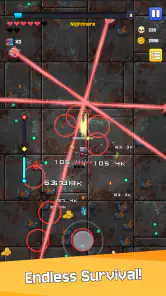
The first few attempts are especially valuable because they reveal how quickly a comfortable position can disappear. Early enemies may seem manageable, but the game’s survivor structure encourages you to think ahead rather than react only to what is directly in front of you. I learned to avoid treating open space as automatically safe. A route that looks clear can become awkward once threats gather from several directions.
For someone new to this style of game, I would recommend treating the first sessions as experiments instead of judging them by survival time alone. Notice which choices let the squad keep functioning when the screen becomes crowded. Notice when chasing a nearby reward pulls you away from a safer route. That mindset makes failure useful and prevents the opening from feeling like a sequence of wasted attempts.
The squad-building theme gives the short runs a stronger identity than a lone-character survival game. Even without turning the experience into a traditional strategy title, it encourages me to think about the overall group rather than one isolated action. The best early decisions are not necessarily the flashiest ones. They are the choices that keep the team capable of handling the next wave of trouble.
Small decisions that shape a run
One of the more interesting habits I developed was separating urgent choices from attractive choices. When the action is calm, it is tempting to pursue whatever seems most rewarding. When the arena tightens, survival has to take priority. That sounds obvious, but the game’s pacing makes the distinction meaningful because a decision that feels harmless several moments earlier can create a bad escape route later.
I also found it useful to avoid making every run identical. Repeating the same approach can feel comfortable, but it hides which parts of the build are genuinely helping. Trying a different emphasis lets me see whether I am surviving because of a strong setup or simply because the early pressure was favorable. This is a practical way to learn the game without needing a separate training mode.
Another useful approach is to view the squad as a resource that needs time to become valuable. Rushing toward every possible improvement can expose the group to unnecessary danger. On the other hand, playing too cautiously can leave me underprepared when the difficulty rises. The best balance is to take opportunities that fit the current route, rather than forcing a detour for a reward that may not justify the risk.
That trade-off is where the game starts to feel more thoughtful than its simple presentation suggests. The pixel art is approachable, but the run itself asks for spatial awareness and restraint. I would not call it a passive game that plays itself while I wait for upgrades. Even when the controls are straightforward, positioning and timing remain important because the wrong movement can turn a manageable situation into a lost run.
How progress feels between attempts
The progression is most satisfying when I can identify a reason that a later attempt went better. A stronger run should not feel like pure luck. I want to understand whether I made a smarter route choice, assembled the squad more effectively, or recognized danger earlier. Crazy Gunner works best when it turns each defeat into a small lesson rather than merely asking me to press retry.
Its short-session design helps with that learning process. Because a run does not demand a huge block of free time, I can remember what went wrong and test a different response soon afterward. This is particularly useful on a phone, where I might have only a few spare minutes while waiting for an appointment or taking a break. The game’s format suits those moments better than an action title that expects a long uninterrupted chapter.
There is also a psychological benefit to having a defined survival target. A vague “play until you are done” structure can make retries feel directionless. Here, I have a clear reason to keep going: reach the end of the challenge while improving the squad along the way. Even when I fail, the next attempt begins with a concrete question about what I can change.
Still, players should not expect a deep role-playing progression system simply because the game includes squad building. Its attraction is the interaction between immediate action and run-based improvement, not a lengthy character drama or a huge world to explore. If your ideal action game is built around elaborate equipment screens, narrative missions, and carefully scripted set pieces, this is a much leaner experience.
That lean structure is both a strength and a limitation. It keeps the focus sharp, but it also means the game has less room to distract me when the basic loop stops feeling fresh. The long-term question is not whether the first runs are entertaining; they are. The question is whether the decisions and challenge continue to feel meaningful after the initial discovery period.
The difficulty curve rewards composure
The most effective difficulty comes from the way pressure changes the value of space. At the start of a run, I can usually think about improvement and positioning together. Later, I have to protect the route ahead and avoid getting trapped by threats that are easier to ignore early on. This produces a natural curve: the game begins as a test of setup and becomes a test of composure.
I appreciate that this makes survival feel earned rather than automatic. A player who moves without considering the surrounding danger can lose control quickly, while someone who remains patient has a better chance of preserving options. The challenge is not only about reacting faster. It is about recognizing when the safe-looking choice is actually narrowing the path forward.
That said, the pressure can be frustrating if you prefer a relaxed action game. Crazy Gunner does not seem designed to let me settle into a comfortable routine for very long. The compact survival goal creates urgency, and urgency is central to the experience. If you dislike restarting after a promising attempt collapses, the repeated-run structure may feel demanding instead of motivating.
I would also avoid judging the game by one unlucky session. Run-based action naturally includes moments where a promising setup does not come together. The better test is whether I can adjust my behavior afterward. In my experience, the game becomes more enjoyable once I stop expecting every attempt to be successful and start looking for repeatable decisions that improve my odds.
For new players, my most useful advice is to preserve an escape option. Do not let the squad drift into a position where every direction is equally dangerous. When the screen becomes busy, a small amount of open room can be more valuable than an immediate reward. This is not a flashy trick, but it changes how the later part of a run feels and helps turn panic into a manageable problem.
Why the loop can keep pulling you back
The retention appeal comes from the gap between a near-success and a complete run. When I fall just short, I usually have a clear idea of what I would change next time. Maybe I took a risky route too early, focused on a tempting improvement instead of maintaining movement, or failed to protect the squad’s position. That sense of unfinished business is a stronger reason to retry than a generic promise of more content.
The game also benefits from its readable premise. I do not need to remember a complicated plot or a large map to return after a break. I can pick it up, understand the immediate objective, and begin making decisions. This makes it a good companion for short breaks, especially for players who enjoy action but do not want to commit to a full match in a competitive multiplayer game.
However, retention can become pressure if the progression starts to feel like a demand rather than an invitation. The presence of in-app purchases is worth keeping in mind here. The game is free to download, but optional items cost between $0.99 and $29.99 each. I would approach those purchases cautiously and first decide whether the basic loop itself is enjoyable. Spending money will not fix a play style that does not suit repeated survival attempts.
This is also where Crazy Gunner differs from more traditional action alternatives. A stage-based shooter may give you a fixed level, a predictable objective, and a clear finish line that does not change much between attempts. A competitive action game may offer deeper long-term mastery but require other players and a steadier time commitment. Crazy Gunner sits between those experiences: it is personal, repeatable, and compact, but its variety depends heavily on how engaging the run decisions remain.
Compared with a slower strategy game, it offers less time to plan and more need to react. Compared with an endless arcade game, it gives the run a more focused purpose through the survival target and squad development. I prefer it when I want to make decisions under pressure without entering a large campaign. I would choose something else when I want rich narrative progression, cooperative play, or a completely calm pace.
Who will enjoy it most
This is a good fit for players who already like pixel action, roguelike repetition, and survivor-style challenges. It is especially appealing if you enjoy seeing a weak opening turn into a workable build and do not mind losing while learning. The Teen content rating also signals that it is aimed at an older audience than a purely child-focused arcade game.
It works well in an everyday scenario such as a short commute or a break between tasks. I can start a run without preparing a large session, focus on the immediate threat, and stop after an attempt without feeling that I abandoned a long mission. That convenience is one of its practical strengths, although players who need a completely predictable stopping point may find the tension of a run less comfortable.
I would skip it if your main requirement is a substantial story, a relaxed pace, or a game that offers the same experience without repeated failure. I would also be cautious if you tend to feel pushed by optional purchases. The free entry is useful for testing the game, but the best way to evaluate it is to see whether its survival loop holds your attention before considering anything extra.
Device compatibility is broad enough for older Android hardware because it supports Android 7.0 and later. The current version is 1.5.0, and the game comes from Ryki Studio. Those details matter less than how it feels in motion, but they make it a practical option for players whose phones are not running the newest software.
My verdict on goals, challenge, and pacing
Crazy Gunner succeeds when its goals remain close to the action. Building the squad, protecting movement space, and surviving the escalating pressure all reinforce one another. I never felt that the run’s objective was disconnected from what I was doing moment to moment. That unity gives the game a clear identity despite its compact format.
Its biggest weakness is the same quality that makes it accessible: the design is focused. Players looking for a broad campaign or a large collection of unrelated activities may find the loop narrow. The game asks you to enjoy refinement rather than constant novelty. If that sounds appealing, the repeated attempts can become satisfying. If not, the simplicity may wear thin quickly.
The reception so far suggests that the game has found an audience, with an average rating of 4.3 from around 11 thousand ratings and more than 100 thousand installs. I read that as encouraging rather than conclusive: the core idea clearly connects with many players, but personal tolerance for repetition will decide whether it works for you.
My final recommendation is straightforward. Try it if you want a free, pixel-styled action game built around short survival runs, squad decisions, and gradual improvement through practice. Go in expecting pressure, restarts, and a focused loop rather than a sprawling adventure. The smartest way to play is to treat every attempt as both a challenge and a lesson; when you do that, the five-minute objective becomes more than a timer and gives each run a reason to matter.
Pros
- Simple controls make it easy to start playing immediately.
- Pixel-art visuals give the game a charming retro atmosphere.
- Short runs fit well into quick gaming sessions.
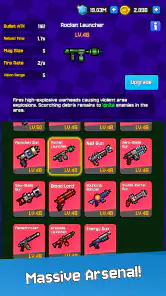
- Weapon upgrades create satisfying progression during each run.
- Offline play is convenient when you have no internet connection.
Cons
- Repeated enemy patterns can make later runs feel predictable.
- Random upgrades may leave some builds feeling underpowered.
- The small text and icons may be difficult to read on phones.
- Progression can slow down after the initial hours of play.
- Ads or in-app purchases may interrupt the overall experience.

- Category
- Action
- Version
- 1.5.0