CLUB - Football Manager Game
- 34.00
- 4.6
- Installs
- 100.00K
- Price
- Free

Screenshots







Analysis by Reviewed
I approached CLUB - Football Manager Game as a sports management game rather than a traditional match-day football title, and that distinction matters from the first session. The appeal is not simply watching a team play; it is making the decisions that shape a squad, especially when the central promise is building a club around real players. I found the most satisfying moments came before a match, when I was thinking about recruitment, squad balance, and whether a signing genuinely improved the team instead of merely looking impressive.
That makes this a good fit for anyone who enjoys football through planning and decision-making. If you want direct control over every pass, a fast arcade match, or a full console-style simulation, this will probably feel too indirect. If you like the idea of taking responsibility for a club and gradually turning a collection of players into a coherent squad, Formation Games has aimed this experience in the right direction.
How the club-owner workflow feels in everyday play
The basic loop is easy to understand. I spend time looking at the squad, considering which areas need attention, making recruitment choices, and then checking how those decisions affect the team as a whole. The important change in mindset is that a famous player is not automatically the correct player. A signing has value only when it fits the needs of the club I am trying to build.
That sounds obvious, but it becomes the first useful habit to develop. Early on, it is tempting to chase the most attractive names and treat every new arrival as progress. A better approach is to identify the weakest part of the squad first. If the team lacks balance, adding another player in an already crowded position can leave the real problem untouched. I got more from the game when I treated recruitment as a sequence of small corrections rather than a collection of exciting purchases.
A realistic everyday scenario is a short evening session after work or school. I might open the game intending to make one signing, notice that the squad has an imbalance, review the available options, and then stop before making an impulsive decision. The game works well in that kind of short, thoughtful session because its appeal comes from choices rather than from requiring a long uninterrupted match. It is also easy to return to when I want something more deliberate than a quick arcade game.
The free entry point helps with that accessibility. CLUB is free to download and play, and it is rated for Everyone, so it is easy to recommend as a low-commitment sports management experience. There are in-app purchases ranging from $1.49 to $129.99 per item, however, which means I would not approach the progression economy casually. Anyone who enjoys long-term planning should decide early whether they are willing to spend or whether they want to play within the free path.
Build around needs instead of names
My strongest practical advice is to create a simple priority order before touching recruitment. Start with the position or area that most limits the squad, then consider depth, and only after that look for luxury additions. This prevents a common management-game mistake: spending attention on glamorous improvements while leaving a structural weakness in place.
I also found it useful to judge a player in relation to the rest of the squad. A signing can be individually strong but still awkward if it duplicates an existing role or leaves another area under-resourced. The best decisions are often less exciting on screen because they make the whole group more usable rather than producing one spectacular headline addition.
Another helpful habit is to pause after each meaningful change and reassess the team. Instead of making several moves in one burst, I prefer to make one decision, inspect the consequences, and then decide whether the next move is still necessary. This reduces the chance of spending resources simply because they are available. It also gives the game a clearer rhythm: evaluate, adjust, test, and repeat.
The settings and screens I would check first
When I begin with a management game, I do not rush straight into recruitment. I first look through the available menus and settings so I understand how information is presented. In CLUB, that means paying attention to the way the squad, players, and club decisions are organized before trying to optimize anything. A clean personal routine is more valuable than randomly tapping through every screen.
I would check whether notifications, sound, and visual options suit the way I plan to play. If I am using the game in short sessions, I prefer a quieter setup that lets me concentrate on decisions. If I am playing at home, sound can make the experience feel more active, but it is not the part that keeps me returning. The practical point is to make the interface support the management loop instead of distracting from it.
I also recommend taking a moment to learn where the important squad information lives. The faster I can move from the club overview to player details and back again, the less likely I am to make a decision based on a quick glance. This is especially useful when comparing a possible signing with someone already in the squad. I would rather spend a minute checking the context than undo a poor choice later.
There is a subtle trade-off here. A management game can feel deeper when it presents plenty of information, but too much information can slow down casual play. CLUB is most comfortable when I establish a repeatable inspection order: review the squad, identify the immediate issue, examine the relevant player options, and then return to the wider club view. That order keeps the game from becoming a series of disconnected menus.
Shortcuts are really repeatable habits
I would not describe the best time-saving techniques as secret shortcuts. They are habits that reduce unnecessary decisions. One is to keep a clear recruitment target in mind before opening the player market or signing screen. Without that target, it is easy to browse endlessly and become distracted by names that do not solve the original problem.
A second is to separate “must improve” from “nice to have.” I use the first category for changes that affect the basic shape of the squad and the second for upgrades that can wait. This makes it easier to stop playing at a sensible point. I can finish a session knowing what the next priority is instead of feeling that I have to keep searching until the club is perfect.
A third habit is to avoid making decisions while reacting to a single disappointing result. One match or one poor moment should not automatically trigger a rebuild. I prefer to look for a repeated weakness before changing course. That approach is particularly important in a game where the fun comes from managing a club over time. Constantly changing direction can make the squad feel like a random collection of moves rather than something I have deliberately built.
Experienced players will also benefit from keeping a mental record of why each important signing was made. Was it to strengthen a weak area, add depth, or prepare for a future change? Remembering the reason helps me evaluate the result fairly. A player who does not immediately transform the team may still have been a sensible choice if the original goal was depth rather than instant dominance.
Where the free model changes the decision-making
The presence of optional purchases deserves a direct discussion because it affects how I judge the game. The free version makes it possible to try the core idea without paying first, which is valuable for a niche management experience. At the same time, the wide purchase range means players should be aware of their own spending boundaries before they become attached to rapid progress.
I prefer to treat purchases as a convenience question rather than a requirement. If I am enjoying the slow process of improving the club, I would rather let decisions and patience carry the experience. If the game’s progression starts making me feel that I must pay to keep the club moving at a comfortable pace, that is the point where I would step back. The best way to preserve the management appeal is to keep the focus on planning, not on buying my way past every obstacle.
This is also where CLUB differs from a simple football match game. In an arcade title, a purchase may feel like an optional cosmetic or a quick way to unlock content. In a club-management setting, spending can influence how quickly I can act on recruitment goals. That makes financial discipline part of the user experience even when the game itself is meant to be entertainment.
What experienced players should not assume
The game’s concept may attract fans of detailed football management simulations, but I would be careful about expecting the same level of depth as a large desktop or console manager. CLUB is designed for mobile play, and its strength is the compact club-owner loop. Someone looking for exhaustive tactical control, enormous databases, or a highly granular simulation may find the experience lighter than expected.
That is not automatically a weakness. A lighter structure can be an advantage when I want to make meaningful decisions without committing to a long administrative session. The trade-off is that players who enjoy analyzing every possible variable may eventually want a more specialized alternative. I would choose CLUB for accessible squad-building and choose a heavier simulator when detailed tactical modeling is the main reason I am playing.
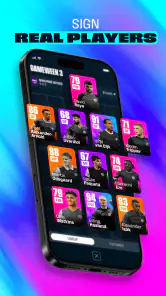
I would also avoid assuming that real players alone guarantee realism. Their presence makes recruitment more recognizable and gives the squad-building process extra appeal, but the enjoyment still depends on how well I manage the team around them. A familiar name can make a decision feel exciting, yet the game remains most rewarding when I ask whether that player actually improves my club’s structure.
Who will enjoy it, and who should skip it?
I would recommend CLUB to football fans who enjoy making decisions more than controlling live action. It suits players who like comparing options, building a squad gradually, and returning to a club with a plan. It is also a sensible choice for someone who wants a sports game that can fit into short mobile sessions without requiring the reflexes of a real-time match.
It is less suitable for players who want immediate action, competitive live play, or a detailed tactical laboratory. If your favorite part of football games is dribbling, shooting, defending, or controlling a full match directly, this manager-focused approach may feel slow. Likewise, if you dislike free-to-play economies on principle, the in-app purchase range may make the experience uncomfortable even if you never buy anything.
Compared with a conventional football game, CLUB gives up direct control in exchange for responsibility at the club level. Compared with a heavyweight management simulator, it offers a more approachable route into squad-building, but with less reason to expect endless layers of detail. Its best audience sits between those two groups: people who want recognizable football decisions in a format that is easier to pick up on a phone.
My verdict after settling into the routine
Formation Games has made a focused sports game for players who enjoy the role behind the team rather than the action on the pitch. The current version is 1.0.75, and the game has already reached over 100 thousand installs, with an average rating of 4.6 from around 8.8 thousand ratings. Those figures suggest that the central idea is connecting with a meaningful audience, but my recommendation is based more on how clearly the club-owner workflow works in practice.
The strongest part is the decision loop: identify a need, consider real-player recruitment, improve the squad, and return with a clearer plan. The main friction comes from the free-to-play structure and from the possibility that experienced simulation fans may want more depth than a mobile-focused game provides. Neither issue ruins the experience, but both should shape expectations before starting.
My recommendation is to try it if you want football management in compact, repeatable sessions, while keeping a firm limit on optional spending. I would begin by learning the squad screens, set one recruitment priority, and resist the urge to sign players simply because they look appealing. That approach reveals what CLUB does best: it turns familiar football names into a planning exercise, and it rewards the player who builds a team with a reason rather than a shopping list.
Pros
- Deep squad management with transfers
- tactics
- training
- and finances.
- Matches provide useful feedback to adjust your strategy and lineup.
- Large football database offers plenty of clubs and players to explore.
- Season progression creates long-term goals beyond individual matches.
- Regular updates can keep rosters and competitions feeling current.
Cons
- Progress can feel slow without spending money on premium resources.
- The interface may seem overwhelming for new football management players.
- Match outcomes can sometimes feel influenced by hidden game mechanics.
- Managing multiple systems requires frequent attention and time.
- Some features may depend on an active internet connection.

- Category
- Sports
- Version
- 1.0.75