Bucks Magnet - Win Real Money
- 229.00
- 4.8
- Installs
- 50.00K
- Price
- Free
Screenshots




Analysis by Reviewed
I approached Bucks Magnet - Win Real Money as a short-session simulation game rather than as a dependable income tool. Its central promise is easy to understand: build up virtual earnings and work toward a cash-out opportunity. That idea makes it immediately appealing, especially when I only have a few spare minutes and want something more purposeful than a standard idle game. At the same time, the money angle changes how I judge every part of the experience. Progress, withdrawal timing, and clarity matter much more here than they would in an ordinary casual game.
Developed by CazualLab, the game is free to install and aimed at a Teen audience. It sits in the simulation category, although the real attraction is the reward-oriented loop rather than detailed management or realistic business planning. I found it most interesting when treating each session as a small routine: open the game, check what has accumulated, make the available progress, and decide whether continuing is worth my time. That rhythm can be satisfying, but it also requires realistic expectations. I would not install it assuming that a few taps will replace a job, solve a financial problem, or produce predictable income.
How the current version feels in everyday use
The current release is version 1.0.2, and the game already has a visible audience, with more than 50 thousand installs. Its average rating is 4.8 from around 2 thousand ratings, alongside roughly 229 written reviews. Those figures suggest that the basic concept is connecting with players, but they do not remove the need to inspect the experience personally. A high rating can show that users enjoy the idea while leaving practical questions about patience, repetition, and cash-out expectations.
My first recommendation is to approach the opening session as a test of the loop, not as a promise of fast money. Notice how quickly the game gives you something meaningful to do, how clearly it explains progress, and whether the path toward withdrawal is understandable. In a reward-based game, these details are more important than visual polish. If I cannot tell why my balance changed or what action matters next, the experience becomes frustrating very quickly.
The strongest use case is the player who likes lightweight simulation and wants a reason to return briefly throughout the day. It can fit into a commute, a short break, or the few minutes before bed. I would keep sessions deliberately short at first. That makes it easier to decide whether the entertainment value justifies the attention, instead of allowing the promise of a reward to turn into automatic checking.
A practical routine is to choose a fixed time to review progress rather than opening the game whenever you feel curious. For example, I might check it during one planned break, make the available decisions, and close it. This approach has two advantages: it keeps the game from taking over idle moments, and it gives me a clearer sense of whether progress feels consistent. It is a useful distinction because a game can be enjoyable without being financially worthwhile.
The reward promise needs a careful reading
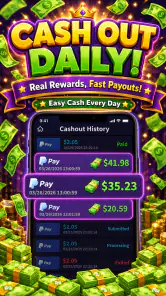
The appeal comes from the possibility of building up real-money rewards and cashing out on a repeating schedule. That is a much stronger hook than collecting imaginary coins, but it also creates the biggest source of friction. I would never treat the displayed balance as money I already possess. Until a withdrawal has actually completed successfully, it is better understood as in-game progress with a possible future value.
This mindset is especially important for younger players, since the content rating is Teen. Parents and guardians should discuss the difference between entertainment and earnings before allowing regular play. A child may see a growing number and assume it has the same certainty as money in a bank account. I would also set a time limit, because reward mechanics can encourage repeated checking even when each individual session feels harmless.
Another useful habit is to read each withdrawal-related instruction slowly instead of tapping through it. Look for eligibility requirements, timing language, and any steps the game places between progress and a completed payout. I am not suggesting that every player will encounter a problem; I am saying that a money-focused game deserves more attention to wording than a typical puzzle or racing title. This is one of the most important differences between using this game casually and using it with expectations.
What the simulation label means here
Players coming from management simulations should adjust their expectations. This is not the kind of game I would choose for deep planning, complex production chains, or a detailed economy. The simulation identity is better understood as a framework for accumulating progress and interacting with a reward loop. If you want to design a city, balance a transport network, or manage a business with several competing systems, a conventional simulation will offer more depth.
That narrower focus is not automatically a flaw. The simpler structure makes the game approachable and reduces the learning curve. I can understand the basic goal without studying a long tutorial or memorizing a large control system. The trade-off is that the experience may feel repetitive sooner than a full management game. Its value depends on whether the reward-oriented routine itself keeps you interested.
I also think the game works better as a small side activity than as a main game. When I expect a compact loop, the simplicity feels convenient. When I expect a substantial simulation, the limited scope becomes more noticeable. That distinction can save a potential player from downloading it for the wrong reason.
What the release and current version tell me
The game was released on July 13, 2026, and version 1.0.2 indicates an early stage of its product life. I see that as both an opportunity and a reason to remain observant. An early release can have a clear, focused concept while still needing refinement in explanations, pacing, and the handling of edge cases around rewards. I would judge the current build on what it does now, not on features I hope may arrive later.
For existing users, a version update is most valuable when it makes the core routine easier to understand or more reliable. In a game built around progress and cash-out, small improvements can have an outsized effect. Clearer status messages, better visibility into pending actions, and fewer confusing transitions would matter more to me than decorative additions. I would pay attention to whether later updates improve confidence in the process rather than merely adding more reasons to return.
New players should also remember that an early version can change the balance between effort and reward. A routine that feels generous today may be adjusted as the developer learns how people use it. Conversely, unclear parts may become more polished. That is why I recommend recording your own impressions after several sessions: how long you played, what progress you made, and whether the reward path remained understandable. Personal notes are more useful than relying only on the headline rating.
The developer, CazualLab, has created a concept that is easy to explain in one sentence, but the long-term quality will depend on execution. Reward games need especially strong communication because users are not only asking whether the game is fun; they are asking whether the rules remain consistent. If the interface makes those rules visible, trust improves. If it leaves players guessing, even a pleasant game loop can become tiring.
How it compares with ordinary alternatives
Against a normal idle game, the main difference is the possibility of a real-world reward. Traditional idle titles usually make their value clear: you are collecting fictional currency to unlock upgrades, expand a base, or reach a new stage. That clarity can make them more relaxing. With Bucks Magnet, the potential cash-out gives each action more emotional weight, but it also makes repetition feel less rewarding if progress slows or the conditions are difficult to follow.
Against a deeper simulation, this game is easier to start and easier to fit into a busy day. A serious management title asks me to plan several steps ahead and accept failure as part of learning. Here, the attraction is the shorter path from opening the app to seeing progress. I would choose this game when convenience matters more than strategic depth. I would choose a conventional simulation when I want decisions to have layered consequences and a richer sense of control.
It also differs from survey or task-based reward platforms. Those services generally frame the user’s time around completing external activities, while this app presents itself as a game. That makes it more enjoyable for someone who wants entertainment first, but it may also make the route to a reward less transparent than a simple task list. If your priority is the clearest possible exchange between an action and a payout, a straightforward work-or-task platform may suit you better.
Small habits that improve the experience
I found three habits particularly useful. First, separate entertainment time from reward expectations. Decide before playing whether you are there for a quick game or for progress toward a withdrawal. Mixing those goals can make every slow moment feel like wasted labor.
Second, inspect the balance and withdrawal area at the same point in each session. This creates a simple record of what changed and helps reveal whether the game explains its process clearly. If the route becomes confusing, stop and reassess rather than continuing automatically.
Third, avoid making decisions based on the most optimistic interpretation of the reward message. Treat the shortest suggested timing as a possibility to understand, not as a guaranteed personal result. That protects your time and keeps the game from creating pressure. In my view, this is the most important advanced tip because the money theme can easily overshadow the fact that the app is still a casual game.
A fourth habit is to keep the game isolated from important financial decisions. I would not use expected rewards to justify a purchase, delay a bill, or promise money to someone else. The app can be a source of light entertainment and perhaps a bonus if the process works as expected, but it should never become part of a budget. That boundary is sensible for any reward-based title, and especially important for teenagers.
Where the experience still needs care
The biggest limitation is the tension between a simple game loop and a serious financial promise. If the gameplay is repetitive, the player may tolerate it while expecting a meaningful reward. If the reward path feels slow or unclear, that same repetition becomes much harder to accept. I would have preferred to see the game communicate the relationship between activity, progress, and withdrawal as plainly as possible at every stage.
There is also a psychological cost to frequent checking. A normal simulation can be paused without much emotional pressure. A reward-oriented game may make me feel that I am missing an opportunity whenever I close it. That is not a reason to reject the app outright, but it is a reason to use notification controls and personal limits if the routine starts influencing your day.
Another limitation is suitability. Players who want reliable income should skip it. Players who dislike repetitive loops should probably choose a richer simulation. People who are uncomfortable with reward mechanics should stick to games where the currency remains entirely fictional. The free price removes an entry barrier, but it does not make the player’s time free, and time is the resource I would watch most closely.
I would also avoid judging the app solely by its rating. The 4.8 average is encouraging, and the written feedback from around 229 reviews can help reveal what players enjoy, but every user approaches a reward game with different expectations. Someone satisfied with a quick casual diversion may rate it highly, while someone seeking predictable earnings may reach a very different conclusion. Reading comments with that distinction in mind gives a more useful picture.
Questions I would settle before regular play
Is it free to start? Yes, the game is listed as free, which makes trying the basic loop straightforward. I would still distinguish a free download from a guarantee that every part of the experience will feel effortless. The sensible test is whether the first sessions explain enough for you to decide if the routine deserves more time.
Can I treat the cash-out schedule as guaranteed? I would not. The game presents a repeating cash-out idea, but I would verify the exact in-app conditions and follow the process carefully before forming expectations. A displayed schedule is useful guidance, not a substitute for completing the steps yourself.
Will it replace another simulation game? Probably not if your priority is depth. It is better viewed as a compact, reward-centered alternative to a standard idle experience. If you want complex systems, long-term construction, or strategic variety, another simulation will likely be more satisfying.
Is it appropriate for everyone? No. The Teen rating matters, and the real-money theme calls for extra judgment from younger players and families. Adults should also consider whether the app encourages habits they are comfortable with. A game can be technically easy to use while still being a poor fit for someone who is vulnerable to compulsive checking.
What should I watch in future updates? I would look for clearer explanations, smoother handling of reward progress, and communication that makes changes easy to understand. I would also watch whether the game remains enjoyable when I ignore the money angle. If the answer is yes, it has a healthier foundation as a casual simulation; if the answer is no, the reward promise is doing all the work.
My final view after weighing the trade-offs
I see Bucks Magnet as a focused experiment in combining a simple simulation loop with the possibility of real-money rewards. Its free entry, accessible structure, and strong current rating make it worth a cautious trial for players who enjoy short sessions and understand that their time still has value. I like the idea of checking progress during a spare moment, but I would keep the routine controlled and treat any payout as uncertain until it has actually been completed.
The current version feels more appropriate for curious casual players than for anyone seeking a dependable financial tool. CazualLab has a clear hook, and the early audience suggests that the concept has found interest, but the long-term verdict will depend on transparency and consistency. For me, the key test is whether the game remains clear and enjoyable without pressuring me to keep checking.
I would recommend trying it if you want a lightweight reward-themed game and are comfortable setting boundaries around time and expectations. I would skip it if you need predictable earnings, dislike repetitive progress systems, or prefer simulations with substantial strategic depth. Used with that honest perspective, it can be an intriguing casual diversion. Used as a promise of fast, reliable money, it is the wrong kind of app to depend on.
Pros
- Simple tap-based gameplay that is easy to understand from the first session.
- Short rounds make it convenient for quick play breaks.
- Bright visuals and satisfying reward animations keep the experience engaging.
- Progress tracking gives players a clear sense of ongoing activity.
- Free to download
- with no purchase required to try the core game.
Cons
- Earnings may be small and can require substantial time to accumulate.
- Reward availability may vary by location
- account
- or promotional conditions.
- Frequent ads can interrupt gameplay and slow down progress.
- Cash-out requirements may include minimum thresholds and verification steps.
- Results and rewards are not guaranteed
- so it should not be treated as income.
- Category
- Simulation
- Version
- 1.0.2