Bowling by Jason Belmonte
- 4.57K
- 4.5
- Installs
- 500.00K
- Price
- Free
Screenshots



Analysis by Reviewed
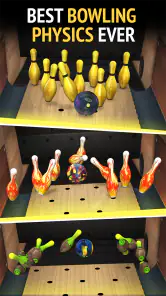
I expected a quick bowling game, but Bowling by Jason Belmonte held my attention for a more specific reason: every turn has a clear physical idea behind it. I choose a line, control the delivery, watch the ball react, and immediately decide whether the next attempt should copy the last one or correct it. That simple sequence gives the game a satisfying rhythm without making it feel like a spreadsheet of bowling statistics.
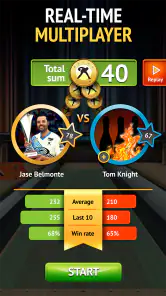
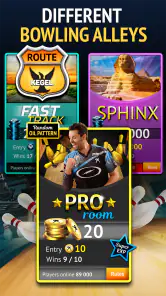
This is a free sports game from WannaPlay Studio Ltd, built around three-dimensional bowling, physics-based ball movement, and competition against other players online. It is rated for Everyone, so it is easy to recommend for a family tablet, a short break, or someone who wants a bowling game without learning a complicated control system first. I found it most enjoyable when I treated each frame as a small experiment rather than blindly repeating the same swipe.
The game has been available since Aug 23, 2017, and its current version is 1.907. That long presence matters because the basic concept is easy to understand: pick up the game, throw a ball, see what happened, and try again. It has reached over 500 thousand installs and holds a 4.5 average from around 18 thousand ratings, which fits my impression of a polished, approachable title rather than an obscure technical demo.
How the bowling loop works in real play
The first action feels immediate
The best way to begin is not by worrying about perfect strikes. I start by watching how the game translates my input into the ball’s path. The first delivery teaches more than a long tutorial would: the direction of the release, the amount of curve, and the timing of the motion all affect whether the ball reaches the pocket or drifts away from it.
That makes the opening action pleasantly direct. I am not choosing from a maze of menus before playing. I am trying to send a ball down the lane, and the result appears quickly enough to connect my decision with the outcome. If the ball misses to one side, I have a practical reason to adjust rather than a vague feeling that my character needs a better upgrade.
New players should resist the temptation to chase a dramatic hook immediately. A straighter delivery is easier to read, especially on a phone where a small movement can feel less precise than it would on a larger screen. Once I understood the basic release, adding controlled movement became more useful than making every throw flashy.
This is also where the game separates itself from a purely casual button-tapping experience. The three-dimensional presentation gives the lane and pins enough visual depth for positioning to matter. I still get the convenience of a mobile game, but the throw has a little more intention behind it than simply pressing “bowl” and waiting for an animation.
Feedback arrives before the excitement fades
Bowling works because the feedback is easy to read. The ball’s route, its contact with the pins, and the remaining setup all tell me what went right or wrong. A near miss is not just a failed score; it gives me a clue about whether I released too early, aimed too far across the lane, or used more curve than the situation needed.
I particularly like the short decision window after a throw. The result is visible, but the game does not ask me to spend several minutes analyzing it. I can make a small correction and immediately test that correction. This creates a useful rhythm: action, visual response, adjustment, and another action.
That rhythm is more rewarding when I focus on repeatable throws. If I change direction, release, and curve at the same time, I cannot tell which choice caused the improvement or the mistake. My practical tip is to alter one element first. Move the aim slightly, keep the delivery similar, and see whether the ball enters a better line. Then experiment with the release. This makes the physics easier to learn and reduces random-feeling failures.
The feedback is also valuable for casual players who do not know bowling terminology. I do not need to understand every technical detail of lane play to notice that a ball is consistently finishing too far left or right. The game lets observation do some of the teaching, which is one reason I think it suits people who want accessible sports gameplay rather than a full simulation course.
Why another throw feels worth starting
The reward is not limited to knocking down pins. A good delivery feels earned because it follows a visible decision. When a small change turns a weak approach into a strong result, I get the satisfaction of having learned something rather than merely receiving a random bonus.
That is the central appeal for me. The game gives a quick reward after every attempt, but the more meaningful reward comes from improving the next attempt. A spare can be satisfying because it rescues a difficult frame; a strike is exciting because the line, timing, and contact all came together. Even an imperfect throw can be useful if it shows me what to change.
The online competition adds another layer to that loop. It gives the bowling a reason to matter beyond practicing alone, since performance can be compared in a competitive setting. I would approach this mode after becoming comfortable with the controls, though. Competing before learning how the ball responds can make losses feel like control problems rather than meaningful challenges.
There is a trade-off here. Players who enjoy direct competition may find the online element motivating, while people who prefer a quiet, entirely offline pastime may find the competitive focus less appealing. This is still a bowling game first, but the presence of online play makes it feel less like a one-and-done toy and more like something I can return to when I want to test consistency.
The reset is what keeps short sessions practical
One reason I can imagine opening this game during an ordinary day is that each session has a natural reset. I can play a few turns, stop, and come back without needing to remember a complicated story or a large map. The basic mental task is always familiar: read the situation, choose a delivery, observe the result, and decide whether to repeat or adjust.
That makes it a good fit for a short waiting period or a relaxed evening when I want interaction without a heavy commitment. It also works for shared play on a family device because the rules are instantly recognizable. Someone can understand the objective by watching one frame, even if they have never played a mobile bowling title before.
The reset can feel less satisfying if I am looking for deep progression or a campaign with a strong narrative structure. This game’s appeal comes from refining the throw and competing, not from uncovering a world or completing a long sequence of story missions. I would skip it if my main requirement were a role-playing system, extensive customization, or a continuous adventure.
Another practical consideration is the free-to-play structure. The game costs nothing to start, but it includes in-app purchases ranging from $0.99 to $99.99 per item. I would recommend deciding in advance whether I am comfortable making purchases, especially if I am handing the device to a younger player. The Everyone rating makes the game broadly accessible, but the purchase model is still worth keeping in mind when choosing it for family use.
Small habits that improve the experience
My first useful habit is to practice consistency before chasing maximum power. A controlled ball that reaches a predictable area is easier to improve than a forceful throw that changes dramatically from turn to turn. Once the path is familiar, I can introduce more movement with a clearer idea of what the change is doing.
My second tip is to use the remaining pins as a planning exercise. After a difficult first delivery, I do not automatically aim at the largest group. I look at the gap and the angle needed for the spare, then choose the simplest route that gives the ball a chance to contact the target. This turns a disappointing frame into a focused recovery attempt.
A third insight is that the game rewards patience between attempts. Because the action is quick, it is tempting to swipe again immediately after a poor result. I play better when I pause for a moment and name the mistake in simple terms: too far inside, too much curve, or an inconsistent release. That tiny pause prevents me from changing everything at once and makes the next throw more informative.
I also find that the game is more enjoyable when I separate practice goals from competition goals. In a practice-minded session, I may test a different line even if it is risky. In an online match, I prefer the delivery I already understand. Treating those situations differently helps preserve the fun of experimentation without turning every competitive attempt into guesswork.
Where it compares well with other sports games
Compared with a traditional bowling game that focuses only on quick animations, this title gives the ball’s movement more importance. I feel involved in the delivery, not just the result. Compared with a highly detailed bowling simulator, however, it is easier to pick up and less demanding to study. That middle position is its strength: enough physical response to make aiming meaningful, but not so much complexity that a newcomer needs a manual.
It also compares favorably with sports games that bury their main action under menus, team management, or long upgrade screens. Here, the core activity remains visible. I can understand why I am playing and what I should improve without first learning an entire management system.
The compromise is depth. Someone who wants every aspect of professional bowling modeled in detail may eventually want a more specialized simulation. Someone who wants a completely consequence-free arcade experience may prefer a game with exaggerated effects and less concern for line control. I see this one as the better choice for players who want quick access with a modest amount of skill development.
Who should install it, and who should pass
I would recommend it to casual sports fans, bowling beginners, and players who enjoy games where each failure offers a clear adjustment. It is especially suitable for short sessions because the action starts quickly and the loop explains itself through repeated play. Families may also appreciate the Everyone content rating and the familiar rules.
I would be more cautious about recommending it to someone who dislikes online competition, free-to-play purchase options, or repeated attempts at the same physical action. The game’s appeal depends on enjoying gradual improvement. If the idea of aiming, correcting, and trying again sounds repetitive, the physics will not magically solve that problem.
It is also not the best match for a player seeking a deep career mode, narrative progression, or a broad collection of sports. Its focus is narrow by design: bowling action, immediate feedback, and competitive replay value. That focus is exactly why it is easy to understand, but it also defines its limits.
My verdict after following the full loop
Bowling by Jason Belmonte succeeds because its main loop is honest. I take an action, receive a clear physical response, earn the satisfaction of a good result or a useful lesson, reset the situation, and find a reason to attempt one more delivery. The loop does not need a complicated story to work; it depends on whether the next throw feels like it might be better than the last.
WannaPlay Studio Ltd has made a sports game that feels approachable without removing the small decisions that make bowling interesting. The three-dimensional lanes, realistic-feeling ball movement, and online competition give the simple premise enough staying power. The free entry point is helpful, although the available in-app purchases mean I would keep spending boundaries in mind.
After a few sessions, I stopped judging it only by how many pins fell and started judging it by how clearly I understood my next adjustment. That is a good sign for this kind of game. If you want a compact bowling experience where every throw teaches you something, this is worth trying. If you want a large progression system or a fully detailed professional simulation, I would look elsewhere. For everyone between those extremes, this is a convincing reason to begin another frame.
The game is free to download, supports devices running Android 6.0 or later, and has built a substantial audience since its release. With around 4.6 thousand reviews alongside its ratings, it has clearly encouraged many players to spend time with its straightforward bowling loop. I would start without purchasing anything, learn the controls through ordinary play, and only then decide whether the competitive side gives me enough value to justify spending.
Pros
- Simple controls make it easy to pick up and play.
- Belmonte-themed content adds personality for bowling fans.
- Short matches suit quick gaming sessions.
- Playable without needing advanced bowling knowledge.
- Works well as a casual
- relaxing sports game.
Cons
- Gameplay may feel repetitive after extended sessions.
- Limited depth may disappoint serious bowling enthusiasts.
- Some features may require in-app purchases or ads.
- Performance can vary on older phones and tablets.
- Online or competitive options may feel less developed.
- Category
- Sports
- Version
- 1.907