The Detonator: Blast & Mine
- 541.00
- 4.5
- Installs
- 1.00M
- Price
- Free

Screenshots



Analysis by Reviewed
My first impression of The Detonator: Blast & Mine was that it understands the appeal of a simple adventure game immediately: there is something satisfying about breaking into the ground, finding what is hidden below, and deciding whether the next blast is worth the risk. The game comes from LootCopter Game Studio and is free to start, which makes it easy to try during a short break without treating the first session like a major commitment.
That simplicity is also the key to judging it fairly. This is not an adventure built around long conversations, a complicated control scheme, or a huge cast of characters. Its identity comes from excavation, explosions, discovery, and the steady rhythm of turning underground space into progress. I found it most enjoyable when I treated each run as a compact problem to solve rather than expecting a traditional story-heavy journey.
The game is available for players rated Everyone, and it has attracted over a million installs. Its average score sits at 4.5 from around twenty-one thousand ratings, with hundreds of written reviews behind that overall impression. Those figures suggest that the straightforward mining-and-blasting loop has found a broad audience, but they do not remove the need to know what kind of player will actually enjoy repeating it.
Digging into the game’s visual language
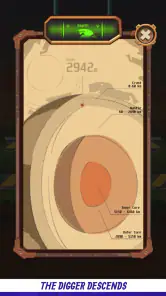
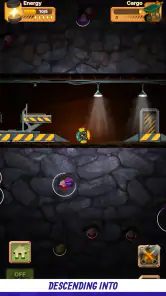
The setting does much of the storytelling. Instead of asking the player to read long explanations, the game presents the Earth’s depths as a place of concealed value and controlled destruction. The basic fantasy is easy to understand: I arrive at a section of ground, use explosive force to open it, and look for the rewards that justify going farther. That clear visual idea gives the adventure a coherent mood even when the individual actions remain uncomplicated.
I like that the theme is not separated from the play. Blasting is not just a decorative effect placed over an unrelated puzzle; it is the action that defines the experience. The underground setting gives every decision a physical feeling. A new opening changes what I can reach, while a poor choice can make the next move feel less efficient. Even without a large narrative framework, the environment supplies a reason to keep exploring.
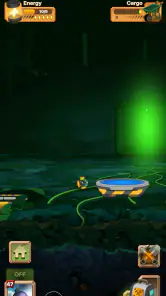
The art direction works best when it keeps the focus on contrast: solid earth against open space, hidden riches against the roughness of the terrain, and a quiet underground setting interrupted by sudden destruction. That contrast helps the game avoid feeling like a plain menu-driven progression system. I am always looking at the field as something that can be altered, not merely as a background behind buttons.
There is a useful psychological effect in this presentation. Before detonating, I am looking at possibility. After the blast, I am evaluating the result. The visual change between those two moments gives even a small action a sense of consequence. It is a modest design choice, but it is one of the reasons the loop feels more like an adventure than a simple sequence of taps.
Why the setting matters more than the story
Players who need a strong plot may find the underground premise too light. I would not choose this game for character development or a dramatic campaign. Its world is primarily a playable space, and that is intentional. The appeal comes from making progress through the environment rather than following a detailed narrative.
For me, that makes it a good fit for short sessions. I can open it when I want a clear objective and immediate feedback, without remembering a complicated storyline from the previous evening. The trade-off is that the sense of discovery depends heavily on the excavation loop staying fresh. If I stop enjoying the act of deciding where and when to blast, the setting alone cannot carry the whole experience.
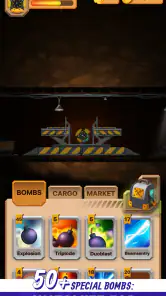
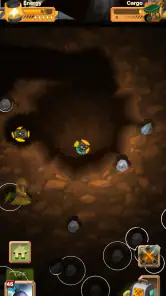
One practical tip is to pay attention to the shape of the area before acting. The temptation is to think only about the nearest visible reward, but the better question is how the blast changes the space around it. I found that pausing for a moment to read the layout made the game feel more deliberate and reduced the sense that I was simply pressing the most obvious option.
Sound, explosions, and the rhythm of a session
The audio direction supports the central contrast between anticipation and release. Underground exploration needs a feeling of restraint, while detonations need to feel like interruptions that matter. When those two moods work together, the game develops a recognizable rhythm: inspect, commit, react, and prepare for the next opening.
That rhythm is important because the mechanics themselves are easy to understand. A complicated soundtrack would distract from the decisions, while a completely flat presentation would make each blast feel interchangeable. The strongest moments come when the sound reinforces the change in pace rather than trying to become the main attraction.
I also think the audio makes the game more suitable for casual play than a constantly frantic adventure would be. There is room to think between actions, and the experience does not need to be treated like a race. I can play a few moments while waiting for something, then stop without feeling that I have abandoned a long chain of events.
That said, the pacing can feel repetitive if I approach every section in exactly the same way. The solution is not to rush faster; it is to make each detonation part of a small plan. I try to distinguish between a blast meant to reach a reward and one meant to open a safer or more useful route. That mental distinction gives the sound and animation more meaning because I am reacting to a decision, not merely to an effect.
A realistic everyday use case is a short evening session after work. I may not have the attention for a large role-playing game, but I still want something more engaging than an idle activity. This game fits that gap well: I can make a few excavation decisions, enjoy the impact of the explosions, and put it down when my attention starts to fade. It is less suitable for someone looking for a quiet, purely relaxing app, because the blast-focused presentation is central to its identity.
How the mechanics support the mood
The main mechanical strength is the close relationship between action and theme. The player is not exploring an underground world with a tool that feels disconnected from the setting; the act of opening the earth is the game’s defining interaction. That alignment makes the experience easy to grasp and helps the first few sessions feel purposeful.
At the same time, the simplicity creates a clear trade-off. There are fewer layers to master than in a large adventure title, so the game depends on the satisfaction of repetition, timing, and discovery. I would describe it as a focused adventure rather than a deep simulation. It gives me a compact loop to refine, not a broad system of characters, crafting, or narrative choices.
The most useful way to play is to separate immediate reward from long-term efficiency. A visible prize can be attractive, but spending every resource or committing every blast just because something is nearby may leave the next decision less comfortable. I get better results when I consider what the action opens up, what it closes off, and whether the reward is worth changing the route.
That is one of the less obvious strengths of the design: it encourages spatial thinking without presenting itself as a formal strategy game. I am constantly reading the underground area as a chain of opportunities. Even when the controls remain accessible, the player can add depth by asking better questions before acting.
Another useful habit is to treat failed choices as information rather than as wasted time. If a route produces little value, I can adjust my approach in the next attempt instead of repeating the same pattern. This matters especially for players who dislike games that punish experimentation. The experience is more comfortable when I accept that not every blast needs to be perfect.
The free entry point is a genuine advantage for curious players. I can test the core loop before deciding whether it deserves regular space on my phone. However, the game includes in-app purchases ranging from $0.99 to $99.99 per item. That wide range makes it important to keep personal limits in mind. I would recommend playing the early experience on its own terms first, rather than assuming that spending is necessary to enjoy the concept.
For younger players, the Everyone rating makes the game approachable from a content perspective, but I would still treat purchase controls as a separate household decision. The age classification describes suitability of content, not whether a player should have unrestricted access to optional spending. That is a practical consideration for families sharing a device.
Who will enjoy it, and who should skip it
I would recommend this adventure to players who like compact progression, destructive interactions, and the feeling of uncovering value beneath a surface. It is especially appealing if you enjoy games that explain themselves through action. The visual setting, explosive feedback, and straightforward objective all work together without requiring a long tutorial-style commitment.
It is also a good choice for people who want a game that can fit around a busy day. The structure is easier to return to than a story that demands detailed memory, and the central action is clear from the start. If you enjoy making small decisions repeatedly and seeing the environment respond, the loop has a satisfying directness.
I would skip it if your ideal adventure requires elaborate dialogue, complex character builds, or a large open world with many unrelated activities. I would also look elsewhere if repetitive resource-focused play quickly loses its charm. In those cases, a narrative adventure or a deeper strategy game will probably offer more variety and a stronger sense of long-term development.
Compared with the usual alternatives in the adventure category, this game is more concentrated. Traditional adventure games often lead with exploration, story, combat, or puzzle solving, while this one makes excavation and detonation the center of attention. That focus is its advantage when I want immediate interaction, but it is also its limitation when I want several different kinds of play in one package.
Practical details before you install
The game was released on September 27, 2022, and the current version is 1.6.9. It requires Android 7.0 or later, so it is accessible on a wide range of older Android devices while still giving newer phones a straightforward adventure to handle. The free download lowers the barrier to trying it, although optional purchases are part of the overall experience.
I would approach installation with one simple expectation: this is a focused game about blasting into the depths, not an all-purpose adventure platform. That expectation matters more than the impressive reach suggested by its install count. A large audience can confirm that the idea is approachable, but personal enjoyment will depend on whether the excavation rhythm matches your taste.
Before committing to a long session, I suggest playing slowly enough to understand how the terrain responds. The first instinct is often to tap quickly because the explosions are satisfying. Taking a little more time reveals the strategic side of the loop and helps distinguish the game from a purely visual destruction toy.
I would also avoid judging it only by how much content appears in the opening moments. The core appeal is not a single surprise; it is the repeated relationship between planning and payoff. If that relationship feels good, the game can become a dependable short-session choice. If it already feels repetitive, additional time is unlikely to transform it into a story-driven adventure.
My final atmosphere verdict
What stays with me is the coherence between the setting, the sound, and the mechanics. The underground world gives the player a reason to look closely, the audio and explosive feedback create a recognizable pulse, and the excavation system turns that mood into something playable. None of these elements needs to dominate. They work because they point toward the same fantasy: finding opportunity below the surface by choosing where to break through.
My biggest reservation is the narrowness of that fantasy. The game does not try to be every kind of adventure, and players who need narrative variety or a broad set of systems may outgrow it. The optional purchase range is another reason to play with awareness, especially on a shared family device. Those are meaningful limitations, not deal-breakers, but they define the audience clearly.
For me, The Detonator: Blast & Mine works best as a compact, visually readable adventure for short bursts of focused play. I enjoy it when I approach each blast as a choice rather than a reflex. If you like shaping an underground route, uncovering rewards, and hearing a quiet setting break into action, I think the free starting point is worth exploring. If you want a sprawling story or constantly changing mechanics, I would choose a different adventure instead.
Pros
- Simple controls make it easy to start playing immediately.
- Short rounds are ideal for quick gaming sessions.
- Explosions and chain reactions feel satisfying when planned well.
- Progression encourages experimentation with different strategies.
- Works well for players who enjoy puzzle-action challenges.
Cons
- Some levels may feel repetitive after extended play.
- Difficulty can rise sharply in later stages.
- Mistimed moves can make failures feel frustrating.
- The visual style may seem basic to players seeking polished graphics.
- Frequent retries may become monotonous for some users.

- Category
- Adventure
- Version
- 1.6.9