Soccer Kicks Pro - Football
- 48.00
- 3.0
- Installs
- 10.00K
- Price
- $0.99

Screenshots


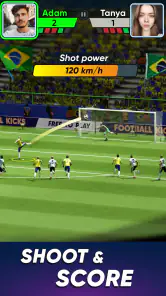
Analysis by Reviewed
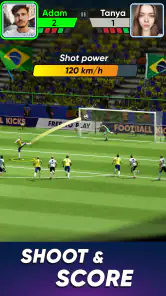
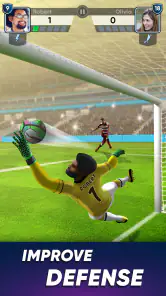
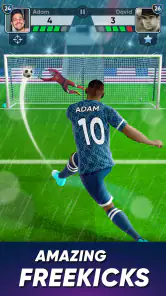
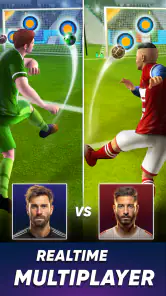
I approached Soccer Kicks Pro - Football as a quick sports game rather than a full football simulation, and that distinction matters from the first tap. Its focus is the penalty kick: line up the shot, choose your direction, and try to beat the goalkeeper with a clean finish. I found the idea easy to understand, which makes it a comfortable starting point for someone who wants a simple football challenge without learning a large control system.
The game is listed as a sports title from INLOGIC PREMIUM - football soccer tennis sport. It costs $0.99, carries an Everyone age rating, and supports devices running Android 7.0 or later. The current version is 2.2.11, while its release date was October 21, 2022. Those details make it especially approachable for families and for players using an older compatible phone, although the experience is best judged as a focused penalty-shooting game rather than a replacement for a complete match simulator.
Getting comfortable with the penalty-kick format
The first useful thing to understand is that the appeal comes from repetition. You are not managing a squad, building a long season, or controlling every pass across a pitch. The central question is much narrower: can you turn a brief chance into a goal? That gives the game an immediate rhythm. I can open it when I have only a few minutes, make several attempts, and stop without feeling that I have abandoned a complicated match halfway through.
That simplicity is also the main trade-off. Players who enjoy the tactical depth of a traditional football game may find the scope limited. There is no reason to install this expecting the strategic variety of a full eleven-a-side title. Its strength is the small decision inside a penalty situation, where a little adjustment can change a miss into a satisfying goal.
The store summary presents it as a soccer game built around scoring a powerful penalty, with a mini-soccer feel. In practice, I would describe it as a compact arcade-style football experience. The wording may suggest a broad collection of soccer activities, but the useful mental model is more specific: this is a game for practicing and repeating the finishing moment.
The average rating is 3.0 from around 477 ratings, with about 48 written reviews, and the game has passed 10K+ installs. I would not treat those figures as a verdict by themselves. They do, however, suggest that expectations are mixed, so I recommend approaching it for its short penalty challenges rather than assuming it will offer the breadth of a major football franchise.
What I would expect before the first kick
Before starting, I would put the phone in a comfortable position and avoid treating the first attempt as a serious test. The opening shots are more useful as orientation than as a score chase. Watch how the aiming gesture responds, notice how much movement is needed, and learn whether your natural swipe is too quick or too wide.
A practical tip is to use the first few kicks to establish a repeatable motion instead of trying a different technique every time. If one attempt goes left, do not immediately swing dramatically in the opposite direction. Make a smaller correction and compare the result. This turns the early part of the game into a simple feedback loop, which is more helpful than relying on luck.
I also recommend playing with the phone held steadily rather than shifting it during the gesture. Penalty games are sensitive to small changes in hand position, and an unstable grip can make an accurate attempt feel random. A two-handed hold, with one hand supporting the device and the other making the shot, gives better control when you are learning.
From installation to the first meaningful success
For a first-time user, the path is straightforward: install the game on a compatible Android device, open it, and begin with an exploratory attempt. Since the minimum operating system is Android 7.0, the compatibility requirement is not especially demanding for many older devices. The $0.99 price also makes the decision simpler than a large paid football game, particularly if your goal is a small, focused experience rather than a major time commitment.
Once the first kick is available, I would aim at a safe area instead of immediately attempting the most dramatic corner shot. A successful basic goal teaches more than an ambitious miss because it confirms how the input behaves and gives you a reference for later adjustments. After that, start moving the target gradually. Try one side, then the other, and notice whether your hand tends to over-correct.
My first meaningful success would not be a spectacular goal. It would be scoring twice with similar gestures. Repeating an outcome is the point at which the controls begin to feel understandable. If you can reproduce a decent shot, you have moved beyond guessing and can start working on placement, timing, and confidence.
One non-obvious advantage of this approach is that it separates control learning from pressure. Many players chase the corner immediately, then decide the game is inconsistent when the shot misses. By beginning with modest placement, you can identify whether the problem is your aiming motion or the goalkeeper’s response. That distinction saves frustration and makes the game feel fairer during the first session.
A realistic everyday use case
I can see myself using this while waiting for a bus, taking a short break between tasks, or sitting with a friend who wants a quick football-themed distraction. It suits moments when starting a full match would be inconvenient. A few penalty attempts create a clear beginning and end, so the game does not demand a long uninterrupted session.
It can also work as a small challenge between family members. Because the age rating is Everyone and the basic objective is immediately recognizable, a younger player does not need to understand formations or football statistics before joining in. An adult can help with the first aiming attempts, then let the child experiment with different shot directions. The limitation is that the experience may become repetitive sooner for players who need a lot of changing content.
For that reason, I would use it as a short-session game, not as my only sports title. It fills the gap between a casual time-killer and a full football simulation. If I wanted a deep career mode, realistic team management, or complete matches, I would choose a different category of game. If I wanted to practice quick decisions without investing a large amount of time, this format makes more sense.
Where new players can become confused
The most likely confusion is assuming that a penalty kick is only about selecting a direction. In reality, the quality of the attempt depends on how consistently you make that choice. A very forceful gesture may feel as though it should produce a stronger shot, but power without control is not useful if it sends the ball away from the intended area. I had better results when I treated the movement as a precise instruction rather than a dramatic swipe.
Another common mistake is changing too many variables at once. If you alter your starting position, the speed of your gesture, and the target direction after every miss, you learn nothing from the result. Keep two elements stable and change only one. For example, aim at the same general side while making the gesture slightly slower. This is a simple method, but it turns repeated attempts into practice rather than a series of unrelated guesses.
Players may also wonder whether a missed shot means the game is unresponsive. Before reaching that conclusion, I would check my grip and the path of my finger. A cramped hand can produce a short or uneven movement, especially on a small screen. Cleaning the screen and playing with a relaxed finger can help as well, not because the game requires special equipment, but because penalty aiming rewards consistency.
The phrase “super goal” can create the wrong expectation. I would not interpret it as a promise that every attempt will feel like a spectacular highlight. The satisfying moments come from placing the ball well and improving your own accuracy. If you want constant cinematic action, this may feel restrained. If you enjoy seeing a small skill improve over several attempts, the narrower design is easier to appreciate.
How I would handle a losing streak
When several shots fail, I would stop chasing the hardest target and return to a simple placement. That reset is more productive than repeating the same exaggerated motion. I would also take a short break if my gestures had become tense. In a game built around one central action, frustration quickly affects the action itself, so a minute away from the screen can be more useful than another rushed attempt.
A helpful personal rule is to judge progress by control, not only by the scoreboard. If a shot travels where you intended but is saved, that is different from sending it in the wrong direction. The first result suggests that your input is becoming reliable; the second suggests that you should keep working on the gesture. This way of reading the outcome gives the game more depth than simply labeling each attempt a win or loss.
There is also a trade-off between safe shots and ambitious ones. Safer placement can help you build a rhythm, while difficult corner attempts provide a stronger sense of achievement when they work. I would alternate between them instead of using only one approach. That keeps practice useful without turning every attempt into a high-pressure gamble.
How it compares with ordinary football alternatives
Compared with a full football simulator, this game is much easier to enter. You do not need to memorize player roles, learn defensive controls, or commit to the length of a complete match. That makes it a better fit for someone who mainly likes the drama of penalty kicks. The cost is a smaller range of decisions and less variety once the central action becomes familiar.
Compared with free casual football games, the $0.99 purchase changes the value calculation. A player who dislikes ads or complicated progression may prefer paying once for a narrow experience, but only if penalty shooting is genuinely the part they enjoy. Someone looking for a broad free game with several modes may receive more variety elsewhere, even if the controls take longer to learn.
It also differs from realistic sports games in tone. The mini-soccer presentation and compact structure make it feel more like an accessible arcade challenge than a simulation of professional football. I would recommend it to a beginner who wants an uncomplicated first step, especially if the idea of managing an entire team feels intimidating. I would skip it in favor of a larger title if realistic physics, licensed teams, online competition, or long-term progression are the main reasons I play football games.
The developer name, INLOGIC PREMIUM - football soccer tennis sport, places the game within a broader sports-oriented identity, but I would still evaluate this particular title on its penalty-kick loop. A developer’s wider catalog does not change the central question for a new user: do you want repeated short attempts, or do you want a complete football package? Answering that honestly prevents most disappointment.
Who will get the most from it
I think it is best for casual players, football fans who enjoy penalty shootouts, families looking for an easy-to-explain game, and anyone who prefers short sessions. It is also suitable for a first-time mobile sports player because the objective is familiar even if the player has never used a football game before.
I would be more cautious recommending it to someone who needs constant novelty. The focused design can be a strength during a quick break, but it can become a weakness during a long sitting. Likewise, competitive players who want detailed rankings, team construction, or a deep progression system should look toward a more comprehensive sports game.
The Everyone rating makes it broadly accessible in terms of age classification, but accessibility in practice still depends on the player’s comfort with touch aiming. A child may understand the goal immediately yet need a few guided attempts to control the direction. That is not a major barrier, though it is worth knowing before handing over the phone and expecting instant accuracy.
My practical recommendation after learning the basics
After the first successful goals, I would create a small routine: begin with a controlled shot, try a more demanding placement, and finish with the technique that feels most reliable. This gives each short session a purpose. It also prevents the game from becoming an endless series of identical attempts because you are deliberately comparing safe and risky choices.
Another useful habit is to remember the gesture that produced a good result. You do not need to write anything down; simply repeat the same starting posture and movement before experimenting again. Over time, this creates a personal baseline. From there, you can make small changes instead of starting from zero every time you play.
If the game feels too easy after a while, increase the challenge through your own shot selection rather than expecting a completely different football experience. Aim closer to difficult areas, use less familiar directions, and try to score consistently instead of celebrating one lucky goal. This self-imposed structure is important because the game’s appeal comes from refining the central action, not from managing a large collection of systems.
On the other hand, if you find yourself wanting full matches after only a few sessions, take that as useful information. This title has probably done its job as a quick introduction to mobile football controls, but a larger simulator will suit your interests better. I would not recommend forcing yourself to enjoy a narrow game when what you really want is team strategy and match variety.
Overall, Soccer Kicks Pro - Football is a modest, focused sports game that makes sense when you want penalty practice in short bursts. Its approachable age rating, low entry cost, and Android 7.0 compatibility make the first step uncomplicated. The current version, 2.2.11, gives the game a clear point of reference for installation, while its 3.0 average shows that it is not a universal favorite.
My honest advice is to install it with the right expectation: treat it as a compact penalty challenge, not a complete football simulator. Start with controlled gestures, use early attempts to learn the response, and measure progress by repeatable accuracy. If that small loop sounds enjoyable, the game can provide a pleasant few minutes at a time. If you need deep tactics, broad modes, or long-term team management, your money and time will be better spent on a more expansive football alternative.
Pros
- Simple controls make it easy to start playing quickly.
- Short matches are convenient for quick gaming sessions.
- Offline play is useful when no internet connection is available.
- Multiple challenges provide goals beyond basic shooting practice.
- Responsive ball physics make well-timed shots feel satisfying.
Cons
- Progress can feel repetitive after mastering the main shooting mechanics.
- Some advanced content may require in-app purchases or extra effort.
- Difficulty spikes can make later challenges frustrating.
- The game may occupy considerable storage on older devices.
- Ads can interrupt the experience
- especially between attempts.

- Category
- Sports
- Version
- 2.2.11