Rush To Home
- 27.00
- 4.4
- Installs
- 10.00M
- Price
- Free

Screenshots
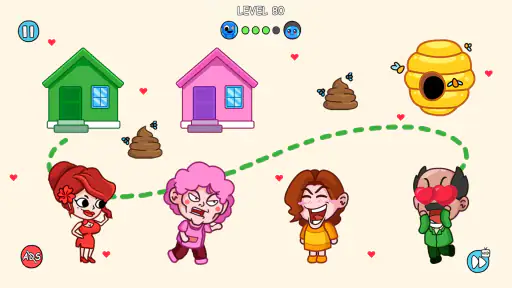
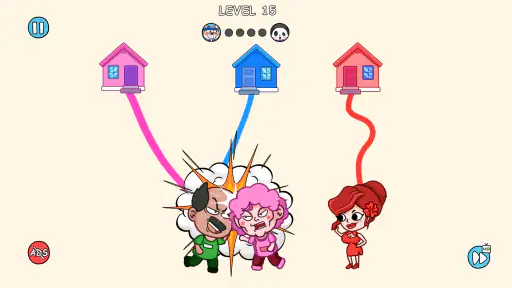

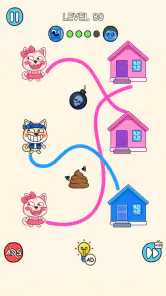
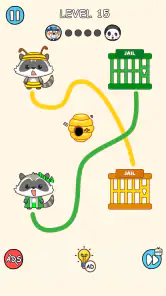



Analysis by Reviewed
When I want a quick, low-pressure puzzle rather than a long gaming session, Rush To Home is an easy one to pick up. It is a casual game from XGame Global built around drawing a route to a toilet, so the central idea is immediately clear: look at the situation, sketch a path, and try to get the character where they need to go. I like that simple premise because it gives each attempt a clear goal without asking me to learn a complicated set of rules first.
A simple routine for each puzzle
My basic approach is to pause for a moment before drawing. I check where the character starts, where the destination sits, and what might make a direct line fail. Then I trace a route that looks workable instead of rushing to scribble the first line that comes to mind. That small habit makes the game feel more like a quick visual puzzle than a test of drawing speed, and it gives me a better chance to spot an awkward turn before committing.
That makes it handy in ordinary gaps in the day: I can play a little while waiting for a drink, sitting through a short break, or winding down before bed. It suits players who enjoy bite-sized challenges and don’t need a story or a large world to explore. If you prefer deep strategy, lengthy levels, or a game that rewards a long uninterrupted session, this deliberately narrow idea may wear thin sooner.
A realistic use for it is a short wait when I have one hand free and only a few minutes to spare. I can study the layout, make a considered drawing, and stop after an attempt without needing to remember a complicated plot or a chain of objectives. It is less suitable when I need a game that can be played almost without looking; the route is the puzzle, so attention matters more than simply tapping through.
Getting Started with Rush To Home
So, the first thing I noticed when I opened Rush To Home was its user-friendly interface. It’s straightforward, without a lot of unnecessary clutter, which is a breath of fresh air in a world full of overly complicated apps. The setup process is super simple—just a few taps and you’re on your way. It’s designed to help you plan your routes to avoid traffic, suggest the best times to leave, and even find the quickest shortcuts to get you home faster. Seriously, it’s like Google Maps on steroids!
What to check before settling into a rhythm
Because the core action is drawing a route, the most useful “setting” to check is how the game responds to your gestures and how clearly you can see the available path. I’d try a short, cautious line first rather than making a sweeping mark across the screen. If a route doesn’t work, I change one part at a time—such as the angle or the order in which I approach a turn—so I can tell what made the difference. This is a practical way to learn the puzzle’s boundaries without assuming there are hidden controls or special tools.
For a relaxed session, I also recommend playing when you can look at the whole screen comfortably. A rushed glance can make a path seem obvious when it actually cuts across a problem area. The game’s simple premise is a strength, but it still asks for a little attention: if you’re trying to play while distracted, a failed attempt can feel less like a puzzle and more like a missed tap.
More From Our News Desk

Clash of Clans Is Won Between the Battles

Android Auto Makes the Case for Quieter Car Software

MobiOffice: Transforming Mobile Productivity with Seamless Integration

EA SPORTS FC™ Mobile Soccer: Redefining Mobile Sports Gaming

How Microsoft OneDrive Became a Mobile Productivity Giant

How Google Translate Breaks Language Barriers Effortlessly
There is no need to invent a settings routine for a game whose appeal is the direct drawing interaction. I would focus on practical conditions instead: make sure the play area is visible, avoid drawing before you have traced the route with your eyes, and keep your finger movement controlled. These habits matter most on a small screen, where a line that looks clean in your head may be harder to place precisely than expected.
Features That Stand Out
One of the features that really caught my attention was the real-time traffic updates. The app uses live data to provide you with the most current traffic conditions, which means you’re less likely to end up stuck in a jam. And if you’re someone who loves options, you’ll appreciate the alternative route suggestions. It’s almost like having your very own navigator brainstorming backup plans on the fly.
Another cool feature is the estimated time of arrival notification. You can share this with your friends or family, so they know exactly when to expect you. It’s a nifty little feature that adds a layer of convenience that I didn’t know I needed.
Small habits that make attempts more useful
I get more out of a puzzle when I treat each failed route as feedback rather than immediately repeating the same drawing. I look for the point where my line became too tight or crossed an obstacle, then redraw with that specific issue in mind. This is especially useful when I’m playing in short bursts: remembering one lesson from the last attempt gives the next one a purpose, even if I only have time for a few tries.
One helpful pattern is to divide the drawing into stages mentally: identify the start and destination, inspect the space between them, then choose the broad direction before worrying about the turns. That prevents me from making a neat-looking line that ignores the shape of the puzzle. If a route fails, changing just one bend or approach keeps the next attempt informative; changing the whole drawing makes it harder to know what I learned.
Compared with many casual games that rely on matching, tapping rapidly, or collecting items, this one puts the emphasis on planning a visible path. That makes it a nice change of pace if I want something more hands-on than a passive time-killer. The trade-off is that the premise has a narrower range than a collection of different mini-games; whether it stays engaging depends on how much you enjoy solving route-drawing challenges.
Performance and Usability
In terms of performance, I found the app to be pretty smooth. There were no noticeable lags or crashes during my time using it, which is always a good sign. The app loads quickly, and the transitions between screens are seamless. It’s definitely optimized for both Android and iOS, so you won’t feel left out regardless of the device you’re using.
Usability is another area where Rush To Home shines. The interface is intuitive, with all the major features easily accessible from the main screen. You don’t have to dig through a bunch of menus to find what you’re looking for, which is a huge plus in my book.
Its straightforward interaction also makes it easy to hand the phone to someone else and explain the goal in a sentence. That can turn a spare moment into a small shared challenge: one person studies the route while another points out a likely snag. I would treat that as informal turn-taking rather than expecting a dedicated competitive or cooperative mode; the enjoyable part is comparing how each person reads the same path.
Who it suits, and where its limits show
I’d point this toward someone who likes clear objectives, quick retries, and puzzles that can be understood at a glance. It can also work as a shared little challenge: one person suggests a route, another spots a possible snag, and then you test the drawing. That kind of casual back-and-forth is a better fit than expecting a full multiplayer experience; the appeal here is the puzzle itself, not a sprawling social feature set.
On the practical side, the game is free to download, carries an Everyone 10+ age rating, and has optional in-app purchases priced from $1.99 to $5.99 per item. I’d start with the free experience and decide for myself whether any purchase is worthwhile rather than treating spending as part of the basic way to play. Its 4.4 average from around 23,000 ratings and over 10 million installs suggest broad interest, but those figures don’t tell me whether its particular drawing puzzles will suit my taste.
The game was released on June 15, 2023, and version 1.0.16 is the current version. It supports Android 7.1 and later. If you’re choosing between this and a more conventional casual game, I’d pick this when I want to think through a route; I’d choose a match or word game instead when I want varied puzzle types or a more familiar progression loop.
The clearest trade-off is focus. A match game may offer different boards and a more familiar sense of collecting progress, while a word puzzle tests recall and vocabulary. Here, the drawing itself is the main attraction, so the satisfaction comes from seeing a workable route rather than switching between unrelated activities. That makes it a good fit for a player who enjoys spatial thinking, but a weaker choice for someone who needs a steady stream of new mechanics to stay interested.
It is also worth separating the game’s playful toilet-themed goal from a practical travel tool. I would not open it to plan an actual commute or check road conditions; its route-drawing premise belongs to a puzzle, not navigation. If the goal is getting somewhere in real life, a dedicated map app is the sensible choice. If the goal is a quick, slightly silly route challenge, this game is the one to consider.
For a younger player, the Everyone 10+ rating is a useful starting point for deciding whether the humor and presentation are appropriate. I would still make that call based on the person who will play, rather than assuming the rating means every family will feel the same way. The game’s basic idea is easy to explain, but the toilet-focused theme will not appeal to everyone, especially players who prefer a more neutral puzzle setting.
Final Thoughts
All in all, Rush To Home is a solid app that delivers on its promises. It’s perfect for anyone who’s constantly on the move and needs a reliable tool to help manage their daily routes. While it might not replace your favorite navigation app entirely, it’s definitely a worthy companion to have on your phone. Give it a try and see how it can make your daily commute a little less stressful.
So, if you’re tired of getting stuck in traffic and want an app that’s got your back, check out Rush To Home. It might just become your new best friend on the road.
My verdict after getting the hang of it
For me, the best way to judge this game is to give its central mechanic a fair chance: take a second to read the puzzle, draw deliberately, and use mistakes to adjust the next route. That repeatable rhythm makes it a pleasant choice for short breaks, especially if I’m in the mood for a small problem with an immediate goal. I wouldn’t choose it when I’m looking for a broad campaign or lots of different activities, but as a focused casual diversion, its straightforward idea is easy to appreciate.
I would recommend it to a friend who likes tracing a solution and does not mind repeating a puzzle to improve a line. I would steer someone toward a word game, a match puzzle, or a larger adventure instead if they want more variety, a substantial progression system, or a world to explore. Its strongest quality is also its boundary: it keeps returning to one clear kind of challenge.
For anyone deciding whether to keep playing after the first session, I’d use a simple test: do you enjoy planning the line before drawing, and does correcting a failed route feel satisfying rather than tedious? If yes, the game’s focused format can make it a useful little break. If the answer is no, there is no need to force it; the casual genre has plenty of alternatives built around different kinds of thinking.
Rush To Home Frequently Asked Questions
What does Rush To Home ask you to do during a puzzle?
Rush To Home centers on drawing a route to reach the toilet, giving each puzzle a clear, easy-to-grasp goal. The appeal is in working out a path that gets the character where they need to go. If you enjoy casual games built around simple visual challenges, this premise may be a good fit; it is less suited to someone looking for a deep story or a complicated simulation.
Is Rush To Home easy to pick up for a first-time player?
The game’s central idea is straightforward: draw a path to the toilet. That makes it easy to understand what you are trying to do, even if finding a workable route takes more thought. Its casual style may suit players who want a game they can approach without learning a complicated set of rules, while the puzzle-solving aspect gives each challenge something to think about.
Who makes Rush To Home, and what kind of app is it?
Rush To Home is a casual game from XGame Global, built around the simple idea of drawing a route to help reach the toilet. Its basic premise makes it easy to understand at a glance, while the challenge comes from finding a workable path through each puzzle. It may appeal to players looking for a quick, lighthearted game rather than a complex adventure.
Is Rush To Home free to download, and what should I know about optional spending?
Rush To Home is free to download, so you can try the casual game without paying upfront. It also offers optional in-app purchases, priced from $1.99 to $5.99 per item, for players who want to spend on extras. If you prefer not to make purchases, check your device’s purchase settings before handing it to a child or another player.
What kind of game is Rush To Home, and who developed it?
Rush To Home is a casual game from XGame Global, built around the simple idea of drawing a route to help reach the toilet. Its basic premise makes it easy to understand at a glance, while the challenge comes from finding a workable path through each puzzle. It may appeal to players looking for a quick, lighthearted game rather than a complex adventure.
Pros
- User-friendly interface
- Engaging graphics
- Wide range of levels
- Regular updates
- Multiplayer support
Cons
- In-app purchases required
- Occasional bugs
- Requires internet connection
- Ads can be intrusive
- Limited offline features

- Category
- Casual
- Version
- 1.0.16