NHRA Legends of Drag Racing
- 270.00
- 4.4
- Installs
- 50.00K
- Price
- Free
Screenshots
Analysis by Reviewed
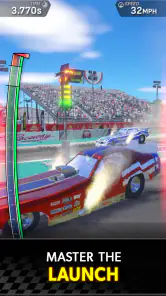
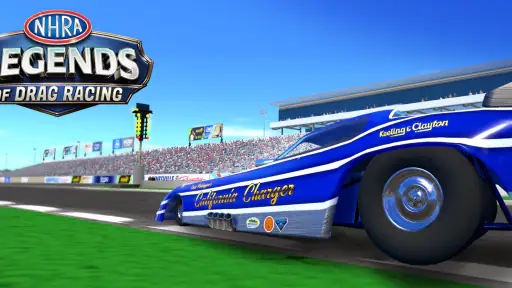
I went into NHRA Legends of Drag Racing expecting a quick, focused racing game, and that is exactly where it makes the most sense. This is a free Android racing game from Concrete Software, Inc. built around NHRA-style drag racing rather than open-world driving or long circuit events. The appeal is the short burst: line up, launch, manage the run, and try to turn a small improvement into a better result.
That focus gives it a clear identity. You are not downloading a broad driving sandbox with several unrelated activities. You are getting a game aimed at people who enjoy the tension of a straight-line race and the satisfaction of refining a repeatable routine. I found it easiest to appreciate when I treated each run as a small experiment instead of expecting a full console-style racing career.
The game is free to start, rated for Everyone, and supports devices running Android 8.0 or later. It has reached over 50 thousand installs and holds a 4.4 average from more than 500 ratings, with over 200 written reviews. Those numbers suggest a modest but engaged audience rather than a huge mainstream racing community. The current version is 1.14.0, so this is a title worth judging as an actively presented product rather than an abandoned experiment.
How the current version feels to play
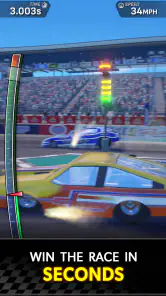
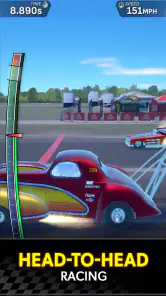
The central strength is concentration. A drag race does not give me much time to recover from a poor start, a mistimed shift, or an ineffective setup choice. That makes every attempt feel readable: I can usually identify the moment where the run went wrong, then try to correct it immediately. Compared with a conventional lap racer, there is less scenery to admire and less room for improvisation, but there is also less wasted time between attempts.
I particularly like this format for short sessions. If I have a few minutes while waiting for an appointment or taking a break, I can play without committing to a long event. A useful everyday routine is to make a handful of runs, focus on one part of the launch or gear timing, and stop once the results become consistent. That approach feels more productive than repeatedly tapping through races without thinking about what changed.
The official NHRA theme also gives the game a more specific flavor than a generic street-racing title. It is aimed at players who recognize the drama of professional drag racing and want that idea translated into a mobile format. I would not choose it for realistic touring-car competition, cornering technique, or free-roaming exploration. Its lane is narrower, and the game is better when it stays in that lane.
One practical point is that the short race structure can be both a benefit and a limitation. I can restart my learning loop quickly, but players who need variety in track layouts, driving styles, or race objectives may find the experience repetitive sooner than they would in a circuit racer. The game asks me to enjoy refinement: small improvements in execution matter more than constant changes of scenery.
More From Our News Desk

Weather by Xiaomi Review: Clear at a Glance, Less Clear Up Close

X Under Pressure: Can It Recover When Posting Goes Wrong?

Clash of Clans Is Won Between the Battles

Android Auto Makes the Case for Quieter Car Software

MobiOffice: Transforming Mobile Productivity with Seamless Integration

EA SPORTS FC™ Mobile Soccer: Redefining Mobile Sports Gaming
What the progression demands from the player
Drag racing looks simple from a distance, but the simplicity makes mistakes visible. There is no corner to blame for losing momentum and no long lap in which to recover. I recommend approaching the early sessions as practice for consistency rather than as a race to unlock everything immediately. Watch how a run feels, remember what you changed, and avoid changing several things at once. That makes it easier to understand whether a better result came from your timing or from a vehicle adjustment.
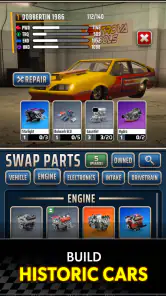
A less obvious advantage of this method is that it protects in-game resources. When a game includes upgrade or customization decisions, spending impulsively can make the next stage feel harder to interpret. I prefer to keep a stable baseline, test one meaningful change, and compare the outcome over several attempts. Even without turning the game into a spreadsheet, this workflow makes the racing more understandable and reduces the feeling that progress is random.
Another useful habit is to separate “fastest possible run” attempts from “reliable run” attempts. A risky launch may occasionally produce an exciting result, but a repeatable launch is more valuable when progress depends on winning several events. I found that thinking like a tuner rather than only like an arcade player makes the game more rewarding. It turns quick races into a small process of diagnosis and adjustment.
Where it sits beside other mobile racing games
Most mobile racing alternatives fall into one of two broad groups: circuit racers that reward steering through corners, or arcade racers that emphasize spectacle, traffic, boosts, and rapid unlocks. NHRA Legends of Drag Racing occupies a different, more specialized position. Its straight-line format removes the steering challenge but increases the importance of timing and preparation. If you enjoy shaving fractions from a launch, that trade-off is welcome. If you want to weave through traffic or master a technical circuit, another type of racing game will suit you better.
It also differs from open-world driving games in how it uses your attention. There is no need to spend time traveling between activities or learning a large map before reaching the next race. That makes it more efficient for focused play, but it also means the game cannot provide the sense of discovery that makes a large driving world memorable. I see it as a companion to broader racers, not a replacement for every kind of driving game.
Against more simulation-heavy racing games, its appeal depends on what you want from realism. A drag-focused mobile experience can communicate the pressure of launch timing without requiring a wheel, a controller, or a long practice session around a circuit. The compromise is that the experience is built around a smaller set of driving decisions. Players who enjoy detailed handling models may find it too specialized, while players who like direct feedback may appreciate the clarity.
What changed for the current release
The current release is version 1.14.0, and the game’s release date is May 26, 2026. Those facts matter mainly because they frame the product as a current mobile title with a defined version to install, rather than an old game being circulated without a clear present state. I would still judge any update by how it affects the actual play loop: smoother access to races, clearer progression, and fewer interruptions matter more to me than a version number by itself.
I am careful not to treat a current version as proof that every possible issue has disappeared. A numbered update can indicate ongoing maintenance, but it does not automatically make a focused racing game broader or deeper. The important question for a returning player is whether the existing core remains enjoyable. If you already like short NHRA-themed runs, the current build is relevant because it is the version you will encounter today. If you disliked the narrow drag-racing format before, an update label alone is not a reason to expect a completely different game.
For new players, the current version also makes it sensible to begin with a clean learning routine instead of relying on old advice from another build. Menus, balance, or progression can change over time in mobile games, so I would test the opening experience personally and form a baseline before spending anything. That is especially important here because the game is free to download but includes optional purchases ranging from $0.99 to $99.99 per item.
How existing players should approach the free model
The free entry point is a genuine advantage for curious players. I can find out whether the drag-racing rhythm suits me without paying before I understand the game. At the same time, the purchase range means I would recommend patience. The best first question is not “What can I buy?” but “What part of my driving is actually holding me back?” If the problem is timing, a purchase will not teach the timing. If the problem is understanding the progression, more resources may only hide the underlying issue.
For an existing player returning after time away, I would first replay familiar events and check whether the car feels predictable. Rebuilding muscle memory is more useful than immediately chasing a difficult target. Keep notes mentally: was the loss caused by the launch, a shift, or a setup choice? This is one of the most practical ways to get value from a short-session game, because it turns each attempt into feedback instead of treating every result as a simple win or loss.
I also suggest setting a personal spending boundary before using the store. The game’s free structure makes it easy to sample, while the upper end of the listed purchase range is substantial enough that impulsive buying deserves caution. I would only consider spending after deciding that the core loop genuinely fits my habits. Players who prefer a completely uninterrupted experience should be particularly careful about whether the free progression pace feels comfortable before committing.
Remaining gaps and real limitations
The biggest limitation is the narrowness that also gives the game its identity. Straight-line racing can be exciting, but it does not offer the same variety as a game built around corners, weather, exploration, or multiple vehicle classes. If I play for long stretches, the repeated structure can become more noticeable. This is not a flaw that better graphics or a larger garage would automatically solve; the game needs enough meaningful decisions to keep the central format fresh.
Another limitation is the learning curve’s dependence on repetition. Players who want immediate, effortless victories may become frustrated because drag racing exposes small errors quickly. The game rewards attention, but that can feel demanding when I only want a casual race. I would skip it if my ideal mobile racer is something I can play with minimal concentration while watching something else.
The free-to-play structure is another point to weigh. Optional purchases can be convenient, but they create a different experience from a one-time paid game. Someone who prefers to buy once and receive a fully open progression path may be happier with a premium racing title. Someone who wants to try the game first, accepts gradual progress, and can ignore optional spending will find the model easier to live with.
Device compatibility is fairly broad for an Android game because the minimum requirement is Android 8.0, but compatibility alone does not guarantee that every older phone will feel equally comfortable. Drag racing depends on responsive input, so a device that struggles with touch response or performance can make timing feel worse than it really is. I would test the first sessions on the phone I plan to use before deciding whether a missed launch reflects my technique or the hardware.
Who should play it, and who should pass
I would recommend this game to NHRA fans, drag-racing newcomers who enjoy learning a precise routine, and mobile players who want races that fit into short breaks. It is also a good choice for people who like measurable self-improvement. The most satisfying moment is not necessarily a dramatic victory; it can be repeating a clean run after several inconsistent attempts and knowing that the improvement came from better decisions.
I would point elsewhere for players seeking a complete motorsport package. If you want long championships built around varied circuits, deep wheel-to-wheel tactics, or a large open world, a traditional circuit or open-world racer will provide more breadth. If you want a purely casual arcade experience with constant spectacle, this game may feel too focused. Its audience is the player who sees value in the run itself, not only in the amount of content surrounding it.
Age suitability is straightforward: the content rating is Everyone, which makes it a reasonable option for a broad family audience. Still, younger players may need help understanding purchase prompts and the difference between free access and optional items. The racing theme is approachable, but the patience required for repeated practice is something parents may want to consider when choosing it for a child.
What I would watch in future updates
For future development, I would watch for improvements that deepen the drag-racing decision-making without diluting the quick-session appeal. More meaningful reasons to revisit older events, clearer explanations of why a setup change helps, and progression that rewards consistency would all strengthen the game. These are the areas that matter most because they support the core experience rather than simply adding unrelated activities.
I would also pay attention to how the game treats returning users. A good update should make it easy to remember what I was working toward and resume without confusion. Clearer feedback after a run would be valuable too: when I lose, I want to understand whether the issue was timing, preparation, or an unavoidable progression wall. That kind of information helps players improve without forcing them to spend.
My overall view is positive but specific. NHRA Legends of Drag Racing is best understood as a focused drag-racing game, not a universal replacement for every mobile racer. Its free starting point, Everyone rating, official NHRA direction, and compact run structure make it easy to try. The trade-off is repetition, a narrower range of driving skills, and a purchase system that calls for restraint.
I would install it if I wanted a racing game for short, concentrated sessions and enjoyed the idea of improving launch and run consistency. I would skip it if I needed open-world freedom, technical cornering, or a complete premium experience with no optional spending. After using it, I think its strongest quality is honesty of purpose: it knows that a drag race can be compelling when the preparation and timing matter. For the right player, that focused loop is enough to keep coming back.
NHRA Legends of Drag Racing Frequently Asked Questions
Is NHRA Legends of Drag Racing free to download, and what purchases are available?
NHRA Legends of Drag Racing is free to download, so you can try its drag-racing format without paying upfront. It offers optional in-app purchases, with individual items priced from $0.99 to $99.99. Consider reviewing purchase settings before handing your device to a child, and remember that spending is optional; the game is designed around racing and progression as well as its paid offers.
What devices and operating systems can run NHRA Legends of Drag Racing?
The game is available for Android and iOS devices, with Android 8.0 as the minimum operating-system requirement. Before downloading, check that your device is running a compatible version of its operating system and has enough available storage for installation. NHRA Legends of Drag Racing is a mobile racing game from Concrete Software, Inc., so you can look for it through the app store used by your device.
What is NHRA Legends of Drag Racing?
NHRA Legends of Drag Racing is a mobile racing game inspired by the National Hot Rod Association and the history of drag racing. It focuses on short, high-speed races where reaction time, tuning, and vehicle performance are important. Players can collect or upgrade drag cars, compete through different events, and experience a presentation built around the excitement of straight-line racing rather than traditional circuit tracks.
How does the gameplay work in NHRA Legends of Drag Racing?
The game is centered on launching your car correctly, shifting at the right moment, and improving performance through upgrades and tuning. Races are usually brief, but they still require concentration because a poor start or mistimed gear change can decide the result. Progress generally involves earning rewards from competitions and using them to make the car faster and more competitive in tougher events.
Can I play NHRA Legends of Drag Racing offline?
Offline availability may depend on the specific mode and version installed on your Android or iOS device. Some single-player functions may work without a constant connection, but online events, account features, advertisements, cloud progress, and certain rewards can require internet access. It is best to launch the game while connected at least once and check its in-game requirements before relying on it during travel.
Pros
- Authentic NHRA cars
- drivers
- and tracks create a convincing drag-racing atmosphere.
- Quick races make it easy to enjoy the game during short play sessions.
- Upgrade options add satisfying progression beyond simply winning individual races.
- Simple controls are accessible for newcomers while still rewarding good timing.
- The game captures the excitement of launches
- burnouts
- and quarter-mile finishes.
Cons
- Progress can feel repetitive once the available events and upgrades are familiar.
- Some improvements may require considerable grinding or repeated race attempts.
- The experience may feel dated compared with newer mobile racing games.
- Limited customization can disappoint players who want deeper tuning options.
- Performance and loading times may vary across older Android and iOS devices.
- Category
- Racing
- Version
- 1.14.0