Idle Bank Tycoon: Money Empire
- 4.63K
- 4.6
- Installs
- 10.00M
- Price
- Free

Screenshots




Analysis by Reviewed
I enjoy idle management games most when they give me small decisions to make without demanding constant attention, and a bank is a fun setting for that balance. Idle Bank Tycoon: Money Empire turns the familiar loop of earning, upgrading, and expanding into a light business simulation. Its strongest appeal is the visible sense of growth: you begin with a modest operation and work toward a larger banking enterprise. The trade-off is that progress still depends on repeating upgrade decisions, so players looking for a hands-on management game may find the routine too simple.
A bank-building game for short sessions
What I like about this setup is that it gives an idle game a setting with an intuitive goal. Improving a bank feels easy to understand: strengthen the operation, bring in more income, and use that growth to develop further. You do not need to be interested in real banking to follow the basic appeal. The theme gives the upgrades a sense of place, while the game remains focused on accessible progression rather than financial realism.
That distinction matters when choosing a simulation. This is not where I would go to learn how a real bank works, or to wrestle with complex financial decisions. It is a casual management game built around a business growing over time. If I want a game that asks me to keep track of many moving parts at once, a deeper tycoon or management sim would suit me better. If I want a clear objective I can pick up briefly, this style makes more sense.
The game is free to play, and the age rating is Everyone. Its current version is 1.56.0, and it requires Android 5.1 or later. Those details make it easier to judge whether it fits a device and household, but they do not change the central question: do you enjoy incremental progress and short upgrade decisions? I would decide based on that loop, not on the bank theme alone.
Building a bank one decision at a time
Starting off in Idle Bank Tycoon: Money Empire, you're handed the reins of a small bank. Initially, it might feel like you're just another number cruncher, but hold on – it gets exciting pretty quickly! The game does a fantastic job of easing you into the banking world, providing a smooth onboarding process that helps new players grasp the mechanics without feeling overwhelmed. The interface is intuitive, and the tutorial is both helpful and concise.
How the management loop develops
The core of the game revolves around building and expanding your bank. As you progress, you're tasked with upgrading various departments, managing staff, and investing in new technologies to maximize profits. One of the coolest features is the ability to unlock new branches, each with unique challenges and rewards. It’s like a mini-empire within an empire!
For me, the useful way to approach those choices is to treat each visit as a short check-in rather than trying to optimize every detail at once. I’d first look for the upgrade that seems to be holding back the bank’s growth, then spend on that before scattering resources across several departments. That simple habit makes the management feel more deliberate and helps keep the game’s many small decisions from turning into aimless tapping.
More From Our News Desk

Weather by Xiaomi Review: Clear at a Glance, Less Clear Up Close

X Under Pressure: Can It Recover When Posting Goes Wrong?

Clash of Clans Is Won Between the Battles

Android Auto Makes the Case for Quieter Car Software

MobiOffice: Transforming Mobile Productivity with Seamless Integration

EA SPORTS FC™ Mobile Soccer: Redefining Mobile Sports Gaming
Branch expansion also gives the growth loop a practical rhythm: improve the operation in front of you, then decide whether you’re ready to take on another one. If you enjoy seeing a business develop in stages, that progression is satisfying. If you prefer a simulation where every worker, customer, or financial choice needs close attention, this is a much lighter experience; its focus is on broad upgrades and momentum, not detailed banking procedure.
Why idle play suits everyday breaks
Moreover, the game has a nifty feature where you can actually go offline and still earn money. Yes, you heard it right! Your bank keeps generating income even when you're not actively playing. This idle aspect is a godsend for those of us who might not have the time to be glued to our screens all day.
That makes it easy to fit into an ordinary day. I can imagine checking in during a coffee break, collecting the benefit of time away, making a couple of upgrades, and closing the game again without needing to reserve a long session. The important trade-off is that offline earnings support the loop rather than replace it: coming back is still about deciding what to improve and how to keep the business moving.
A small but helpful routine is to avoid opening the game every few minutes just to watch the numbers change. The idle format is more satisfying when I let the bank run between visits and use each return to make a meaningful upgrade or consider expansion. That approach also suits anyone who wants a casual game that can be paused naturally, rather than one that expects constant attention.
Making brief visits feel worthwhile
A practical way to keep each session focused is to arrive with one question in mind: what would make the next stretch of growth feel easier? It might be a department that needs attention, a staff-related improvement, or the decision to keep building where you are instead of moving on. I would avoid treating every available button as an equal priority. The game’s appeal comes from watching a few sensible choices add up, and a short check-in can lose that satisfying shape if it becomes a sequence of taps without a reason.
This also helps answer a common concern about idle games: whether you need to stay active for them to be worthwhile. Here, the offline-income idea makes stepping away part of the intended rhythm, so I would not plan to keep the game open just to feel productive. It suits a commute break, a pause between tasks, or a quiet moment at the end of the day. The limitation is equally clear: if you want a game that rewards uninterrupted attention with demanding decisions, the idle structure may feel too hands-off.
Presentation and sense of progress
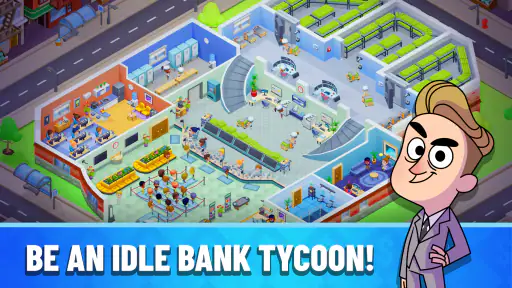
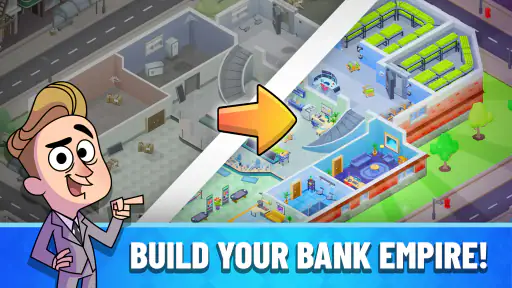
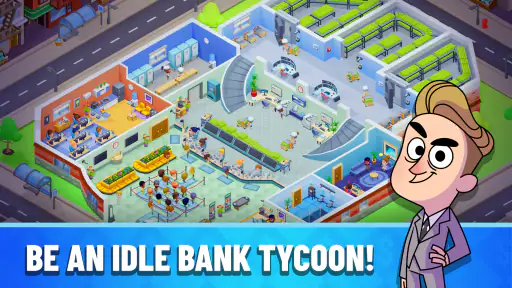
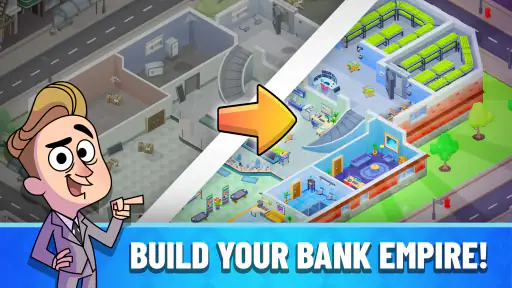
The visuals in Idle Bank Tycoon are vibrant and appealing, with a cartoony style that adds a touch of fun without being too over-the-top. The animations are smooth, and watching your bank grow from a humble building to a bustling headquarters is immensely satisfying. The sound design complements the visuals perfectly, with cheerful tunes that keep the energy upbeat as you manage your empire.
The presentation helps the numbers feel connected to a place that is changing, rather than leaving the whole experience as a row of abstract upgrades. That visual reward matters in an idle game: even when the underlying task is familiar, seeing the bank develop gives each stretch of progress a clear payoff. I would still treat the cheerful style as a matter of taste; anyone wanting a serious financial simulator should look elsewhere.
For me, the bank’s visible development is more useful than decoration alone. It gives a returning player an immediate sense of context: the operation has moved on, and there are new things to consider. That makes it easier to remember why I am spending resources, particularly when I have only a few minutes. Still, a pleasant presentation cannot make every repeated upgrade feel fresh. If the numbers and gradual changes are not enough to hold your interest, polished visuals will only soften that limitation, not remove it.
Strategy, events, and the limits of the formula
While the game is designed to be accessible, there's plenty of strategic depth for those who seek it. Balancing investments, managing your team efficiently, and deciding when to expand requires careful planning and foresight. It's this balance of simplicity and strategy that keeps players hooked, always wanting to optimize and improve their banks further.
Additionally, there are events and challenges that pop up, offering limited-time rewards and adding an extra layer of excitement. These events often require quick thinking and strategic decision-making, pushing you to think on your feet.
Events can give a returning player a reason to change the usual upgrade routine, but they also make the game less compelling for someone who wants every activity to be available at their own pace. I’d treat them as optional variety, not as a reason to feel behind. If a limited-time task clashes with your schedule, the core bank-building loop is still the main attraction; a game built around open-ended sandbox control may be a better fit if you dislike time-sensitive goals altogether.
Choosing when to expand
One useful trade-off to keep in view is the pull between making the current bank stronger and moving toward another branch. Expanding is an appealing sign of progress, but it can also shift your attention away from improvements that would make the operation you already have feel more developed. I would not rush into expansion just because it is the most visible next step. A short pause to compare the available upgrades with the appeal of moving forward can make the decision feel more like management and less like chasing the next milestone.
That approach is especially helpful if you prefer a calm pace. The game gives you reasons to keep improving, but it does not need to become a checklist you must clear in one sitting. If an event or a new objective happens to fit your playtime, it can add welcome variety. If it does not, I would return to the ordinary growth loop rather than letting a limited-time task dictate every session. Players who find timed goals stressful may be happier with a sandbox simulation that lets them set their own agenda.
Who will get the most from it
This is a good match for players who like watching a small operation grow and enjoy making quick, low-pressure choices between other activities. It can also work as a first step into management games: the bank theme gives upgrades a clear purpose, while the idle structure makes it approachable without asking for a long uninterrupted session.
I’d be less likely to recommend it to someone who wants realistic finance, deep staff simulation, or a constant stream of complex decisions. Compared with more hands-on tycoon games, this one puts more weight on gradual upgrades and passive progress; compared with very simple idle clickers, its departments and branches offer a little more shape to the growth. That middle ground is its strength, but it also means it won’t satisfy either extreme.
A realistic day-to-day use case is a player who likes a small game between errands but does not want to commit to a long campaign. They can open the bank, see how it has progressed, choose a useful improvement, and leave again. That is a better fit than a session-based strategy game if spare time arrives unpredictably. On the other hand, if you only enjoy games when each visit introduces a new mechanic or a major tactical puzzle, the repeated upgrade rhythm may feel thin after the early sense of discovery.
It also makes sense for someone who enjoys watching a single project develop rather than switching among lots of unrelated activities. The departments and branches give the bank a structure to return to, so the progress has more direction than a bare counter climbing on its own. But the game is not a substitute for an elaborate business simulator. I would skip it if detailed control over staffing, customer behavior, or financial systems is the reason I play management games in the first place.
If you’re deciding whether to try it, the practical question is whether you enjoy checking in on a growing business more than actively controlling every part of one. It is free to play, with in-app purchases ranging from $0.99 to $74.99 per item, so I’d keep optional spending separate from the basic question of whether the loop is enjoyable. It is rated for Everyone, and the current version is 1.56.0, with Android 5.1 as the minimum requirement.
The purchase range is worth keeping in mind before you start, especially if you prefer games with no optional spending at all. I would first play for the basic loop and decide whether it is enjoyable without treating purchases as a shortcut to progress. That is a sensible way to judge a free idle game: does the ordinary cycle of returning, upgrading, and expanding feel rewarding on its own? If it does, optional items are just that—optional. If the game only becomes appealing when you are tempted to spend, it is probably not the right match.
A measured recommendation
Kolibri Games has made a simulation that is easy to understand and easy to revisit. Its 4.6 average from around 536,000 ratings, alongside over 10 million installs, suggests it has found a broad audience, though popularity alone won’t make its repeating upgrade loop right for every player. I see its best quality as convenience: the bank can keep progressing while I’m away, and a short return can still feel productive.
Those figures offer useful context, but I would not use them as a promise that every player will enjoy the pace. The more personal test is whether I like turning a brief visit into one or two decisions and then letting the bank run again. If that is the sort of low-pressure routine I want, the game has a clear reason to stay installed. If I want careful control, long sessions, or a more realistic approach to business, I would choose a more involved simulation instead.
All in all, Idle Bank Tycoon: Money Empire is an engaging and rewarding experience that will keep you coming back for more. Whether you're a fan of idle games or just looking for something new to try, this game offers a delightful mix of strategy and fun. So why not give it a shot and see if you have what it takes to build your own banking empire?
Idle Bank Tycoon: Money Empire Frequently Asked Questions
Is Idle Bank Tycoon: Money Empire suitable for casual players who only check in occasionally?
The game is built around idle progress, so its banking-business theme can suit players who prefer to make decisions in short sessions rather than play continuously. Its premise is to grow a bank through management and incremental progress, with progress continuing while you are offline. You can return to the game, review how your business is developing, and decide what to improve next.
Can I play Idle Bank Tycoon: Money Empire without spending money?
Yes. The game is free to download and play, and purchases are optional. The paid options may help accelerate progress or provide special items, but the published gameplay description presents the experience as playable without them. If you choose to buy something, take a moment to review the price shown for that item and confirm the purchase carefully, especially if you share your device with someone else.
What kind of game is Idle Bank Tycoon: Money Empire, and who developed it?
Idle Bank Tycoon: Money Empire is a simulation game developed by Kolibri Games. Its premise is centered on building and growing a bank business, making it a fit for players who enjoy management and incremental progress. The game is free to download, and it is rated for Everyone, so its stated age category is suitable for a broad audience.
What is the main objective of Idle Bank Tycoon: Money Empire?
Idle Bank Tycoon: Money Empire is a simulation game where players aim to build a banking empire. The main objective is to manage and upgrade various bank branches, attract more clients, and maximize profits. Players must strategically invest in different business sectors and manage resources efficiently to grow their financial empire and become the ultimate banking tycoon.
How does the gameplay work in Idle Bank Tycoon: Money Empire?
In Idle Bank Tycoon: Money Empire, players start with a small bank and gradually expand by upgrading facilities and hiring managers. The game involves generating passive income through investments and improving bank operations. Players must make strategic decisions on where to allocate resources, which upgrades to purchase, and how to efficiently manage their growing empire. The game offers an idle gaming experience, meaning progress continues even when the player is offline.
Pros
- Engaging idle gameplay mechanics.
- Variety of bank operations to manage.
- Visually appealing graphics.
- Frequent updates with new content.
- Offline earning capabilities.
Cons
- Can become repetitive over time.
- Requires in-app purchases for quick progress.
- Advertisements can be intrusive.
- Limited customization options.
- Initial learning curve for new users.
- Category
- Simulation
- Version
- 1.56.0








