Honey Bee Life Simulator 3D
- 0.00
- 0.0
- Installs
- 100.00K
- Price
- Free
Screenshots

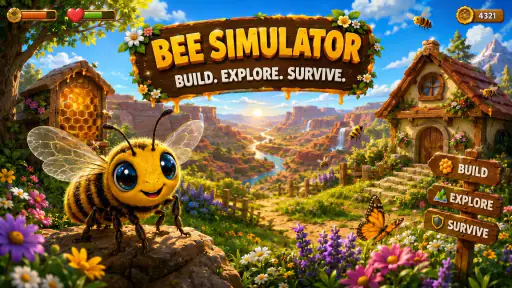
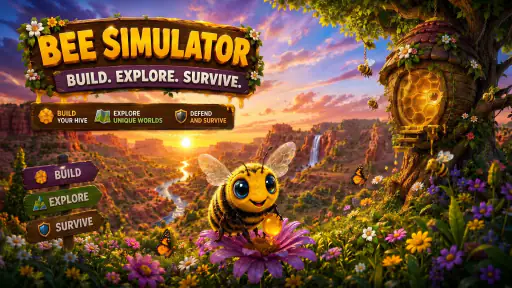

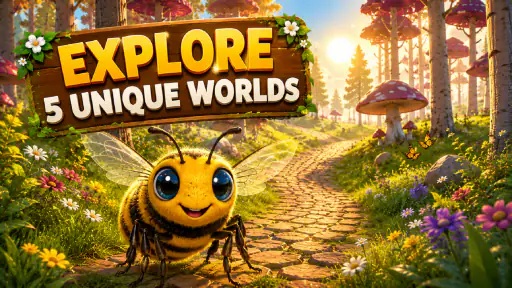
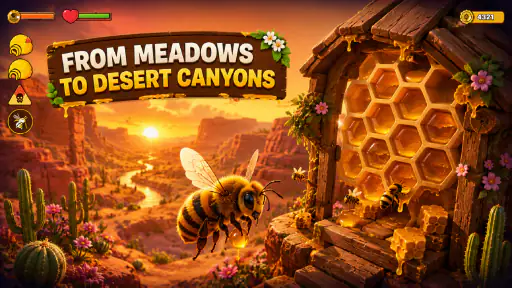
Analysis by Reviewed
Honey Bee Life Simulator 3D is the kind of adventure game I open when I want something gentle and easy to understand rather than a demanding action experience. I play as a honey bee, move through the hive and surrounding environment, gather nectar, and work toward growing the colony. That basic loop is immediately clear, and it gives the game a pleasant sense of purpose without asking me to learn a complicated control scheme first.
Developed by Games Astra, this free Android game is aimed at Everyone and currently sits at version 0.7. It has passed over 100 thousand installs, which suggests that the idea has found an audience among players who enjoy animal simulations and relaxed exploration. I would describe it as an approachable adventure game with light management ambitions: the bee is the focus, but the larger attraction is watching individual tasks contribute to the life of the hive.
What matters most here is not a dramatic plot or a deep competitive challenge. The appeal comes from having a small, understandable routine and seeing whether that routine remains enjoyable after the novelty of flying around as a bee fades. In my experience, the answer depends heavily on what you want from a simulator. If you like short sessions, simple objectives, and a friendly nature-themed setting, it has a reasonable chance of holding your attention. If you expect a detailed colony-management game or a demanding adventure, its lighter approach may feel limited.
How the first goals shape the experience
The opening idea is easy to grasp: explore, find nectar, bring your effort back into the colony, and use that activity to support expansion. I appreciate this because the game does not need a long explanation to make the first few actions meaningful. Even before I think about longer-term progress, I understand why I am moving through the world and what my next useful action should be.
That clarity is especially helpful for younger players and anyone who does not usually play simulation games. The Everyone rating matches the calm presentation and accessible premise. I can imagine handing the game to someone who enjoys animals but is not comfortable with complex menus. The bee identity provides enough context for the early tasks: flying out has a purpose, collecting has a purpose, and returning to the hive connects the two.
My advice is to treat the first session as a learning period rather than rushing to judge the whole game. I spend a little time noticing where useful resources appear, how the bee moves, and which routes feel less awkward. In a game built around repeated collection, a familiar route can make a bigger difference than frantic movement. This is one of the first practical habits I would recommend: learn the environment before trying to optimize it.
The early goals also work well as a low-pressure introduction to the colony theme. The game does not need to make every moment exciting if the routine itself feels satisfying. There is a small pleasure in completing an outing, returning to the hive, and feeling that the colony is moving forward. That feeling is modest, but it is more important here than spectacle.
Progress that is easy to read
Good simulator design depends on visible progress. When I collect nectar or complete a useful outing, I want to understand how that action helps me. Honey Bee Life Simulator 3D benefits from a straightforward relationship between activity and improvement: the things I do as the bee are connected to the larger goal of building up the colony.
This makes the game suitable for short everyday sessions. For example, I could play for a few minutes during a break, complete a collection run, and stop without feeling that I had abandoned a complicated campaign. The game’s structure lends itself to small objectives rather than requiring a long uninterrupted sitting. That is a real strength for mobile play, where convenience often matters more than elaborate storytelling.
At the same time, the progress signals need to carry enough weight to keep the routine interesting. If the only satisfaction comes from repeating the same trip, the sense of development can become thin. I found that my enjoyment improved when I gave each outing a specific purpose instead of flying around without a plan. A useful personal workflow is to decide whether I am exploring, gathering, or simply checking how the hive is developing before I begin.
That approach turns a loose sandbox feeling into a more deliberate session. It also helps reveal the game’s limits honestly. The colony theme creates expectations of layered organization, changing responsibilities, and strategic choices. Players who want those systems in depth may find the visible progress more decorative than strategic. Players who prefer a simple cycle will probably see the same design as pleasantly uncomplicated.
The most important progress tip is to judge each trip by what it contributes, not by how long it lasts. Long sessions are not automatically better. A short, purposeful collection run can feel more rewarding than wandering through the environment while waiting for something new to happen.
Unlocks, goals, and the rhythm of improvement
The central question for me is whether the game gives enough reason to continue after I understand the basic loop. Building the colony provides a natural long-term direction, but a direction is not always the same as a rich progression system. The experience is strongest when each improvement feels connected to the bee’s daily work rather than appearing as an unrelated reward.
I prefer progression that lets me notice a difference in how I approach the next outing. If an upgrade or development step changes what I can do, where I go, or how efficiently I work, it gives the collection loop renewed meaning. If it only provides a distant target without changing my decisions, the motivation becomes more passive. That distinction is important for anyone deciding whether this is a game to play regularly or simply a pleasant title to sample.
For younger players, the slower structure may be an advantage. They can focus on recognizing objectives and connecting actions with results without being pushed into a harsh failure state. For adults looking for a deeper management challenge, the same pacing may feel too forgiving. I would not choose this as a replacement for a detailed strategy game centered on production chains, resource balancing, or complex colony planning.
The game also works differently from a conventional adventure title. In a typical adventure, I expect a sequence of set-piece events, story beats, or increasingly difficult encounters. Here, exploration and collection are the main reasons to move through the world. That makes the experience calmer, but it also means that the quality of the progression loop matters more than narrative momentum.
Does the difficulty curve stay engaging?
Honey Bee Life Simulator 3D is not built around the kind of difficulty curve I associate with combat-heavy adventures. Its challenge comes more from managing attention, learning the environment, and deciding how to use each outing. That can be refreshing, especially when I want a game that does not punish every mistake.
The trade-off is that relaxed difficulty can become predictable. Once I understand how to move, gather, and return, the challenge may depend largely on whether I still enjoy repeating those actions. This is not necessarily a flaw. Some players use mobile games as a way to unwind, and an uncomplicated routine is exactly what they want. I simply would not recommend it to someone who needs constant surprises or a steadily escalating test of skill.
My practical suggestion is to set personal goals when the built-in challenge feels light. I might try to complete a run efficiently, explore an unfamiliar part of the environment, or focus on improving the colony in a measured way instead of collecting without direction. These self-imposed targets do not transform the game into a strategy title, but they can make the pacing feel more active.
There is also a useful distinction between difficulty and friction. A game can be easy while still being awkward to control or repetitive in its tasks. When I evaluate this title, I pay attention to whether a problem comes from my decisions or from the routine itself. If I am failing because I misunderstood an objective, that is a challenge I can learn from. If I am simply repeating a slow trip with little new information, that is pacing friction.
That distinction matters for families. A child may enjoy the freedom to explore, while an older player may quickly ask what changes from one session to the next. I think the game is better suited to relaxed discovery than to mastery. Its strongest audience is not looking for a leaderboard or a difficult campaign; they are looking for a friendly way to inhabit the role of a bee.
Retention pressure and the free-to-play question
The game is free to download, which makes it easy to try without committing money first. It includes in-app purchases priced from $14.99 to $19.99 per item, so I would encourage families to think about spending controls before letting a child play independently. The free entry is attractive, but the presence of relatively substantial individual purchases means that the payment side deserves attention even in an otherwise gentle game.
I do not view optional spending as automatically negative. The real issue is whether the core loop remains comfortable for someone who chooses not to buy anything. For me, that is the key test: can I enjoy exploring and collecting without feeling that progress is constantly pushing me toward a purchase? A free game is more satisfying when the unpaid path feels like a complete experience rather than a sample designed mainly to advertise extras.
This is also where retention pressure can affect the mood. A calm bee simulator should feel like a game I return to because the routine is pleasant. If reminders, locked improvements, or repeated prompts become the main reason I continue, the relationship changes from relaxation to obligation. I recommend playing in short sessions and deciding in advance whether I am enjoying the activity itself. That makes it easier to avoid spending simply because I have already invested time.
For a parent, I would treat the age rating and the purchase model as two separate considerations. The Everyone rating makes the theme broadly accessible, but that does not remove the need to manage purchases on a shared device. For an adult player, the question is simpler: the free version is a low-risk way to see whether the collection loop suits you, while the purchase options should be considered only after you know the basic routine has lasting appeal.
Compared with a paid adventure game, the free model lowers the barrier to entry but may create more uncertainty around long-term pacing. Compared with another casual simulator, the bee setting gives this title a distinctive identity, yet the value depends on how much depth you want from that identity. I would choose it over a generic idle game when I want to feel involved in the gathering process. I would choose a fuller management game when I want detailed planning and more meaningful trade-offs.
Who will enjoy the hive, and who should skip it?
I think this is a good match for players who enjoy animal-themed games, light exploration, and progress that can be understood without a manual. It is also a sensible option for short mobile sessions. The minimum operating-system requirement is Android 7.0, so it can suit people using older compatible devices rather than only the newest phones. That accessibility supports the game’s casual character.
I would particularly recommend it to someone who likes the idea of a simulation but finds traditional management games intimidating. The bee role provides an immediate fantasy, while the colony gives each outing a broader purpose. It can also be a pleasant choice for a child who wants to explore a virtual natural setting, provided an adult handles purchase permissions on the device.
I would skip it if I wanted a story-driven adventure, complex colony economics, intense survival mechanics, or a demanding skill curve. I would also be cautious if repetitive collection tasks quickly lose their charm for me. The game’s premise is appealing, but the premise alone cannot replace variety. Players who need frequent new mechanics should look toward a more expansive adventure or strategy alternative.
Another trade-off concerns control expectations. A bee simulator sounds like it should offer effortless freedom of movement, but mobile flying can still require adjustment. I recommend trying the controls in an open area before committing to longer objectives. If movement feels natural, the exploration becomes the game’s main pleasure. If it feels imprecise, the repeated gathering loop may magnify that irritation.
My progression verdict
After spending time with Honey Bee Life Simulator 3D, I see it as a modest, accessible adventure built around a clear fantasy rather than a deep simulation. Its early goals are understandable, its progress is easy to follow, and its relaxed difficulty makes it approachable. The strongest sessions are the ones where I choose a purpose, make a focused outing, and return to the hive feeling that the trip mattered.
Its weaknesses are tied to the same simplicity that makes it welcoming. Players may eventually want more variation, stronger strategic decisions, or a difficulty curve that tests them more directly. The free-to-play structure also means I would pay attention to the role of the in-app purchases before recommending it for unsupervised play. These are not reasons to dismiss the game, but they do define the audience it serves best.
My recommendation is to try it as a calm, short-session bee adventure, not as a full colony-management substitute. Games Astra has created a focused experience with an inviting premise and a low barrier to entry. If collecting nectar, exploring a hive, and watching a colony-oriented routine develop sounds relaxing, the game is worth testing. If you need deep unlocks, dramatic challenges, or constant novelty, I would look elsewhere rather than expecting this gentle loop to become something it was not designed to be.
Pros
- Relaxing gameplay with a gentle nature-themed atmosphere.
- Simple controls make it accessible for younger players.
- 3D environments provide a pleasant sense of exploration.
- Short sessions are convenient for casual mobile gaming.
- Bee-focused objectives offer a distinctive simulator concept.
Cons
- Gameplay may feel repetitive after completing the early objectives.
- Progression can be slow without frequent play sessions.
- Some device screens may make small objects difficult to spot.
- The simulator offers limited depth compared with complex management games.
- Ads or optional purchases may interrupt the overall experience.
- Category
- Adventure
- Version
- 0.7