DUST: Dirt ATV Offroad Racing
- 3.00
- 3.5
- Installs
- 50.00K
- Price
- Free

Screenshots
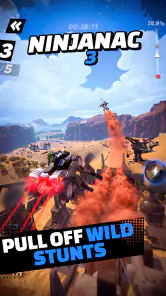
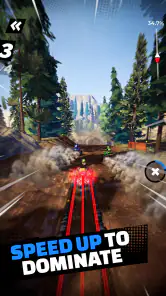
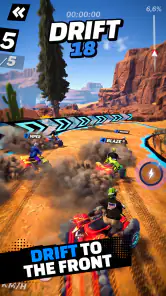

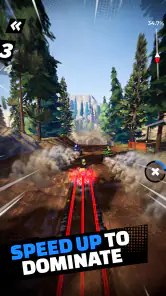
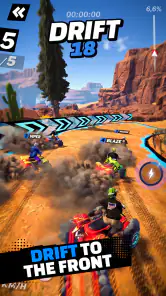

Analysis by Reviewed
I went into DUST: Dirt ATV Offroad Racing expecting a quick, messy off-road racer, and that is exactly where it makes the most sense. This free racing game from Vira Games Inc. puts an ATV quad bike at the center of its experience, with dirt, mud, and rough terrain providing the main character of every run. It is not trying to be a polished road-racing simulator. Its appeal comes from the feeling of wrestling with an all-terrain machine when the surface is uneven and the route looks hostile.
That focus gives the game a clear identity. You are not choosing between a large collection of unrelated racing disciplines; you are stepping into a compact off-road fantasy and seeing whether the controls, terrain, and challenge keep you interested. I found it easiest to enjoy in short sessions, especially when I wanted something more physical and unpredictable than a standard asphalt racer.
The game sits in the Racing category, is suitable for Everyone, and is free to play. Its current version is 1.0.9, and it requires at least OS 7.1. It launched on May 28, 2026, and has passed 50 thousand installs, with an average rating of 3.5 from 37 ratings and 3 reviews. Those figures suggest a modest but real audience rather than a huge established racing community, so I would approach it as a focused, lightweight off-road game instead of a major franchise alternative.
How the first rides establish the goal
The strongest early goal is simple: keep the ATV moving and learn how to handle the dirt without throwing away a promising run. That simplicity is useful because it lets you concentrate on the physical rhythm of racing. Instead of spending the opening moments comparing complicated vehicle statistics or studying a long upgrade tree, you can focus on steering, timing, and reading the ground in front of you.
For me, the first useful adjustment was to stop treating every section like a normal road. An off-road route rewards calmer inputs. A sudden turn or an overly ambitious correction can cost more than a small loss of speed, particularly when the surface makes the ATV feel less settled. I got better results by preparing for turns earlier and accepting that a controlled line is often more valuable than a dramatic burst forward.
That creates a practical early objective for new players: do not chase perfect runs immediately. First, learn which movements make the quad bike stable, which corners invite a wider approach, and where the terrain demands patience. This is a more satisfying starting point than simply holding the accelerator and hoping the route behaves like a paved circuit.
The game’s “DUST” identity also works best when you let the environment influence your decisions. Mud and dirt are not just decoration in the concept of the game; they set the expectation that traction and momentum matter. Even without turning the experience into a technical simulation, that framing encourages you to drive with awareness. I found myself looking farther ahead than I normally would in a casual racer because reacting at the last second is a poor strategy on rough ground.
More From Our News Desk

Weather by Xiaomi Review: Clear at a Glance, Less Clear Up Close

X Under Pressure: Can It Recover When Posting Goes Wrong?

Clash of Clans Is Won Between the Battles

Android Auto Makes the Case for Quieter Car Software

MobiOffice: Transforming Mobile Productivity with Seamless Integration

EA SPORTS FC™ Mobile Soccer: Redefining Mobile Sports Gaming
A realistic everyday use case is a short break between tasks. If I have only a few minutes, an ATV run gives me an immediate activity with a clear target: finish more cleanly, handle a difficult section better, or recover from a mistake without restarting my whole evening. It is a better fit for that situation than a large racing game that expects a long session before anything meaningful happens.
What counts as progress during a session
The progress signals here are more about performance and growing familiarity than about a heavily explained long-term journey. A cleaner run is meaningful because it shows that I have understood the terrain better. When I stop overcorrecting, take a turn with more control, or carry momentum through a rough patch, I can feel the improvement even if the game does not turn that moment into a major celebration.
That kind of progress is easy to overlook if you expect every racing game to provide constant unlocks, collections, or elaborate rewards. DUST works better when you judge advancement by how reliably you can manage the ATV. The route becomes less intimidating as your decisions improve, and that is the central satisfaction. It is a skill loop rather than a promise of endless content.
My advice is to use each attempt for one specific lesson. On one run, concentrate on braking before a turn. On another, focus on keeping the vehicle balanced over uneven ground. Trying to improve everything at once makes the controls feel more chaotic than they need to be. Breaking the challenge into small targets gives the game a clearer sense of momentum and prevents repeated failures from becoming meaningless.
There is also a useful distinction between surviving and racing well. A player can reach the end by making cautious decisions, but that does not necessarily mean the run was efficient. Once basic control feels comfortable, the next goal is to preserve speed without becoming reckless. That second stage is where the game can become more interesting for players who enjoy refining a route rather than merely completing it.
The most valuable progression is learning the terrain’s timing, not simply pushing the ATV harder. That is an important trade-off. Aggressive driving can feel exciting, but on an off-road course it can also produce a chain of mistakes. A slightly slower entry often leaves you in a much better position for the next section, while a careless shortcut in momentum can turn one error into a complete loss of control.
Where the difficulty becomes meaningful
The difficulty curve feels most convincing when it asks for better judgment instead of only demanding faster reactions. Dirt and mud naturally create uncertainty, so the challenge comes from combining steering with speed management. If you are used to conventional racing games where the ideal line is obvious and the road surface is predictable, this ATV-focused format may initially feel loose. I see that looseness as part of the appeal, although it can also make early mistakes feel less transparent.
When a run goes wrong, I want to understand why. Was I too fast, too late with a turn, or too aggressive with a correction? The game is most enjoyable when the answer feels connected to my input. Players who like learning through repetition should find that process rewarding. Players who want immediate precision and perfectly predictable handling may prefer a more traditional circuit racer.
I would not recommend approaching the harder moments by simply repeating the same input pattern. Off-road racing benefits from small adjustments. Enter a rough section with a little more room, leave yourself space for a correction, and avoid assuming that the line that worked once will always be the fastest choice. Surface changes make flexibility more useful than memorized button sequences.
One non-obvious trade-off is that cautious driving can make the game feel less exciting while it is actually helping you improve. New players may mistake restraint for failure because the ATV is not moving at maximum speed. In practice, maintaining control gives you more opportunities to learn the route. Once the track feels familiar, you can gradually increase aggression without turning every attempt into a gamble.
Another useful habit is to treat a failed run as information about pacing. If a mistake happens near the same kind of obstacle repeatedly, the problem may not be the obstacle itself. You may be arriving with too much momentum, or you may be using the same correction too late. Changing the approach before changing the entire strategy is often the smarter experiment.
Does the challenge keep the game alive?
The retention pressure in DUST comes from the desire to handle the ATV more confidently, but that pressure has a limit. A skill-based loop can be satisfying when each attempt reveals a clear improvement. It becomes thinner when a player is looking for a large progression system, a broad vehicle roster, or a steady stream of new objectives. I would not choose this game expecting the same long-term structure as a content-heavy racing title.
That does not make the experience unsuccessful. It simply means the game’s replay value depends heavily on your relationship with driving itself. If you enjoy repeating a route to improve your line, recover more cleanly, and maintain better control, the compact design can be appealing. If you need frequent unlocks to make another session feel worthwhile, the motivation may fade sooner.
The free price also makes it easy to test without committing money. For a casual player, that lowers the barrier to trying an off-road racer during a spare moment. I would still judge the game by whether its core handling feels enjoyable within the first few sessions, rather than assuming that a free download automatically justifies extended play. The central driving loop has to carry the experience.
Compared with the usual alternatives in mobile racing, DUST feels narrower but more focused. A conventional street racer generally emphasizes clean lanes, sharp cornering, and the satisfaction of speed on a predictable surface. A larger arcade racer may offer more cars, more modes, and more visible progression. DUST is better suited to someone who specifically wants mud, uneven ground, and the distinctive balance of an ATV rather than a broad collection of racing activities.
That comparison also clarifies who should skip it. If your favorite part of racing games is customizing a garage, comparing detailed vehicle statistics, or moving through a large career structure, this may feel too restrained. If you dislike repeating attempts to improve handling, the off-road focus may become frustrating. On the other hand, if standard road racing feels too clean and you prefer a rougher, more immediate challenge, the game has a clear reason to exist.
Practical ways to get more from the ATV
I found three habits especially useful. First, look beyond the next turn. The best line is often decided before the corner arrives, because entering with the wrong speed leaves little room to recover. Second, make corrections deliberately rather than stacking several quick movements together. On rough terrain, panic inputs tend to create a second problem before the first one is solved.
Third, separate learning sessions from score-chasing sessions. During a learning attempt, take the safer line and observe how the ATV responds. During a performance attempt, use that knowledge to carry more speed. Mixing both goals can make it difficult to tell whether a failure came from unfamiliar terrain or unnecessary risk.
These habits are especially helpful on a phone, where a short session can encourage rushed decisions. I would play with enough attention to see the route clearly and avoid treating the game as something to operate entirely on autopilot. The compact format invites quick play, but the off-road handling rewards a few focused minutes more than distracted tapping between notifications.
Another practical point is expectation management. The game is not at its best when judged as a complete racing ecosystem. It is at its best as a direct ATV challenge with a strong environmental theme. That narrower expectation makes the rough edges easier to accept and lets the central question stay simple: can the handling make another run feel worth attempting?
My verdict on the progression and pacing
For me, DUST succeeds when its goals remain close to the driving. The early aim is understandable, the useful progress comes from improved control, and the difficulty encourages more thoughtful pacing than a typical road racer. That gives the game a coherent loop: ride, notice a mistake, adjust the approach, and try again with a better sense of the terrain.
The limitation is equally clear. The game’s long-term pull may depend too much on whether you personally enjoy repetition and self-improvement. Without a strong appetite for refining runs, the experience can feel smaller than racing games built around extensive progression. I would not present it as a replacement for a full-featured racing collection, but I would recommend it to someone who wants a focused off-road diversion.
Vira Games Inc. has chosen a specific lane here, and that focus is more valuable than pretending the game offers every kind of racing. The Everyone age rating and free access make it approachable for casual players, while the ATV handling gives experienced arcade-racing fans something different from another smooth asphalt track. My 3.5-average impression feels consistent with a game that has a worthwhile central idea but may not satisfy every expectation around depth and retention.
In the end, I would install it for short, purposeful sessions rather than an all-day racing marathon. Give it a chance if you like dirt, mud, and the challenge of keeping a quad bike under control when the route refuses to behave like a normal road. Skip it if your priority is a deep garage, extensive unlocks, or a constantly expanding career. DUST is most convincing as a focused test of off-road control, and within that smaller goal, it can deliver a pleasantly rough change of pace.
DUST: Dirt ATV Offroad Racing Frequently Asked Questions
Is DUST: Dirt ATV Offroad Racing suitable for children?
DUST: Dirt ATV Offroad Racing has an Everyone age rating, so it is presented as suitable for a broad audience. It is a racing game about ATV riding over dirt and off-road tracks, with the focus on driving, obstacles, and competition. Parents who want to check details such as advertising or purchase options can review the game’s store page before downloading.
Who developed DUST: Dirt ATV Offroad Racing, and is it a popular game?
DUST: Dirt ATV Offroad Racing is developed by Vira Games Inc. It has more than 50,000 installs and an average rating of 3.5 from 37 ratings, with three written reviews. Those figures offer a quick sense of its reach and player feedback, though individual experiences can differ depending on expectations, device performance, and how much a player enjoys arcade-style off-road racing.
What is DUST: Dirt ATV Offroad Racing?
DUST: Dirt ATV Offroad Racing is an off-road racing game focused on ATV driving across dusty tracks, rugged terrain, jumps, and challenging obstacles. It is designed for players who enjoy fast arcade-style races and vehicle control rather than realistic road racing. Before downloading, keep in mind that the experience centers on dirt courses, stunts, competition, and upgrading or improving your performance through repeated races.
How does the gameplay work in DUST: Dirt ATV Offroad Racing?
The main gameplay involves guiding an ATV through off-road tracks while accelerating, steering, avoiding hazards, and trying to finish ahead of rival riders. Courses may include uneven ground, sharp turns, ramps, and sections that test your timing. Controls are generally easy to understand, making the game accessible to casual players, although mastering corners, jumps, and speed management can require practice.
Can I play DUST: Dirt ATV Offroad Racing offline?
Whether DUST: Dirt ATV Offroad Racing works fully offline can depend on the version installed, device, and features being accessed. Basic racing may be available without a constant connection, but advertisements, cloud saving, updates, leaderboards, or other online features may require internet access. It is best to launch the game once while connected and check its current requirements before relying on it during travel.
Pros
- Responsive ATV controls make rough terrain enjoyable to navigate.
- Short races fit well into quick gaming sessions.
- Different environments keep the off-road courses from feeling repetitive.
- Vehicle upgrades provide a clear sense of progression.
- Offline play is convenient when a stable connection is unavailable.
Cons
- Some races rely heavily on trial and error to find the best route.
- Later upgrades can require considerable grinding or repeated races.
- The camera may obscure obstacles during jumps and tight turns.
- Visual detail is modest compared with newer off-road racing games.
- Limited customization may disappoint players seeking deeper vehicle tuning.
- Category
- Racing
- Version
- 1.0.9