Downtown Mafia: Gang Wars Game
- 647.00
- 4.5
- Installs
- 5.00M
- Price
- Free

Screenshots
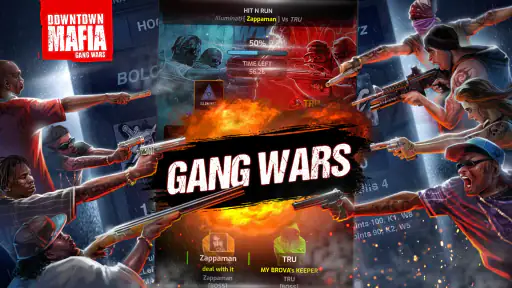



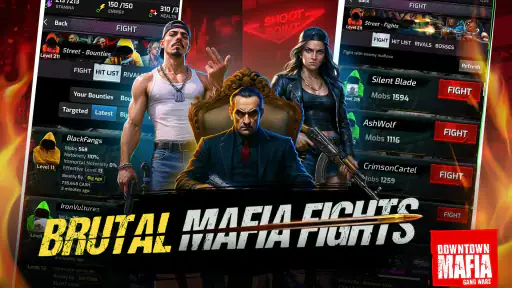

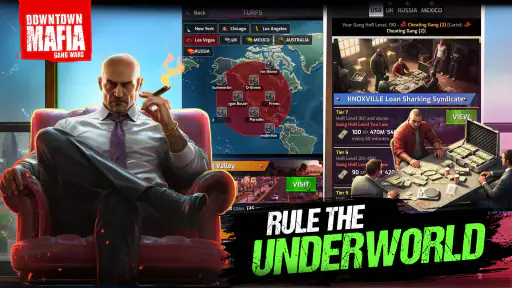
Analysis by Reviewed
Downtown Mafia: Gang Wars Game is the kind of role-playing game I open when I want a quick decision, a little competition, and a reason to check back later. It is built around a text-led mafia world rather than animated battles or a large 3D map, so the appeal comes from choices, progression, social interaction, and the feeling of building a criminal reputation over time. I found it much closer to a compact online routine than to a traditional console-style role-playing adventure.
That distinction matters before you install it. If you are expecting cinematic missions, detailed character movement, or a long story told through cutscenes, this is probably not the right fit. If you enjoy checking resources, improving a character, comparing progress with other players, and making small strategic choices throughout the day, the format makes more sense. The game is free to download, and DYNAMICNEXT has kept it available as a long-running mobile title since its release on October 2, 2012.
How Downtown Mafia turns short sessions into a long-term game
My first impression was that the text-based presentation is not merely a limitation; it is the central design choice. Instead of asking me to steer a character through a detailed environment, the game puts the focus on menus, written actions, status information, and the consequences of choosing what to do next. That makes it easy to play in small gaps, such as while waiting for an appointment or taking a short break from work.
The role-playing structure works through gradual improvement. You are not relying on reflexes to win a fight, and the game does not ask you to master complicated controls. The important question is usually how to spend limited attention and available resources. That gives the experience a different rhythm from action-oriented mafia games: less immediate spectacle, more planning and patience.
I also noticed that the social side is important to the overall identity. The game is presented as a social massively multiplayer role-playing experience, so its appeal is not limited to personal progression. A player who enjoys seeing how a character develops in relation to other people will get more from it than someone who treats it as a completely private single-player campaign.
That social emphasis can make the world feel more active, but it also creates a dependency on the community. A text-based online game is most enjoyable when there are people to interact with, compete against, or keep up with. If you prefer a self-contained adventure that delivers the same experience whether you play today or months from now, a conventional offline role-playing game may suit you better.
The best way to approach the opening hours
I would not rush through the early part simply by tapping every available action. The more useful approach is to learn what each screen is trying to tell you before committing resources. Text-based games often hide their depth in wording and menus rather than visual effects, and a careless early choice can leave you with less flexibility later.
My practical advice is to establish a repeatable routine. Check the actions that advance your character, review the available social activity, and then decide whether the next step is worth your current resources. This sounds simple, but it prevents the common mistake of treating every button as equally valuable. In a game built around progression, consistency usually matters more than one exciting session.
A second useful habit is to separate active play from maintenance. When I have only a minute, I use that time for quick checks and straightforward actions. When I have longer, I look more carefully at progression and social choices. This keeps the game from becoming a chore and makes the idle element work in its favor rather than against it.
The idle design is also why the game can fit people who do not want to remain on screen constantly. You can make decisions, leave the app, and return later to continue your routine. That convenience is valuable, but it comes with a trade-off: the experience may feel slow if you need constant action, visual feedback, or immediate rewards.
What the text-based format does well
The strongest part of the presentation is clarity. Written menus can communicate a lot without asking the phone to render a busy environment, and the result is generally easier to understand at a glance than a crowded action game. I can focus on what an action means instead of watching an animation and guessing which numbers changed afterward.
This format also leaves room for imagination. A mafia-themed game does not need to show every street, vehicle, or weapon to create a sense of progression. The written framing lets me fill in some of those details mentally. For players who enjoy role-playing through decisions and status rather than through character customization, that restraint can be surprisingly effective.
On the other hand, the same restraint will feel bare to players who judge a mobile game mainly by its presentation. There is no escaping the fact that much of the experience is reading, tapping, waiting, and checking. The game is not trying to compete with visually rich crime adventures, and I would not recommend it to someone who wants exploration as the main activity.
The interface also rewards patience. At first, a long list of actions and information can feel less welcoming than a guided tutorial in a modern role-playing game. I needed to slow down and identify the purpose of each part of the routine. Once that clicked, the simplicity became more useful, but the opening experience could still be demanding for anyone who wants instant direction.
Free access and what the price really means
The most important value point is straightforward: the game is free to download and play. That makes it easy to test the core loop without paying at the start. For this type of long-term role-playing game, that matters because the format is personal. Some players will enjoy checking in repeatedly, while others will discover quickly that text-based progression is not their thing.
There are in-app purchases ranging from $0.99 to $99.99 per item. I see that range as a reason to treat optional spending carefully rather than as a reason to dismiss the game outright. Free entry gives you a chance to decide whether the routine is enjoyable before spending anything, but the presence of high-priced individual items means you should set your own limit in advance.
I would not describe the game as a paid-value purchase, because there is no required upfront price to evaluate. Its value comes from how much use you get from the free access and whether the social, idle, and progression loops hold your attention. If you never spend, the relevant question is whether the free experience gives you enough to do. If you do spend, the sensible question is whether a particular purchase improves your enjoyment rather than simply shortening the wait for progress.
That distinction is especially important in an idle game. A purchase can feel attractive when progress slows, but speeding up a routine does not automatically make the routine more enjoyable. I recommend playing long enough to understand your normal pace before considering an in-app purchase. Otherwise, it is easy to pay for convenience before knowing whether you actually like the underlying game.
There is also a useful personal rule here: never treat a large optional item as a substitute for learning the systems. In a menu-driven role-playing game, understanding the best order for your actions can be more valuable than immediately buying something. I would first improve my decision-making, then consider spending only if the game remains a regular part of my day.
Where the game earns its place on a phone
The main value is convenience. The game does not demand a long uninterrupted session, so it can become a small daily habit. I can check in during a commute, make a few choices, and return later without needing to remember a complicated control scheme. That makes it a better companion for fragmented time than many action role-playing games.
It also offers a particular kind of mental engagement. The choices are not physically difficult, but they encourage me to think about timing, priorities, and long-term improvement. I enjoy that low-pressure planning more than I expected. It is a good alternative when I want a game that occupies my attention without requiring fast reactions or sound turned on.
The social setting adds another layer of value. Comparing progress or participating in a shared criminal world can make repetitive actions feel meaningful. The game is not just a private spreadsheet of upgrades; its identity depends on the idea that other players are part of the environment. For someone who enjoys online communities, that can be the difference between a routine that lasts and one that is abandoned after a few sessions.
At the same time, I would not call it equally valuable for everyone. Players who need a strong narrative, frequent visual rewards, or a clear ending may find the progression too open-ended. The game is designed around continuation, not a short campaign with a final conclusion. That can be satisfying for a daily player and frustrating for someone who wants a complete story in one weekend.
Trade-offs that are easy to miss
The first trade-off is between accessibility and depth. Text-based actions are easy to perform, but the game may require more interpretation than a heavily guided title. You have to pay attention to what an option does and decide whether it fits your current plan. That gives experienced players room to develop a routine, while newcomers may initially feel that the game explains less than they would like.
The second is between idle convenience and momentum. Returning later is part of the appeal, but waiting can also make the game feel inactive. I found that it works best when I accept the slow rhythm instead of trying to force it into an action-game schedule. If I expect something dramatic every time I open the app, the experience feels limited. If I treat it as a continuing project, the same pace feels more appropriate.
The third is the relationship between social play and personal control. Other players can make the world more interesting, but they also mean that the experience is not entirely shaped by my own choices. A competitive or cooperative environment can change in ways I cannot control. That uncertainty is part of the online appeal, yet it may bother people who want a predictable progression path.
Another friction point is the age rating. The game is rated Teen, which fits its mafia setting and means it is not aimed at young children. Parents should consider whether the criminal theme and online social context are suitable for the particular teenager using it. I would also advise younger players to be especially cautious with optional purchases, since the available item range reaches from small amounts to substantially higher spending.
Device compatibility is relatively broad: the current version is 0.9.40 and requires Android 7.0 or later. That makes it accessible on many older Android devices, although the experience will still depend on how comfortable you are with the interface and online routine. The long history of the game may appeal to players who like established mobile communities, but it also means newcomers should be ready to learn a style that is less modern and visually elaborate than newer releases.
Who should spend time with it
I would recommend it to someone who likes mafia themes but does not need a cinematic crime story. It is particularly suitable for players who enjoy incremental progress, short sessions, and checking a character several times across the day. The free entry makes it easy to experiment, and the text-first design keeps the demands on your phone and your attention relatively modest.
It is also a good match for people who like games that become part of a routine. A realistic use case would be a player who checks progress after breakfast, makes a few decisions during a lunch break, and returns in the evening to review what changed. That pattern is more natural here than sitting down for a single intense session. The game rewards regular attention rather than dramatic bursts of play.
Players who enjoy online interaction may find more staying power because the social layer gives context to otherwise repetitive actions. If your favorite part of a role-playing game is comparing development, building a reputation, or seeing how your choices fit into a larger player community, this format has a clear advantage over a purely offline alternative.
I would skip it if you want real-time combat, open-world movement, voice acting, or a heavily scripted plot. A conventional action role-playing game will be better for visual excitement, while an offline story-driven game will be better for a controlled narrative. I would also skip it if you dislike waiting, menus, or games that ask you to return regularly instead of delivering all their content immediately.
Players who are uncomfortable with optional purchases should not assume that free access removes every spending decision. The game can be tried without an upfront payment, but the purchase range means self-control matters. I would use the free version as a test, decide whether the daily loop genuinely fits, and only then consider spending a small amount that I can comfortably afford.
My verdict after weighing the value
My overall view is positive, but it is specific rather than universal. Downtown Mafia: Gang Wars Game succeeds as a compact, text-based social role-playing game with an idle rhythm. It gives me a reason to return, lets me progress without demanding fast reactions, and creates a distinct mafia atmosphere through choices and ongoing development instead of expensive presentation.
The game has also built a substantial audience, with an average rating of 4.5 from around 4.3 thousand ratings and over 5 million installs. Those figures suggest that the format has found a real audience, although they should not replace your own test of the gameplay. A popular game can still be the wrong match if you need action, story, or a more polished modern interface.
DYNAMICNEXT has kept the title available for a long time, and that longevity is useful for anyone looking for an established mobile game rather than a brand-new experiment. The current version shows that it remains maintained as a product, while the older design philosophy remains visible in the text-heavy structure. I see that as both its character and its main limitation.
My recommendation is to try the free version first and judge it by your willingness to return, not by the first ten minutes. Give the routine enough time to show whether planning, social progress, and idle development appeal to you. If they do, the game can become an enjoyable small habit. If you are waiting for a visual crime adventure, it is better to skip it and choose a game built around movement and action.
For me, the deciding factor is honesty about the format. This is not a substitute for a console-style mafia epic, and it does not need to be. It is a lightweight online role-playing experience for people who enjoy gradual advancement and regular check-ins. At no upfront cost, it is easy to sample; with optional purchases available, it is worth keeping spending deliberate. For the right player, Downtown Mafia: Gang Wars Game delivers a focused and unusually patient take on mafia gaming.
Pros
- Strategic territory control adds depth beyond simple mission-based combat.
- Regular events provide extra objectives and rewards for active players.
- Distinct gang units encourage experimenting with different team combinations.
- The urban setting gives battles a stylish
- recognizable atmosphere.
- Progression systems offer clear goals for upgrading your crew and base.
Cons
- Energy or action limits may interrupt longer play sessions.
- Some upgrades can take considerable time without premium resources.
- The interface may feel crowded for players new to strategy games.
- Random rewards can make obtaining specific items unpredictable.
- Online features require a stable connection to access the full experience.

- Category
- Role Playing
- Version
- 0.9.40