Atlantis Invaders
- 1.06K
- 4.8
- Installs
- 10.00M
- Price
- Free

Screenshots


Analysis by Reviewed
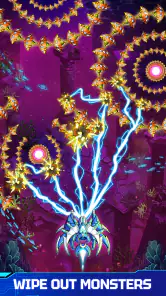
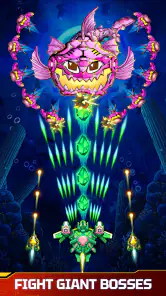
I went into Atlantis Invaders expecting a quick action game, and that is exactly where it makes the strongest impression: it gives me short bursts of underwater shooting, then asks me to make enough smart decisions to keep the next run alive. It is a free action game from Spirit Bomb - Heartcore Games, built around a deep-sea setting, a growing fleet, and hostile creatures that fill the screen with danger. The basic idea is easy to understand, but surviving well requires more than holding down a firing button.
What makes it worth discussing is the combination of approachable controls and the pressure of a bullet-hell format. I can start playing without studying a complicated rulebook, yet enemy movement, incoming projectiles, and the condition of my fleet quickly force me to pay attention. The game works particularly well when I have a few spare minutes and want something active rather than a passive time-killer. It is less convincing if I am looking for a slow strategy game, a narrative adventure, or a calm experience that can be played without concentration.
How the current version feels to play
The current release is version 15.00.030, and the overall experience feels like an established mobile game rather than a rough first attempt. The central loop is immediately readable: take control, attack sea monsters, avoid danger, and improve the fleet so later encounters become manageable. That clarity matters on a phone because I can understand the purpose of a session within seconds instead of spending the first few minutes navigating menus.
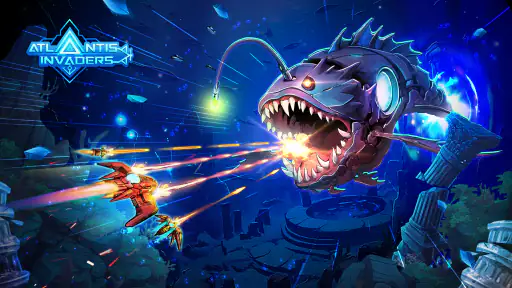
The deep-sea theme gives the action a useful identity. It is not simply another arena filled with anonymous enemies. The sense of defending Atlantis gives each run a little more purpose, while the underwater presentation helps separate the game from the usual military, fantasy, and space settings found in mobile action titles. I would not play it primarily for a rich story, but the setting does enough to make the repeated battles feel connected.
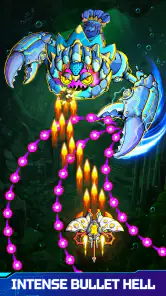
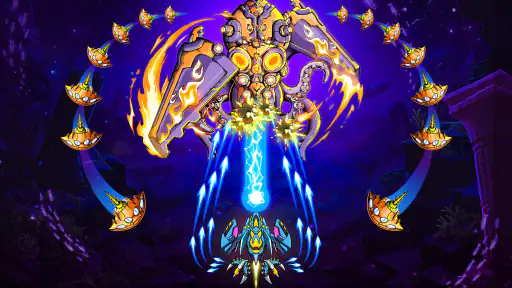
The bullet-hell design is the main test. Enemies and projectiles can turn an apparently safe section into a movement puzzle, so I have to watch open spaces rather than focus only on the target I am attacking. A common mistake is to chase damage too aggressively. In practice, staying alive often matters more than squeezing in one extra attack. That is one of the first useful habits I would recommend to a new player: treat positioning as part of the attack, not as a separate defensive chore.
Touchscreen action can become frustrating when controls are imprecise, but this game benefits from keeping its basic interaction direct. I can concentrate on movement and timing instead of juggling a large collection of buttons. That simplicity also makes it approachable for players who do not normally choose bullet-hell games. At the same time, it means experienced players may want more depth from the control scheme than the first sessions provide.
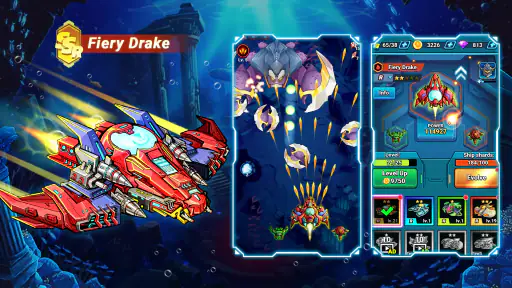
The fleet-building element gives the action a longer-term reason to continue. Rather than treating every encounter as an isolated attempt, I have a sense that successful play should improve my future options. This is important because pure score chasing is not enough to hold my attention for long. Building toward a stronger fleet creates a practical goal, especially when a difficult encounter exposes a weakness in my current approach.
One subtle strength is the way the game encourages me to separate two decisions that are easy to confuse: how to survive the present attack and how to prepare for the next one. During a fight, I need to find a safe route through the projectiles. Between fights, I need to think about whether my progress is making the fleet more capable or merely helping me force my way through one immediate obstacle. That distinction gives the simple action loop more texture than the store summary suggests.
A good fit for short, focused sessions
I can imagine playing Atlantis Invaders during a commute, while waiting for an appointment, or after finishing a task when I want a compact burst of action. The game does not require the same long uninterrupted commitment as a large console-style adventure. A short session can still feel meaningful if I manage to survive a difficult sequence or make useful progress with the fleet.
That convenience has a condition: this is not a game I would recommend playing while distracted. Bullet-hell action punishes divided attention, and a quick glance away from the screen can be enough to lose control of a situation. It is suitable for short sessions, but those sessions still need active concentration. If I want something that can run in the background while I watch a video, I would choose a different type of mobile game.
The Everyone content rating also makes it broadly approachable from an age perspective. That does not mean every player will enjoy it equally. Younger or inexperienced players may need time to learn the visual language of incoming attacks, while older players who enjoy arcade-style pressure may appreciate the immediate challenge. The rating describes accessibility of content, not the difficulty of the action itself.
How the fleet changes the usual mobile action formula
Many mobile action games rely on a repeated pattern of entering a stage, defeating enemies, collecting rewards, and trying again. Atlantis Invaders uses that familiar structure but gives the fleet a more central role. I am not only asking whether I can dodge well in the current moment; I am also thinking about how my broader setup supports the way I prefer to play.
That creates an interesting trade-off. A player who likes direct reflex challenges may be tempted to treat fleet development as a way to overpower mistakes. I found it more satisfying to use progression as support for better play rather than as a replacement for it. If I rely entirely on improvements to compensate for careless movement, difficult sections can still feel rough. The strongest results come when a better fleet and cleaner positioning work together.
A practical approach is to notice what actually ends a run before spending effort on improvement. If I repeatedly lose because I move into crowded areas, I need to change my route and timing. If I survive comfortably but cannot deal with tougher enemies quickly enough, then fleet development becomes the more relevant answer. This simple diagnosis prevents me from treating every problem as a reason to chase more power.
That is also where the game compares favorably with very basic arcade alternatives. A conventional shooter may offer immediate fun but little reason to return once the novelty fades. Here, the fleet gives repeated sessions a sense of direction. On the other hand, players who prefer a purely skill-based arcade experience may find progression distracting because success is not determined by reflexes alone.
What the current release means for returning players
The release history points to a game that has been available since November 17, 2020, while the present version shows that it is not being approached as a one-off launch experiment. For an existing player, that matters less as a promise of future content than as a sign that the game has had time to settle into its identity. I would approach the current version as the active form of a long-running mobile action title, not as an unfinished preview.
Still, a version number by itself does not tell me how much a returning player will notice immediately. The important question is whether the current build changes the way I play, and that depends on where I stopped before. Someone returning after a long break should spend a little time reacquainting themselves with the fleet and the rhythm of enemy patterns instead of assuming old habits will work perfectly. Even familiar action games can feel different after time away because muscle memory fades quickly.
New users benefit from starting with a learning mindset rather than rushing toward the hardest available challenge. I would use early sessions to observe how projectiles travel, which spaces remain safe, and how much movement is needed to avoid danger. This is more effective than constantly reacting at the last second. Bullet-hell games often become easier once the player begins anticipating patterns instead of treating each projectile as a separate surprise.
The game has attracted a large audience, with over ten million installs and an average rating of 4.8 from roughly sixty-one thousand ratings. Those figures suggest strong broad appeal, but they should not be mistaken for proof that every player will enjoy the same difficulty curve. A popular action game can still feel demanding to someone who prefers relaxed controls, and a well-rated title can still be a poor match for a player who dislikes repeated attempts.
Where the free model creates friction
Atlantis Invaders is free to download, which makes trying it easy, but the presence of in-app purchases ranging from $0.99 to $199.99 per item deserves attention before anyone invests heavily in the progression loop. I would not treat the existence of purchases as an automatic reason to avoid the game, yet it is a reason to decide early how I want to play. Players who are comfortable progressing without spending should set that expectation from the beginning.
The important trade-off is psychological as much as financial. When a game combines repeated combat with fleet improvement, I may start wondering whether a difficult section is asking for better play or stronger development. That uncertainty can weaken the satisfaction of a victory. My advice is to judge each obstacle first through play: try changing movement, timing, and positioning before assuming that spending is the intended solution.
Players who want a completely self-contained premium experience should probably look elsewhere. A paid action game with a single upfront purchase may offer a cleaner relationship between progress and play, even if it lacks the same free entry. Conversely, someone who wants to sample a game before committing money will find the free model more convenient. The right choice depends on whether flexibility or a controlled purchase matters more to you.
Another limitation is the potential repetition inherent in the format. Shooting, dodging, and improving a fleet can be satisfying for a long time, but the loop remains focused. If I need extensive character dialogue, exploration with many different activities, or a constantly changing campaign structure, this is not the strongest option. Its appeal comes from refining performance inside a clear action framework, not from offering a broad collection of unrelated systems.
Small habits that make the game more enjoyable
The first habit I recommend is leaving room to move before the screen becomes crowded. New players often drift toward the edge of the action because it feels safer, but that can remove escape routes. I try to preserve at least one direction in which I can move when a new threat appears. This is a simple adjustment, yet it makes later moments feel less like unavoidable accidents.
The second is to avoid upgrading or developing the fleet purely because an option is available. I get more value from identifying the specific reason a battle is difficult. If enemies are surviving too long, offensive improvement may help. If I am regularly trapped by incoming attacks, stronger preparation will not replace better positioning. Matching the improvement to the failure makes the progression system feel purposeful rather than random.
The third is to use failed attempts as pattern-learning sessions instead of immediately restarting with frustration. I pay attention to what happened just before the loss: did I focus too much on an enemy, move into a narrow area, or react too late to a new wave of danger? That review turns a defeat into practical information. It is especially useful for players who are new to bullet-hell games and assume every loss means they simply need faster reactions.
A fourth useful approach is to separate “one more try” from a realistic session plan. Because the action is compact, it is easy to keep restarting long after attention has dropped. I play better when I decide in advance to make a few focused attempts, then stop if my movement becomes careless. This is not a feature of the game itself, but it is a genuine way to avoid turning a fun arcade loop into an exhausting grind.
Who should choose it, and who should skip it
I would recommend this game to someone who likes mobile action with visible pressure, quick attempts, and a progression layer that gives the fleet a reason to grow. It is especially suitable for players who enjoy learning enemy behavior and improving through repetition. The underwater setting is a nice bonus for anyone tired of the usual battlefield or outer-space presentation.
I would be more cautious recommending it to someone who dislikes dodging-heavy games. The central challenge is not likely to disappear simply because the fleet becomes stronger. Players who want a slow, story-led experience should also look elsewhere, as should anyone who finds repeated attempts irritating rather than motivating. The game asks me to accept failure as part of learning, and that is not a good fit for every mood.
It is also not my first choice for a child who wants an entirely passive or very gentle game. The content rating is Everyone, but the action can still be demanding, and success depends on attention. For a family deciding whether to install it, I would describe it as accessible in presentation but active in difficulty. That distinction gives a more realistic idea of what the experience feels like.
What I would watch in future updates
The current version gives the game a solid identity, but the long-term health of a title like this depends on how well it keeps the fleet and combat loop feeling meaningful. I would watch for changes that make progression clearer, reduce unnecessary friction, or give experienced players fresh reasons to refine their skills. Those improvements would matter more to me than simply adding more surface decoration.
I would also pay attention to how the balance between free progression and optional purchases develops. A free action game can remain welcoming when spending is clearly a choice, while unclear pressure can make difficult encounters feel less satisfying. For current players, the best sign would be a system that continues to reward careful movement and smart fleet decisions rather than making power the only reliable answer.
For now, I see Atlantis Invaders as a focused and approachable mobile shooter with more staying power than its simple premise initially suggests. It succeeds when I want compact action, a clear underwater identity, and a reason to improve between attempts. Its limitations are equally clear: the loop can become repetitive, bullet-hell pressure is not relaxing, and the purchase structure requires personal boundaries.
My final recommendation is to try it if you enjoy learning through repetition and want a free action game that can fit around a busy day. Give the fleet-building side enough attention to support your play, but do not expect it to remove the need for careful movement. If you prefer a premium game with no purchase decisions or a deeper narrative adventure, another option will suit you better. For everyone else, Atlantis Invaders is a worthwhile underwater challenge whose strongest moments come when preparation and reflexes finally work as one.
Pros
- Fast-paced arcade gameplay that is easy to learn
- Smooth controls make dodging enemy attacks feel responsive
- Varied enemy formations keep each stage engaging
- Short missions are convenient for quick gaming sessions
- Bright underwater visuals give the game a distinctive style
Cons
- Difficulty can rise sharply in later stages
- Repeated enemy patterns may reduce long-term variety
- Progression may feel grindy without frequent upgrades
- Limited story content offers little narrative motivation
- Frequent action can make the screen feel visually crowded

- Category
- Action
- Version
- 15.00.030