AI Dungeon Master & RPG Fablia
- 60.00
- 4.5
- Installs
- 10.00K
- Price
- Free

Screenshots


Analysis by Reviewed
I approached AI Dungeon Master & RPG Fablia expecting a lightweight role-playing game, but its central idea is more flexible than a normal branching adventure. Instead of moving through a completely fixed script, I can build a hero and interact with an AI Dungeon Master that turns my choices into an ongoing fantasy story. That difference matters: the appeal is less about collecting a perfect team or memorizing a map and more about seeing how the adventure reacts when I try something unexpected.
This is a free role-playing game from Applogy Studio, rated for Everyone. It has earned a 4.5 average from around 550 ratings and has passed 10 thousand installs, which gives it a modest but visible presence among mobile fantasy games. The current version is 2.6.6, and it runs on Android 7.0 or later. I would describe it as an experiment in interactive storytelling first and a conventional RPG second.
How the AI Dungeon Master changes a mobile RPG
The defining capability is the AI Dungeon Master. In a traditional role-playing game, the available actions are usually obvious: tap an attack button, choose a dialogue option, equip an item, or follow a quest marker. Here, the fantasy is that I can approach a situation as a character rather than as someone selecting only the actions the developer anticipated.
That creates a different kind of freedom. A locked door is not merely a prompt to search for a key. I might decide to question the guard, look for another entrance, make a risky promise, or attempt something that would never appear in a standard menu. The value comes from the Dungeon Master interpreting the direction and continuing the narrative instead of forcing every moment into a narrow sequence.
I found that this capability works best when I treat the game like a conversation with a narrator. Short, clear decisions are easier to follow than a tangled paragraph containing several unrelated plans. Saying what my hero wants, what they are afraid of, and what they are willing to risk gives the story more usable material than simply typing “I do something clever.”
The important distinction is that the AI creates possibility, not guaranteed consistency. It can make a scene feel personal and surprising, but it is not the same as a human Game Master who remembers every detail, balances every encounter, and understands the emotional intention behind a joke or a complicated plan. I enjoyed the freedom, but I also had to accept that the story could occasionally feel looser than a carefully authored campaign.
Building a hero with a clear point of view
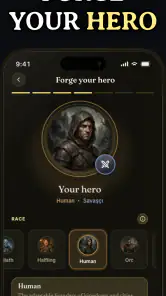
Hero creation is more useful when I think beyond appearance or a basic fantasy label. A character with a simple motivation gives the Dungeon Master something to work with. A runaway apprentice, a disgraced knight, or a cautious treasure hunter naturally suggests different decisions in the same scene. Even if the game does not turn every background detail into a formal mechanic, role-playing with a consistent point of view makes the generated adventure feel more coherent.
My practical tip is to choose one strong goal and one limitation before starting. For example, a hero who wants to clear a family name but refuses to betray an ally is easier to play than a character who is brave, greedy, kind, ruthless, secretive, and loyal all at once. The first concept creates meaningful tension. The second can make choices feel random, which makes the resulting story harder to steer.
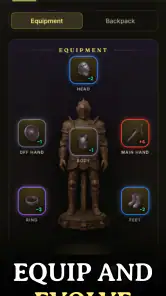
This is also where the game differs from a conventional character-building RPG. In a stat-heavy alternative, I would spend more time comparing numerical bonuses, party roles, equipment, or skill trees. Fablia puts more weight on what I say and choose in the story. Players who enjoy imagining a character’s voice may find that refreshing; players who mainly want deep optimization may find the experience less satisfying.
What playing actually feels like
In practice, I would begin with a scene, establish what my hero wants, and respond to the situation in ordinary language. The Dungeon Master then moves the story forward, presenting a consequence, a new problem, or a chance to change direction. The rhythm is closer to an improvised tabletop session than to a typical mobile quest chain.
The best exchanges happen when I give the game a concrete intention rather than trying to control every sentence of the outcome. “I distract the sentry by pretending to deliver a warning, while keeping one hand near my hidden dagger” is a useful action because it communicates a plan, a method, and a risk. It leaves room for the Dungeon Master to decide whether the attempt works and what complication follows.
That approach also makes failure more interesting. In a conventional game, a failed attempt may simply mean losing health or reloading a checkpoint. In an AI-led story, failure can become a new direction: the guard may believe the lie but demand proof, the dagger may be noticed, or the hero may escape while creating a future enemy. I do not need every result to be favorable, because the point is to continue the fiction rather than repeatedly search for the one correct button.
There is a trade-off in that freedom. A fixed campaign can deliver carefully timed reveals, memorable set pieces, and a deliberate difficulty curve. Fablia’s open-ended structure can produce a more personal sequence, but the quality depends on how clearly I guide the interaction and how well the generated response fits what came before. I would not approach it expecting the same polished pacing as a fully scripted role-playing epic.
A realistic use case for short sessions
The game makes the most sense to me in small pockets of free time. Imagine having a quiet half hour after dinner and wanting a fantasy adventure without committing to a long multiplayer session. I can create a hero, enter a situation, make several meaningful choices, and stop at a natural pause. The story does not require me to coordinate with friends, wait for a party, or learn a complicated combat system before enjoying the premise.
It is also a good fit for someone who likes writing but does not always have the energy to build an entire world. I can bring the character idea and let the Dungeon Master supply prompts, obstacles, and consequences. That makes it useful as a playful storytelling companion, especially when I want to test a character concept before using it in a tabletop campaign or a personal writing project.
For families, the Everyone rating makes the game easier to consider than a mature fantasy title, but I would still pay attention to how a child interacts with an open-ended storytelling system. The rating is reassuring for the intended audience, yet the experience is shaped by user input, so I would guide younger players toward simple, age-appropriate adventures rather than assuming every improvised direction will suit them equally well.
Where it is stronger than ordinary RPG alternatives
Compared with a standard mobile RPG, the strongest advantage is the ability to pursue an unusual idea. Scripted games are excellent when I want reliable rules, clear objectives, and a designed sequence of rewards. Fablia is more appealing when I want to ask, “What happens if I try this?” and accept that the answer may open a path the designer could not have written as a separate button.
It can also be more approachable than a full tabletop role-playing session. I do not need to find a group, schedule a meeting, prepare a rulebook, or worry about taking over the table. The AI Dungeon Master supplies the immediate response, while I decide how ambitious or theatrical my hero should be. That makes it a convenient solo option for people who like tabletop ideas but lack a regular group.
On the other hand, a conventional offline RPG is usually the better choice when I want dependable progress, a stable world map, carefully tuned battles, or a strong sense of completion. A visual adventure with authored dialogue may also be preferable when the pleasure comes from voice acting, animation, and cinematic presentation. Fablia’s central strength is imagination guided by interaction, not spectacle or mechanical depth.
The friction points I noticed
The first limitation is that an AI Dungeon Master can be less predictable than a human or a script. A response may be imaginative but not perfectly aligned with the tone I intended. If I describe a subtle political maneuver, the game may need a clearer explanation of what my hero is actually attempting. I learned to correct the direction early instead of allowing a small misunderstanding to become the foundation of the next several scenes.
The second issue is continuity. Open-ended storytelling is exciting partly because it is not locked to a single route, but that same flexibility can make details feel less firmly anchored than they would in a handcrafted campaign. I recommend keeping a tiny personal note of the hero’s goal, important allies, unresolved threats, and promises made. This is not a glamorous feature, but it improves the quality of a longer session because I can remind myself what matters before making the next choice.
A third consideration is spending. The game is free to start, but in-app purchases range from $2.99 to $999.99 per item. That is a very broad range, so I would approach purchases carefully and avoid assuming that paying is necessary to enjoy the basic concept. Anyone sharing a device with children should use the platform’s purchase controls and discuss spending beforehand. The free entry point is attractive, but the presence of optional items means the game deserves the same purchase awareness as other free-to-play titles.
Device compatibility is fairly generous because Android 7.0 is supported, but older compatible devices may not provide the same comfortable experience as newer phones. I would also prefer a stable connection for an AI-centered game, since the main interaction depends on generating responses rather than simply running a self-contained offline story. That makes it less suitable for a journey where connectivity is unreliable and more suitable for relaxed play at home or in a dependable network environment.
Small techniques that make the stories better
One useful technique is to separate action from intention. Instead of only saying that my hero enters a room, I explain whether the aim is to gather information, intimidate someone, hide evidence, or buy time. The same physical movement can lead to very different scenes when the Dungeon Master understands the purpose behind it.
Another is to introduce constraints deliberately. If every plan is possible and every risk is avoided, the adventure loses tension. I get more interesting results when I give my hero a reason not to use the easiest solution: protecting an innocent witness, preserving a disguise, or refusing to reveal a magical secret. Constraints create the kind of dilemmas that make an improvised story memorable.
I also recommend ending a session with a clear unresolved thread. Rather than stopping immediately after a random exchange, I prefer to leave the hero facing a decision, carrying a suspicious letter, or owing someone a favor. That gives the next session a starting point and prevents the adventure from feeling like a collection of disconnected prompts.
Finally, I would not overcorrect every unexpected result. If the Dungeon Master introduces a complication that is plausible, accepting it can produce a better story than insisting on a perfect interpretation. I only step in when the response changes a core fact, misunderstands the hero’s basic action, or pushes the tone somewhere I do not want to play. That balance preserves the surprise without surrendering control.
Who will get the most from it
I think this game is best for solo players who enjoy fantasy role-playing as an act of imagination. It suits people who like making decisions in character, experimenting with unusual plans, and accepting imperfect outcomes in exchange for a more personal narrative. It is especially appealing if a normal game’s dialogue wheels feel restrictive and a tabletop group is not available.
It is less convincing for players who want a competitive system, collectible progression, elaborate tactical combat, or a campaign that unfolds exactly as authored. Someone who dislikes typing or describing actions may also find the central interaction less engaging than a game built around taps and visual controls. The AI Dungeon Master is the reason to play, but it is also the reason to skip the game if improvisation is not your preferred form of entertainment.
Applogy Studio has chosen a focused idea rather than trying to imitate every part of a large role-playing game. That focus gives Fablia its identity. I would not call it a replacement for a story-rich console RPG or a real tabletop group; I see it as a portable middle ground where I can bring a character concept to life quickly and see where a flexible narrator takes it.
My recommendation after playing
AI Dungeon Master & RPG Fablia is worth trying if the phrase “make a choice and see what happens” genuinely appeals to you. Its free price makes experimentation easy, and the Everyone rating broadens its audience, while the 4.5 average suggests that the core concept is connecting with the players who have tried it. I would begin with a simple hero, a clear goal, and a willingness to accept complications rather than treating every response as a puzzle with one correct answer.
My recommendation comes with a realistic expectation: this is an improvised storytelling game, not a perfectly authored fantasy campaign. The strongest moments come from the interaction between my idea and the Dungeon Master’s interpretation. The weaker moments come when continuity slips, a plan needs clarification, or the open structure feels less rewarding than a traditional progression system.
For a quiet evening, a quick character experiment, or a solo fantasy adventure that does not force me down a fixed path, that exchange is enough to make it interesting. I would keep an eye on optional spending and choose a conventional RPG instead when I want polished combat or a tightly controlled plot. But if you want to play the role of the person steering the story, rather than simply selecting from its prepared branches, Fablia offers a distinctive mobile experience.
Pros
- AI-generated stories make each adventure feel unique.
- Supports creative role-playing without needing a prepared game master.
- Quick character and world setup gets campaigns started fast.
- Useful for solo players who want an RPG experience anytime.
- Flexible storytelling encourages experimentation and unexpected choices.
Cons
- Story quality can vary depending on prompts and character choices.
- AI responses may occasionally contradict earlier events or details.
- Some advanced content or features may require in-app purchases.
- Long sessions can become repetitive if prompts lack variety.
- Requires an internet connection for most AI-generated interactions.

- Category
- Role Playing
- Version
- 2.6.6