 About Temple Run
Temple Run’s Community Thrives Beyond the Game
The most revealing thing about Temple Run is how often its community begins after a run ends. A player clips a near miss, compares a score, or tells a friend they finally cleared a stubborn objective; the game itself rarely pauses to make that exchange happen. Its social ecosystem is less a built-in gathering place than a loose network of personal records, shared memories, and challenges passed between people. That distinction explains both the game’s durable appeal and the limits of its community features.
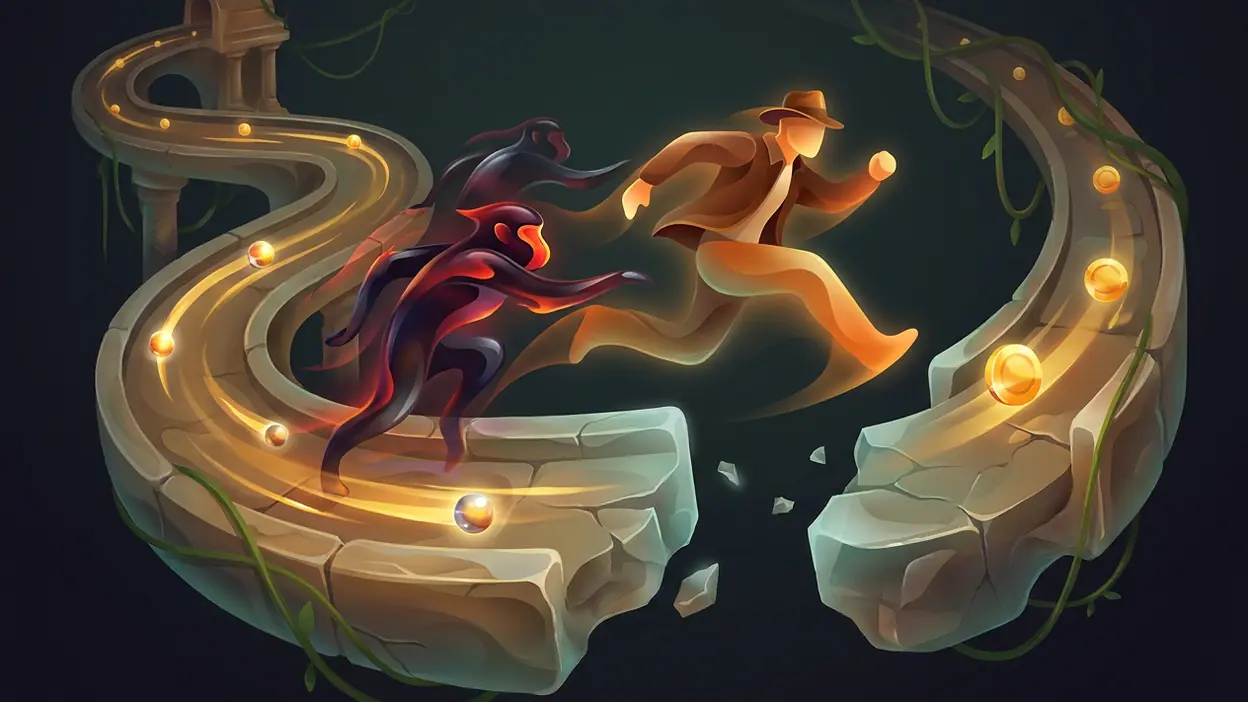
The core experience remains wonderfully legible: swipe to turn, jump, and slide as an explorer races through ancient ruins with demonic monkeys close behind. The route keeps tightening. A corner arrives just as coins pull your attention sideways; a gap appears after a turn; one late gesture ends a run that felt, seconds earlier, unstoppable. That quick rhythm makes each attempt easy to explain and easy to compare. Community grows naturally around the question every endless runner asks: how far did you get?
A social life made from repeatable runs
The participation model
Temple Run is fundamentally a solo arcade game. Players act in real time, but the meaningful social layer is indirect: scores, unlocks, personal milestones, and the stories people attach to a particularly good or disastrous run. There is no need to coordinate a team or maintain a public identity to take part. You can play privately, then bring the result into a conversation wherever your friends already gather.
That low-friction model is a strength. A run lasts only as long as your reflexes hold, so participation does not demand a scheduled session or a long-term commitment. The game’s simple controls also make its premise easy to demonstrate. Someone watching over your shoulder can understand the danger before the first turn, and can see why surviving another stretch feels satisfying. It is a strong setup for casual competition, even when the game is not hosting that competition itself.


The trade-off is that participation can feel thin inside the product. Temple Run’s main loop does not depend on conversation, collaboration, or user-created levels. Its community is therefore strongest among people who bring outside habits to it: comparing records, trading tips, or sharing clips. The game supplies a common test, not a full social venue.
How newcomers enter
Newcomers do not need a tutorial on community etiquette. They need to learn the physical language of the run: swipe at the right moment, keep track of the path, and resist chasing every coin if a safe landing matters more. The first few attempts are useful introductions because failure is immediate and understandable. A missed turn is not mysterious; the player can usually identify the gesture or distraction that caused it.
That clarity makes the game easy to recommend. A friend can hand over a device, explain the basic controls, and let the next run teach the rest. New players can also join a score comparison without catching up on years of lore or mastering a complicated character build. Still, established players may have advantages through practiced timing, upgraded abilities, or greater familiarity with the hazards. The barrier is modest, but not nonexistent.
Latest News


For a newcomer, the best invitation is often a simple dare: beat this score, survive farther, or finish a particular objective. It gives the first session a purpose without turning the game into homework. The danger is that an enormous record set by a veteran can make the target feel remote. A more welcoming rivalry compares people at similar levels, or focuses on personal bests rather than an unbeatable top score.
Recurring rituals
Temple Run’s natural ritual is the restart. A run ends, the player takes stock, and the next attempt begins almost immediately. That loop produces a familiar social pattern: one more try, one more chance to correct the turn that went wrong. It is not a group ritual in the formal sense, but it is recognizable to anyone who has watched a friend keep going after a near miss.
Other recurring habits depend on the player and the version they are using. People may pursue objectives, collect coins, unlock characters, or return to see whether they can beat yesterday’s distance. The exact rewards and available features can vary across releases and platforms, so it is safer to describe these as common play patterns rather than universal community events. What remains consistent is the appeal of a measurable attempt with a clean endpoint.
These rituals have a satisfying pace. Unlike a long role-playing session, a Temple Run attempt leaves little administrative residue: no party to assemble, no inventory to sort before another person can join. The same compactness makes it easy to fit into spare minutes. It also means the game has to keep earning the next attempt through the pleasure of the run itself.
Player contribution and creator culture
Players contribute most visibly by turning play into something shareable. A remarkable distance, a close escape, or a spectacular collision can become a screenshot, a short video, or a story told in a group chat. Creators can build tutorials, challenge videos, and nostalgic retrospectives around the game’s distinctive chase. These are community contributions, but they generally happen on external platforms rather than inside the runner.
That distinction matters. A video creator may help a newcomer understand tactics or remind an old player why the game was compelling, yet the game does not automatically turn that work into an in-game conversation. I would not assume that any particular version offers creator tools, a universal sharing feed, or a stable official community hub without checking the platform and release in question. The more reliable observation is that Temple Run’s clear visual action makes it easy to show, while its underlying systems leave much of the interpretation to players.
There is also a small but meaningful creative act in how people set challenges for one another. A friend might ask for a run without collecting a certain number of coins, or set a personal target after a familiar route starts to feel routine. Such house rules are not necessarily built into the game, but they refresh its basic loop. The community becomes a source of variation where the formal structure is deliberately spare.
Social friction
The game’s most common social friction is the familiar one of unequal expectations. One player wants a relaxed few runs; another treats the leaderboard as a serious contest. A huge score gap can turn a playful comparison into a discouraging one, especially for someone still learning the turns. Because the central activity is individual, there is little need for the team arguments or coordination failures found in cooperative games. But there is also no built-in team structure to soften a loss.
Performance comparisons can be complicated by differences in device, version, controls, and play history. A score is a useful shorthand, not a complete account of skill. Someone may be returning after years away, playing on a different screen, or simply treating the game as a quick diversion. Healthy communities keep the comparison light and make room for personal bests, not just the person at the top.
Another source of friction is the repetition itself. For one player, learning the timing is the pleasure; for another, the same ruins and hazards begin to feel familiar. A friend who stops playing is not necessarily rejecting the community. Temple Run’s social bonds are often casual enough that people can step away without leaving a team behind, which is convenient but gives the ecosystem little power to pull them back.
Moderation, safety, and unknowns
Because much of the social activity occurs outside the game, safety depends heavily on where players share. A private chat among friends has different risks from a public video platform or an open discussion forum. I would not describe the game itself as providing a comprehensive community-moderation system based on the core running experience. Nor should players assume that every unofficial fan group, score board, or creator channel is monitored by the game’s publisher.
That is not evidence of a specific safety failure; it is a limit on what can be confidently claimed. Features and policies can differ by platform, region, and update. Parents and younger players should use the privacy and reporting controls of whichever external service they use to share content, and treat unsolicited messages or requests for personal information with caution. The game’s low-pressure, solo structure keeps many social risks away from the run, but it cannot govern every place where the run is discussed.
Where the network value appears
The network value is modest but real: the game gives people a shared reference point. “I nearly made it” means something because the danger is visible, the controls are intuitive, and a score records the outcome. That common vocabulary can turn a private arcade session into a brief social exchange. The benefit is not a large persistent network; it is the ease with which a player can invite another person into the same small challenge.
That is a different kind of social value from a service designed around a feed or a team roster. Hill Climb Racing, another compact arcade game, similarly invites personal-best comparisons, while Temple Run’s pursuit and branching turns give its runs a sharper sense of immediate peril. The contrast is useful, but neither game needs to become a social platform to make a score worth sharing. Temple Run’s community works best as an add-on to play, not as a substitute for it.
Its network also carries nostalgia. For many players, the chase is tied to an earlier era of mobile gaming, when a quick run and a high score could fill a spare moment. That memory can make a recommendation feel warmer than a feature list. It is not enough to sustain every player, but it helps explain why clips and conversations can outlast a person’s regular playing habit.
Can the ecosystem last?
A community built around one repeatable mechanic can last as long as that mechanic remains satisfying and easy to revisit. Temple Run has a sturdy foundation: short sessions, immediate feedback, recognizable dangers, and goals that can be self-imposed. Its community is also resilient in a practical sense because it does not require everyone to be online at once. A shared score can travel between people at different times.
But this is a lightweight ecosystem, not a self-sustaining social world. It depends on players, creators, and fan spaces to provide the discussion and novelty that the core game does not generate by itself. If those outside channels quiet down, the runner remains playable, but its shared culture becomes less visible. Updates, platform changes, and the continued availability of particular services can affect that picture, so no claim about a single permanent community channel should be taken for granted.
The most likely future is therefore not a sudden disappearance of the community, but a gradual shift in where it lives. Old records, remembered challenges, and creator videos can keep the game in circulation even when fewer people play regularly. Meanwhile, new players can still grasp the appeal in seconds. That combination gives Temple Run a long tail, though not necessarily a constantly bustling one.
Temple Run’s community is strongest when it stays small, informal, and competitive in a friendly way. The game does not need elaborate social machinery to create a reason to compare runs; its chase already supplies one. What it lacks is a deep in-game home for the people who want more than scores and stories. I see that as a clear limitation, not a fatal flaw: Temple Run is an excellent shared challenge and a modest community platform, and its enduring network value comes from making a personal run easy to pass along.