 About Chess - Offline Board Game
Chess - Offline Board Game: How Much Can You Trust Its Offline Promise?
Chess has a useful trick: the rules are familiar enough that a match can begin before you have decided whether the app deserves your trust. That makes Chess - Offline Board Game a revealing test of a simple promise: let me play a game of chess without needing a stable connection or a complicated setup. The board itself is reliable territory; the uncertainty sits around it. How safely can you recover from a wrong move, a pause, or a state you do not understand? The game is most convincing when treated as a self-contained chessboard, and less so when you expect the surrounding app to explain every failure.
The reliability promise
Offline chess has an unusually clear value proposition. You open the game, choose a side or opponent, and settle into the quiet rhythm of looking for threats. A move creates a new problem; a reply changes the shape of the board; a blunder can turn a comfortable position into a scramble. There is no need for the match to depend on a live opponent or a server if you are playing against the computer or simply using the board locally. That is the practical appeal, not some grand claim about being disconnected from every network service.
That distinction matters in a resilience review. Offline play is not the same as guaranteed offline recovery. A game can let you start without internet while still leaving questions about whether a partially completed match is saved, whether settings persist, or what happens if the app is suspended at the wrong moment. The title’s promise invites confidence in the board, but it should not be stretched into a guarantee about every edge case. My judgment is that its core activity is naturally suited to offline use; the exact boundaries of persistence and recovery deserve more caution.
First setup failure points
Chess has a gentler first-run burden than a game built around accounts, downloads, and live matchmaking. You do not need to learn a fictional world before making sense of the first screen. The pieces and their movement are the tutorial most players already carry in their heads. That makes the opening minutes forgiving: even if you are rusty, a pawn move is a familiar invitation rather than a demand to decode a new control system.


But a low learning curve does not eliminate setup friction. The meaningful choices are likely to be familiar chess ones—who plays which color, how strong the opposition should feel, and whether the board is arranged for a quick game or a longer study. If those options are not immediately obvious, a novice can mistake a configuration question for a rules question. I would not claim a particular setup flow or onboarding sequence without verified evidence of the current build. The safer conclusion is that chess itself keeps the learning cost low, while the app’s specific first-run guidance is an area where expectations should stay modest.
That restraint is useful for players who install games in less-than-ideal conditions. If you have weak signal, a small screen, or only a few spare minutes, a board game can still be approachable because its essential vocabulary is visual. Yet the opening screen still has to make the next action legible. A polished happy path is not merely getting to a board; it is knowing whether a game has started, whose turn it is, and what choices remain before the first move.
Mistakes and reversibility
Chess makes mistakes unusually visible. A careless queen move does not produce a vague penalty meter; it can expose a king, lose a piece, or hand the opponent a forcing attack. That directness gives the game its tension and its replay value. You finish a match already replaying the moment where the plan broke, then start again with one adjustment in mind. A short game can become a lesson, and a longer one can feel like a chain of decisions that keeps asking whether you have noticed the board’s latest threat.
Latest News


In an app, though, a mistaken tap is not the same as a mistaken move. The first is an interface error; the second is the game. Whether a move can be undone, and under what conditions, is therefore a central safety question. I cannot verify a universal takeback behavior from the product name alone, so I will not present undo as a confirmed feature. Players who need a forgiving practice environment should check the available in-game controls before committing to a long match. If the interface makes a move instantly final, that is fair chess but a rougher fit for learners tapping on a cramped screen.
This is where the game’s simplicity cuts both ways. There are fewer controls to misread than in a fast action title, but each selection carries real weight. A touch that lands on the wrong square can change the position immediately. Good chess software should make selection and destination clear, and ideally distinguish a chosen piece from a completed move. Without verified evidence about its exact highlighting or confirmation behavior, the sensible advice is practical: slow down before moving a high-value piece, especially on a small display.
Interruption and return
Chess is naturally pause-friendly. There is no live clock implied by the title, and a computer match does not demand that you respond in a fraction of a second. Someone can put the device down to answer a call, then return to the same strategic question: what is threatened, and what is my opponent planning? That measured tempo makes this a better interruption match than a real-time multiplayer game, where a brief absence can become a forfeit or a lost position.
Still, pause-friendly is not proof of state preservation. An incoming call, a switch to another app, a low-memory shutdown, or a device restart may all test different layers of saving. A game that remains open in the app switcher may simply be held in memory; that is not the same as a match being written safely to storage. I would expect a casual chess game to be more tolerant of ordinary pauses than a twitch game, but I cannot promise that every unfinished position survives every interruption. If the game matters to you, finish a short test match before trusting it with a lengthy one.
That recommendation may sound cautious for a board game, but chess can absorb time without announcing it. A player may spend twenty minutes studying a position, then discover that the app has returned to a fresh board or an unclear menu. The emotional cost is not just lost progress; it is the loss of a train of thought. Reliable return behavior is part of the experience even when the game has no cinematic campaign to resume.
Connectivity pressure
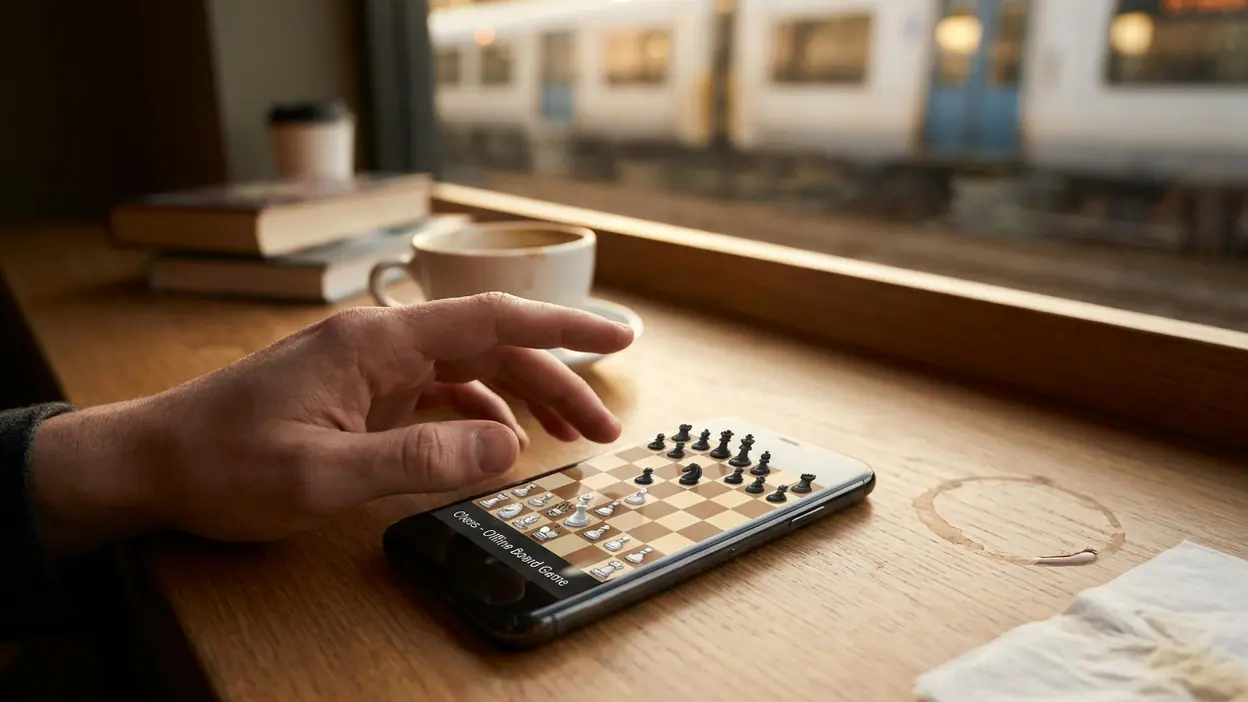
The strongest resilience argument is the one in the name: offline board play. Chess does not need a stream of new content to remain playable, and a computer opponent can make a quiet commute or a patchy connection feel irrelevant. This is the kind of game that belongs in a waiting room, on a train, or in a place where service comes and goes. The board’s central loop—read, choose, respond—does not become less meaningful just because the signal disappears.
There is an important limit. Offline capability for a local match does not establish that every mode, feature, or first launch works without a connection. Nor does it tell us whether the game checks network access for advertisements, optional services, or other functions. The available evidence supports the broad use case of offline chess, not a blanket claim that every screen works in airplane mode. If your use case is a remote trip with no service at all, test the installed version before leaving, rather than discovering which parts rely on connectivity after you have lost it.
Compared with a live trivia game such as Trivia Crack or a social round of UNO!, the chess loop is easier to preserve locally: there is no group waiting for your answer and no shared turn to synchronize. That contrast sharpens the title’s appeal without proving how its optional features behave. Its best case is a dependable opponent on a board you can return to; its weaker case is any expectation that offline status automatically covers every service around that board.
Unclear states and recovery guidance
Chess has an advantage when something goes wrong: the board is a readable record of the game. Even without a tutorial, players can usually see whose turn it is by the last move and infer why a king is under pressure. A position may be confusing, but it is rarely opaque in the way a hidden objective or a multi-step app workflow can be. If you return after a distraction, scanning the pieces gives you a route back into the problem.
That visual clarity does not answer every state question. Is the match paused, finished, or waiting for an input? Did a tap select a piece, or did it move? Was a game saved, or merely left open? These distinctions matter most to beginners, who may read a lack of response as a broken control rather than a legal-move restriction. Clear turn indicators, selected-piece feedback, and an obvious restart or return path are the small details that separate a usable board from a confusing one. I cannot verify how consistently this game communicates each state, so I would not treat its apparent simplicity as evidence that no guidance is needed.
For recovery, the safest routine is deliberately plain: check the turn, inspect the last move, and avoid restarting until you know whether the current position is recoverable. If a match disappears after an interruption, there is no basis here for promising a restore option. Likewise, if you make a move you regret, assume it may stand unless the interface clearly offers a way back. That is not a claim that recovery tools are absent; it is a warning not to build a long session around an unverified safety net.
The game’s best recovery aid is the board’s own legibility. The pieces stay in view, the rules give the position structure, and the player can reconstruct a plan from what remains. That is a real strength, though it is not a substitute for saved progress or good interface feedback. Chess can help you understand a position; only the app can tell you whether it has preserved it.
Where evidence is missing, and who needs more certainty
The limits of this review are specific. I cannot verify the exact behavior of every current version under forced closure, device restart, storage pressure, or a connection change during startup. I also will not invent menu labels, undo rules, autosave guarantees, or a particular difficulty range. Those details can change between releases and may differ by device. A confident review should separate what the product’s core design makes plausible from what has actually been demonstrated.
For a casual player who wants a quiet game against a computer, the uncertainty is probably manageable. Chess does not ask for a long tutorial, and an interrupted position is easier to reason about than a complex mission with hidden state. For a learner using the app to practise, move reversibility and clear feedback matter more: repeated accidental taps can teach frustration instead of chess. For someone relying on it as a no-signal travel companion, the central offline match is the right expectation, but testing before departure remains sensible. And for a tournament-minded player who wants an exact record of every unfinished position, confirmed save behavior matters more than the convenience of a quick board.
That is the line between a useful recommendation and an overclaim. Chess - Offline Board Game has the strongest case as a low-friction way to play chess when the internet is absent or attention is intermittent. Its subject is inherently resilient: turns are deliberate, the board is self-explanatory, and a match does not depend on a crowd. What remains unproven is the app’s response to the less glamorous failures—an accidental move, a killed process, or an ambiguous return state. Players who need guaranteed recovery should verify those behaviors on their own device before trusting it with a serious session.
My verdict is favorable, with a firm boundary. This is a sensible pick for accessible, offline-minded chess, where the pleasure comes from the next move rather than a layer of live services. Its rhythm suits short pauses and repeat games, and the familiar board gives it more grace under pressure than many mobile games. But resilience is not just being playable without a signal; it is keeping the player oriented when something goes wrong. Until saving, undo, and interruption behavior are confirmed, treat the game as a dependable place to play a casual match—not as a guaranteed archive of every position you leave behind.