 About Jigsaw Puzzles - Puzzle Games
Jigsaw Puzzles Show What Casual Puzzle Players Want Next
Casual puzzle games have spent years making every spare minute feel productive. The next standard may be less about squeezing in another level and more about letting players settle into a satisfying rhythm without turning relaxation into a chore. Jigsaw Puzzles - Puzzle Games makes a useful case study: its appeal rests on a straightforward act of fitting pieces together, while the wider category increasingly borrows the brisk pacing and reward machinery of match games. That contrast says a lot about what players expect now, and what developers risk making stale.
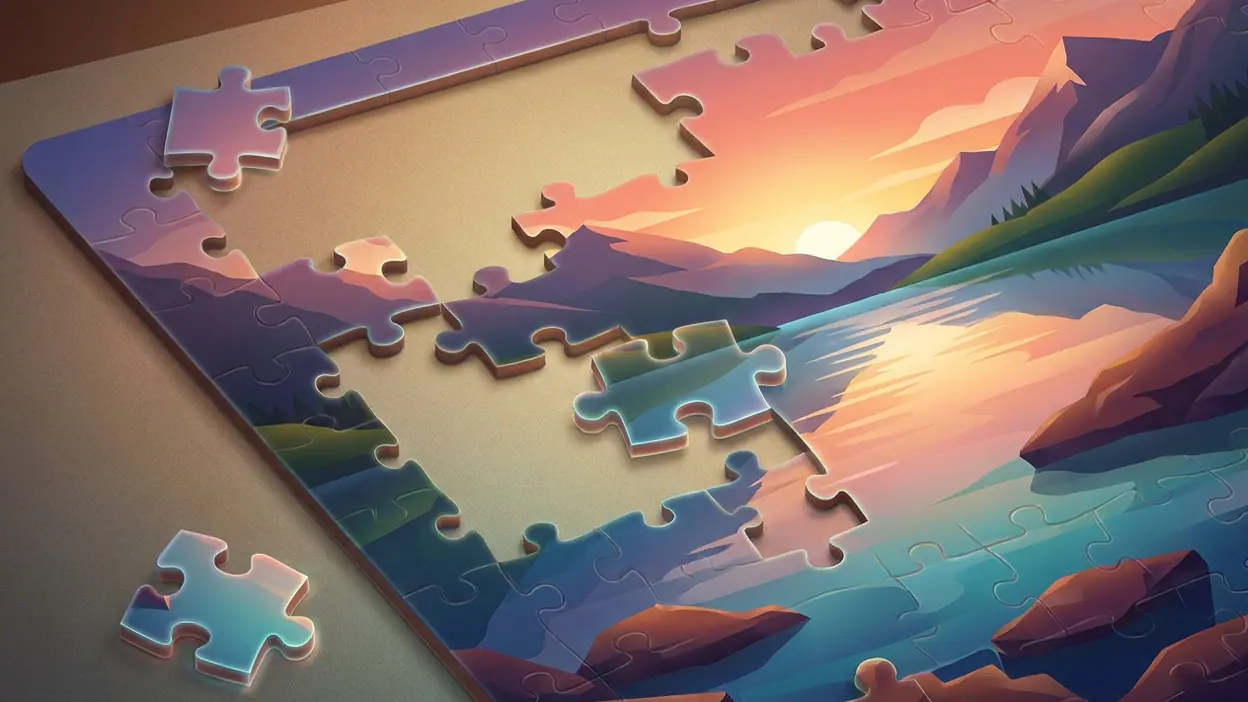
A jigsaw puzzle has a naturally legible promise. Look at the picture, find a piece, test the fit, and watch an image emerge from disorder. The pleasure is tactile even on a touchscreen: a loose piece waits to be picked up, moved, rotated or compared against the edges of the growing picture. There is no opponent to beat and no timer insisting that a quiet moment become a performance. The game’s central appeal is the steady shift from scattered fragments to a finished scene.
The category’s changing baseline
That simplicity no longer means players expect a bare board and little else. A modern mobile puzzle has to make starting effortless, explain its controls without a manual, and keep the play area readable on a small screen. It also needs enough choice to suit different moods: a quick, manageable challenge for a short break, or a more involved picture to return to over several sessions. Clear piece movement, responsive touch handling and useful progress cues are baseline expectations, not premium extras.
Jigsaw Puzzles - Puzzle Games fits the category’s most durable convention: it makes the image itself the reward. The player is not asked to master a complicated ruleset before the fun begins. Instead, attention goes to color, shape and pattern. A border piece is easy to recognize; a patch of similar blue sky is less forgiving. That small difference in difficulty supplies the loop. Each correct placement offers a brief confirmation, and each newly connected cluster gives the eye more information for the next decision.


The game’s strongest signal is that a puzzle can remain engaging without borrowing the urgency of a level-based arcade game. Its rhythm is patient by design. You scan, pick up, compare and place; then pause to see whether the new piece changes what you understand about the board. A difficult patch can slow the session, but that friction belongs to the puzzle rather than to a timer or a rival. For players who want their phone game to quiet the room rather than fill it with pressure, that is a meaningful design choice.
It also follows familiar mobile conventions. Digital jigsaws need to reduce the fiddliness of handling dozens of tiny pieces, and they need to keep a large collection of pictures approachable. The format is well suited to short sessions because progress remains visible even when a puzzle is unfinished. The player can leave with a recognizable corner or a growing band of color, then return with a little more context than before. That continuity is an understated form of replay value: the next session begins with a task already in motion.
Where the game challenges a category habit is in the idea that every session must end with a dramatic payout. Many casual titles package play into discrete stages, attach a prize to each one and use that prize to pull the player into the next round. A jigsaw’s satisfaction is less transactional. Completion matters, but so does the middle: the moment a pile of nearly identical pieces starts to resolve into a tree line, a building or a stretch of water. This makes the game feel closer to a hands-on pastime than a conveyor belt of levels.
Latest News


What neighboring games reveal
Related games sharpen the difference. Royal Match and Royal Kingdom make progress brisk and legible: match, clear, earn a reward, then move forward. Their structure turns each board into a compact test with a clear endpoint. That approach is effective because it gives players a reason to keep going, but it also sets an expectation that every minute should produce a visible win. The jigsaw loop answers a different question. Instead of asking how quickly a board can be cleared, it asks whether the player enjoys spending time with the image.
Art Puzzle - Puzzle Games offers a closer comparison because it also puts visual completion at the center. Its appeal points toward a broader category shift: players increasingly want puzzles to feel authored, not interchangeable. A picture is more than a background when its details guide the solve and make the final reveal worth seeing. Blockudoku: Block Puzzle Game, by contrast, draws on spatial planning and the pressure of keeping a board open. It demonstrates how a familiar puzzle rule can stay compelling through the tension between a current move and the space needed later.
Even Tic Tac Toe - 2 Player XO is instructive, despite its different scale. Its appeal depends on immediate comprehension and a social context: the rules are known, and another person can make the same small board feel fresh. Across these games, the common standard is not a shared mechanic. It is a quick route into play, a clear sense of what the player is trying to do, and a reason to care about the next move. Jigsaw Puzzles - Puzzle Games meets the first two through familiarity and visual clarity; its longer-term pull depends on how well its picture selection and difficulty range keep that simple loop from feeling repetitive.
This is where the category’s emerging standard becomes more demanding. A puzzle game should not just provide content; it should give players control over the kind of attention they spend. That can mean a choice of image, piece count or session length, alongside helpful tools that ease frustration without solving the puzzle for them. The strongest casual design lets a player tune the challenge rather than forcing every person through the same pace. Relaxed play and genuine mental engagement are not opposites, but they do require thoughtful options.
There is still a lag across mobile puzzles: many games treat collection size as a substitute for variety. A large gallery can look generous and still feel monotonous if images share the same palette, composition or difficulty. Jigsaw Puzzles - Puzzle Games is at its best when the visual material gives the player distinct clues to follow. It is less compelling when a stretch of the board becomes a wall of similar textures and the act of searching turns into blind trial and error. Good piece controls can soften that problem, but they cannot make an uninteresting image worth completing.
Another limitation is that a slow, solitary loop has fewer built-in reasons to return than a streak system, daily challenge or competitive mode. Those features can add structure, but they can also change the emotional contract. A player who came for a calm puzzle may not want reminders that imply they are falling behind. The category has to learn that retention does not always mean greater pressure. A dependable library, a satisfying range of challenge and the freedom to stop mid-puzzle can be stickier than a calendar full of obligations.
For users, the distinction is practical. If the goal is a quick burst of action and frequent rewards, the match-and-progress model has obvious strengths. If the goal is to occupy the hands and focus the mind without racing a clock, a jigsaw offers a different kind of value. It can turn a few quiet minutes into visible progress, and an unfinished puzzle can remain an invitation rather than a failure. The best mobile puzzle is not necessarily the one with the most elaborate progression; it is the one whose demands match the player’s mood.
That is the category’s likely direction: more considered variety, more flexible difficulty, and less dependence on making every session feel urgent. Jigsaw Puzzles - Puzzle Games shows why the classic jigsaw still belongs on a phone. Its basic loop needs little explanation, yet it rewards patience with a concrete visual result. The broader puzzle category will keep borrowing energy from levels, rewards and competition, but those devices are no longer enough by themselves. The lasting standard will be choice: games that understand when players want a challenge, when they want momentum, and when they simply want to fit one more piece into place.