Screw Master 3D: Pin Puzzle
- 1.19K
- 3.0
- Installs
- 5.00M
- Price
- Free

Screenshots




Analysis by Reviewed
I tend to enjoy casual puzzle games most when I can understand the basic goal quickly but still have to pause and think before acting. That is the appeal of Screw Master 3D: Pin Puzzle: its pin-and-ball puzzles are approachable at a glance, yet the arrangement of pieces can make a seemingly obvious move the wrong one. I’d treat it as a small mental challenge for spare moments, rather than a game to rush through on autopilot.
How it fits a quick break
The clearest use case is a short pause when I want something more engaging than scrolling but do not have time to settle into a long game. I might open it while waiting for an appointment, make a careful attempt at a puzzle, and put my phone away when my turn is called. The main advantage is that the goal is easy to grasp, so I do not need a long warm-up to get into the task.
That convenience depends on having enough attention to follow the pieces. If I am walking, talking with someone, or constantly switching between apps, I am more likely to miss how a move affects the rest of the layout. I would treat it as a brief focus activity, not background entertainment. For a commute where I cannot keep looking at the screen, an audio game or a simple idle game would be a more comfortable choice.
A useful way to approach tricky layouts
When I reach a crowded board, I find it useful to pause and identify the pieces that seem to control the most movement before touching anything. Rather than choosing the pin that looks easiest to remove, I would look for a move that opens space without sending the balls into a dead end. If I make a mistake, changing one decision on the next attempt is more informative than repeating the whole sequence at random.
This is a small but worthwhile habit because it turns failure into a clue: I can tell whether the problem was the order of moves or a misunderstanding of where a piece would go. It also helps me avoid tapping just to see what happens, which can make a logic puzzle feel arbitrary. Players who enjoy planning several steps ahead are likely to get more from the board than those who prefer immediate rewards for every tap.
Who will enjoy the puzzle style
I’d recommend giving it a try if you like spatial reasoning and enjoy predicting how objects will move when one part of a setup changes. It can also work for someone who wants a casual game with a clear, visual task rather than a story or a large set of systems to learn. The Everyone content rating makes it broadly accessible as a content label, although younger players may still benefit from an adult checking purchase settings.
It is less suitable if you want a relaxing game that asks almost nothing of you, or if you prefer puzzles with a single obvious answer and no need to test a sequence. Players who enjoy word challenges or number logic may find those formats a better match, since they rely on different kinds of reasoning. I would also look elsewhere if a repetitive puzzle loop quickly loses its appeal; the central pleasure here is working out arrangements, not collecting a varied set of activities.
More From Our News Desk

Clash of Clans Is Won Between the Battles

Android Auto Makes the Case for Quieter Car Software

MobiOffice: Transforming Mobile Productivity with Seamless Integration

EA SPORTS FC™ Mobile Soccer: Redefining Mobile Sports Gaming

How Microsoft OneDrive Became a Mobile Productivity Giant

How Google Translate Breaks Language Barriers Effortlessly
Where the current release stands
Supersonic Studios LTD develops this free casual game, which arrived on October 10, 2024. Its current version is 1.4.8.0, and it needs Android 7.0 or later. That gives returning players a useful point of reference when checking whether their installed copy is current, while new players can see that the game has received version updates since its release. I wouldn’t assume a particular change from the version number alone; the practical question is whether the pin puzzles still feel enjoyable on your device.
The game has an average rating of 3.0 from around 43,000 ratings, with about 1,200 written reviews, and has passed 5 million installs. Those figures suggest a sizable audience but also a divided reception, so I’d go in with measured expectations rather than treating popularity as proof that every level will click for me. It is rated for Everyone, though that broad age label does not guarantee that every player will enjoy the same pace or puzzle difficulty.
A Simple Concept with a Twist
At first glance, Screw Master 3D: Pin Puzzle seems like a walk in the park. The premise is simple: manipulate pins to guide balls into containers. Sounds easy, right? But here’s the catch; each level introduces new obstacles and mechanisms that require you to think several steps ahead. It’s this twist in gameplay that transforms a simple concept into a challenging mind-bender.
What the current version means for players
The version number is useful as a marker for existing players, but it is not a reliable changelog on its own. If I were returning after a break, I would first see whether the game opens and whether its puzzles still suit the way I like to play, rather than expecting a particular new feature simply because the version has advanced. That distinction matters: a current build can be relevant without proving that the underlying experience has changed in a specific way.
For someone deciding whether to install it now, the basic appeal remains the same kind of hands-on puzzle: inspect the arrangement, choose a move, and see whether the result helps or hurts the plan. That gives newcomers a straightforward way to judge it. I would not approach it expecting a deep narrative or a broad collection of unrelated game modes; the interest lies in solving the board in front of me.
Visual clarity and the limits of 3D
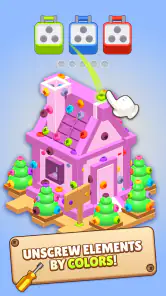
The first thing that strikes you about the game is its vibrant and engaging visuals. The colorful design isn’t just pleasing to the eye; it also makes the gameplay more intuitive. Every pin and ball is clearly defined, which is crucial when you’re strategizing your next move. The 3D graphics add a layer of depth that makes every level feel like a new adventure.
That presentation is useful when I need to distinguish the parts of a layout quickly, but a three-dimensional board can also make me slow down and check what is in front of or behind another piece. I would not assume that a bright screen makes every puzzle effortless to read. If a move looks ambiguous, taking a moment to inspect the whole setup is better than tapping based on the first impression.
How the challenge develops
What really stands out is the game’s ability to consistently challenge you. Just when you think you’ve mastered a level type, the game throws a curveball with new mechanics or trickier configurations. This ever-evolving difficulty is what keeps the game fresh and exciting. You’ll find yourself saying, "just one more level," only to realize hours have passed.
That growing challenge is a strength when I have the patience to learn from a failed attempt, but it can be a source of friction if I want every level to move at the same easy pace. A useful compromise is to stop after a puzzle that has taken more attention than expected and return when I can focus again. There is little value in turning a quick diversion into a test of endurance if I am no longer enjoying the reasoning.
My practical tip is to scan the whole board before touching a pin. Ask which piece is supporting another and where the balls will go after the first move; that brief pause can prevent a chain of mistakes. If a level catches me out, I’d reset my approach and change one decision at a time rather than tapping randomly. This makes the puzzle feel more like reasoning and less like trial and error, especially when the layout looks crowded.
Choosing between this and other casual games
For a realistic use case, I’d open it while waiting for a coffee or sitting through a short break: one focused attempt gives the mind something to do without requiring a long session. It suits players who like spatial puzzles and enjoy working out the order of moves. Compared with match-three games, which often emphasize quick pattern recognition, this asks you to consider how pieces interact. If you prefer word puzzles, number problems, or a calm game with no pressure to plan, those alternatives may be a better fit.
The distinction is not simply that one type is harder than another; they ask for different attention. A match-three game is often easier to play in quick glances, while a pin arrangement rewards keeping track of what has already moved and what might move next. If I want a puzzle I can dip into without remembering a plan, I might choose a simple matching game. If I want to reason through a physical-looking setup, this one has a more specific appeal.
When the focused play becomes a drawback
There is a trade-off in that same focused design. A puzzle can be satisfying when I spot the right sequence, but less enjoyable if I’m tired and just want effortless tapping. The colorful 3D presentation also makes the board easier to read, yet a visual puzzle still asks for attention; it is not ideal when I need to keep looking up or multitask. I’d save it for a moment when I can give the screen a little concentration.
Another practical question is whether it can serve as a reliable offline distraction. The game is described as not requiring an internet connection, which makes it a handy option when I expect patchy access. I would still avoid building an important travel plan around any mobile game, but for an ordinary wait or a quiet moment away from a strong connection, that offline suitability is a real convenience.
Playing away from home and managing spending
One of the best features of Screw Master 3D is its suitability for mobile gaming. The levels are short enough to play during a quick break but engaging enough to keep you entertained during a long commute. Plus, the game doesn’t require an internet connection, which is a huge bonus when you’re on the go.
For a commute, I would pick a seat or a safe moment when I can give the screen proper attention rather than trying to solve a layout while moving through a crowded station. It works better as a small, self-contained activity than as something to play continuously while navigating the day. That is a useful distinction for anyone choosing a game for travel: portability is helpful, but the visual planning still calls for attention.
It costs nothing to start, but the game includes in-app purchases ranging from $1.99 to $99.99 per item. I’d decide in advance whether I’m comfortable spending in a free game and avoid treating a purchase as necessary to enjoy the basic puzzle loop. If you are setting it up for a younger player, the Everyone rating is reassuring as a content label, but it is still sensible to review purchase settings together. That small step can prevent an unexpected checkout from interrupting casual play.
For parents, the practical point is to think separately about content and spending: an age label addresses the former, while purchase controls help with the latter. For adult players, the same principle is useful if I want this to remain a no-cost pastime. I can install it for free, try the core puzzle experience, and decide for myself whether any purchase is worth considering rather than assuming it is part of the entry price.
What to expect from its staying power
The changing configurations can keep the basic interaction from feeling identical every time, but a game built around one central puzzle idea will not suit everyone indefinitely. If I enjoy the process of studying a board and refining a sequence, I can see myself returning for short sessions. If I mainly play to discover new worlds, characters, or a wide range of mechanics, I would look for a different casual game instead.
The rating gives me another reason to keep expectations measured. An average of 3.0 across a large pool of player ratings indicates that the experience is not universally satisfying, though it cannot tell me which particular levels or design choices will bother an individual player. I would use it as a prompt to try the game with an open mind, not as proof that I will either love it or dislike it.
Conclusion: A Must-Try for Puzzle Lovers
If you’re a fan of puzzle games that combine simplicity with complexity, then Screw Master 3D: Pin Puzzle deserves a spot on your device. Its vibrant visuals, challenging levels, and intuitive gameplay make it a standout in the mobile gaming world. Whether you’re a seasoned puzzle solver or a casual gamer, this app offers something for everyone. So, why not give it a spin and see if you have what it takes to become a master of the screws? Trust me, you won’t regret it!
My recommendation is narrower: try it if thinking through a pin arrangement sounds more appealing than simply clearing a screen, and judge the feel of its challenge for yourself. The 3.0 average is a reminder that it will not suit everyone, and there’s no need to push through if the puzzle rhythm feels repetitive or frustrating. For players who like a quick, visual problem to solve between everyday tasks, it is an easy free download to sample; for those seeking a deep campaign or a reliably soothing experience, a different kind of casual game will likely be a better choice.
Screw Master 3D: Pin Puzzle Frequently Asked Questions
Can younger players enjoy Screw Master 3D: Pin Puzzle?
Screw Master 3D: Pin Puzzle has an Everyone content rating and is built around casual 3D puzzles, making its general premise approachable for a broad range of ages. Younger players may enjoy examining the pieces and trying different solutions, though they might sometimes appreciate help understanding how a particular puzzle works. It is a puzzle-focused experience rather than a story-driven game.
Is Screw Master 3D: Pin Puzzle suitable for short play sessions?
The game’s casual puzzle format makes it a natural option for players who want to tackle a challenge when they have a little free time. Its central activity is solving 3D screw and pin puzzles, so you can focus on working through a brain teaser rather than following a lengthy story. Whether you prefer brief sessions or a longer puzzle stretch, the premise is straightforward to pick up.
What kind of game is Screw Master 3D: Pin Puzzle?
Screw Master 3D: Pin Puzzle is a casual puzzle game built around three-dimensional screw and pin challenges. Its store summary describes it as a game of twisting and solving 3D puzzles, with brain teasers at its center. If you enjoy working through compact logic challenges and figuring out how pieces fit together, its basic premise may appeal to you.
Who makes Screw Master 3D: Pin Puzzle, and what is its age rating?
The game is developed by Supersonic Studios LTD and has an Everyone content rating. That rating makes it broadly suitable for players of different ages, although younger players may still appreciate help understanding the puzzle mechanics. The experience focuses on solving casual 3D challenges rather than on a story-driven format, so it is easy to approach as a pick-up-and-play game.
What is the main objective of Screw Master 3D: Pin Puzzle?
Screw Master 3D: Pin Puzzle is a brain-teasing game where your primary objective is to solve various pin puzzles by strategically removing or inserting screws to clear paths and complete each level. The game challenges your problem-solving skills and requires you to think critically about each move to successfully progress through increasingly complex puzzles.
Pros
- Engaging 3D puzzle gameplay.
- Intuitive controls for easy play.
- Visually appealing graphics.
- Challenging levels increase difficulty.
- Regular updates with new puzzles.
Cons
- Contains in-app purchases.
- Ads can be frequent and intrusive.
- Requires internet for full features.
- Some levels may be too challenging.
- Limited hints available for players.
- Category
- Casual
- Version
- 1.4.8.0