Aero Escape
- 1.36K
- 3.8
- Installs
- 500.00K
- Price
- Free

Screenshots






Analysis by Reviewed
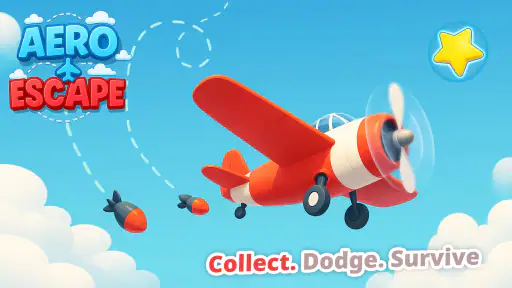
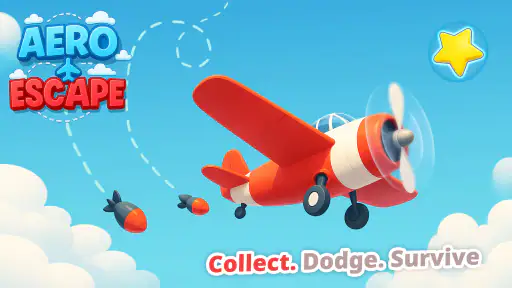
Aero Escape is the kind of casual game I can open for a quick break without needing to learn a complicated control system first. The central idea is immediately clear: guide an aircraft through danger, avoid incoming missiles, and collect stars while trying to keep the run alive. That simplicity is its strongest quality, but it also sets a high bar for how well the moment-to-moment action must hold up.
After spending time with it, I see a game aimed at players who enjoy short reflex challenges rather than a large adventure or a deep progression system. It is free, rated for Everyone, and developed by Gimica GmbH. The current release is version 1.4.0, and the game has already passed 500 thousand installs, so it has found an audience beyond the first few curious downloads.
How the current version feels to play
The opening experience is refreshingly direct. There is no need to understand a long backstory or decode a crowded interface before playing. You are placed in an aerial survival challenge where movement, timing, and awareness matter more than planning several turns ahead. I appreciate that approach because it makes the game easy to recommend for a spare minute on a commute, during a coffee break, or while waiting for an appointment.
The real appeal comes from the tension between collecting stars and staying out of danger. If I focus only on survival, I can usually make safer decisions, but I also leave potential rewards behind. If I chase every visible star, I risk moving into a path that is harder to escape. That small decision loop gives the game more personality than a simple obstacle-dodging exercise.
Missiles create the pressure. They turn an otherwise open-looking space into a problem of anticipation: I have to notice where danger is coming from, decide whether a star is worth the risk, and avoid making a last-second movement that leaves the aircraft with nowhere to go. The controls are easy to understand, but that does not make the challenge effortless. The difficulty comes from reacting consistently when several decisions arrive close together.
One useful way to play is to treat each run as a practice session rather than immediately chasing a personal best. On early attempts, I pay attention to how much room the aircraft needs to change direction and how quickly a safe route can disappear. Once that rhythm becomes familiar, collecting stars feels less like guessing and more like choosing between calculated risks.
This is also where the game works well as a casual title. I do not need a long uninterrupted session to get something from it. A short attempt can still provide a clear goal, and a failed run usually teaches me something about positioning or timing. That quick restart loop is valuable for players who prefer games that respect small pockets of free time.
A simple challenge with more decision-making than it first suggests
The store summary presents the game as a test of reflexes, and that is accurate, but I would describe it as a combination of reflexes and route judgment. Purely reacting to what is directly in front of the aircraft is not always enough. I get better results when I look slightly ahead, identify the safest open area, and avoid moving toward a star before checking whether the escape route remains available.
That habit is one of the more practical lessons the game offers. A star is not automatically a good target. Sometimes the better choice is to pass it and preserve a clean line of movement. This makes the scoring objective interesting because it encourages ambition without forcing every reward to be collected. Players who enjoy optimizing a run will find more to think about than players who only want a relaxed flight.
Another useful approach is to avoid overcorrecting. When danger appears, a large movement may feel reassuring, but it can create a second problem by sending the aircraft too far from the next safe position. Smaller adjustments are often easier to recover from. I found this especially important when trying to combine survival with star collection, because the safest-looking reaction is not always the most controllable one.
For younger players, the clear objective and Everyone content rating make the concept approachable. However, approachable does not mean every child will find it easy. Reflex games can become frustrating when a near-success ends suddenly, so it is better suited to players who enjoy repeating short challenges. Adults looking for a calm, slow-paced experience may feel differently, even though the game itself is simple to understand.
What the recent release tells me about its direction
The game was released on September 26, 2025, and version 1.4.0 is the current version I am considering here. That combination suggests a relatively early stage in the product’s life rather than a mature title with years of accumulated systems. I would therefore judge it mainly on the clarity of its core loop and on whether the current build feels coherent, not on expectations of a huge amount of content.
The version number is worth noting for existing users because it identifies the present point in the game’s development. A player returning after an earlier build should treat the current release as the reference point for the experience, while remembering that a compact casual game may evolve through refinements rather than dramatic reinvention. I would not assume that a new version automatically means a completely different game; the important question is whether the central flying challenge remains enjoyable.
From my perspective, the current state benefits from keeping its focus narrow. Dodging missiles, managing movement, and deciding when to collect stars are understandable goals that do not compete with a complicated menu of systems. That focus can help a newer game establish a recognizable identity. At the same time, it means the quality of repeated runs matters enormously. If the core encounters stop feeling fresh for a particular player, there may be less around them to provide variety.
For someone deciding whether to install it now, I would frame the choice this way: download it if you want a free, lightweight casual challenge built around short reflex sessions. Do not choose it expecting a story-driven flight game, a simulation, or a broad collection of aircraft activities. Its value is concentrated in the immediate action.
How it fits into everyday play
A realistic use case is a five-minute waiting period. I can start a run, concentrate on the immediate danger, and stop without needing to remember a complicated plot or maintain a long-term strategy. If I fail, the attempt still feels contained. If I do well, I have a simple score-oriented achievement to carry into the next session.
It can also work as a small reaction-training routine. I would not call it a formal training tool, but repeating the same kind of decision under pressure encourages better visual scanning and more controlled movement. My practical suggestion is to alternate between survival-focused runs and collection-focused runs. The first builds consistency; the second tests whether I can take calculated risks without becoming careless.
Players using an older device should pay attention to the minimum operating system requirement: Android 7.0 or later. That makes the compatibility floor fairly accessible for Android users, although the experience can still depend on the individual device. On a phone with a smaller display, precise visual tracking may feel more demanding, especially when danger and collectible targets occupy nearby areas.
The game is free, which lowers the barrier to trying it. I still recommend approaching any free casual game with a clear expectation: the absence of an upfront price makes experimentation easy, but it does not guarantee that every player will enjoy repeating the same central activity. In this case, the right question is whether missile avoidance and star collection sound satisfying enough to revisit.
Where it compares well with familiar alternatives
Compared with a traditional endless runner, this game puts more emphasis on open movement and aerial positioning rather than following a mostly fixed forward path. That difference matters. In a runner, I often think in terms of lanes, jumps, and immediate obstacles. Here, I think more about space, angles, and whether a movement leaves a usable escape route.
Compared with a slow puzzle game, it offers less time to analyze and more pressure to respond. A puzzle player who enjoys deliberate planning may find the missile encounters too abrupt, while someone who likes quick decisions may appreciate the immediacy. Compared with a full flight simulator, it is dramatically more accessible but far less concerned with realistic aircraft handling. The aircraft is a vehicle for the challenge, not the subject of a detailed simulation.
That positioning makes it a good alternative when I want something more active than a simple idle game but less demanding than a large action title. It does not ask me to manage a complicated inventory, learn a large map, or commit to a long campaign. The trade-off is that players who need deep customization, narrative progression, or many distinct modes should look elsewhere.
The game’s average rating is 3.8 from around 20 thousand ratings, with about 1.4 thousand written reviews. I read that overall response as a sign of a recognizable but not universally satisfying casual experience. It is strong enough to show that many people are willing to play it, while the rating also suggests that the simple format will not suit everyone. I would not use popularity alone as a reason to install it; the fit with your preferred style matters more here.
Effects on returning players
For people who already played an earlier release, the current version should be judged by how comfortably it supports the basic loop. A returning player will likely care less about the first explanation of the controls and more about whether runs feel reliable, readable, and worth repeating. Version 1.4.0 gives users a clear current reference, but I would still approach it as an evolving casual game rather than a finished, content-heavy package.
One advantage for existing users is that the central skill remains easy to re-enter. Even after time away, the goals are understandable: stay clear of missiles and make smart choices around stars. That makes it less intimidating to revisit than a game with a complicated progression tree. The downside is that a player who has already exhausted the appeal of its basic challenge may not find enough change in a version update alone to make it feel new.
My advice for returning players is to change the way you evaluate your runs. Instead of only asking how long you survived, watch whether you are making fewer emergency movements, choosing safer star opportunities, and recovering more often from an imperfect position. Those small improvements can restore interest because they turn repetition into a measurable personal challenge, even when the game itself keeps a compact structure.
Remaining friction and who should skip it
The biggest limitation is also the most obvious design trade-off: the game is built around one clear activity. That focus helps it start quickly, but it may not provide enough variety for players who expect a steady stream of new mechanics. If you need a campaign, character development, elaborate missions, or a strong social layer, this is probably not the right download.
I would also skip it if you dislike failure that comes from split-second decisions. The game’s appeal depends on the possibility of losing a run because a movement was late, too large, or aimed at the wrong target. Players who prefer forgiving controls and relaxed progress may find that tension tiring rather than exciting.
Another point is the difference between accessibility and depth. The Everyone rating and simple premise make the game approachable, but the same simplicity can feel limited to experienced mobile players who have spent a lot of time with endless arcade games. The challenge may remain enjoyable, yet the surrounding experience is unlikely to satisfy someone looking for a broad, constantly changing package.
There is also a practical trade-off in chasing stars. Collecting them gives the run a stronger purpose, but it can tempt me into unsafe paths. My recommendation is to establish a survival rhythm before trying to maximize collection. If I begin by treating every star as mandatory, I turn a manageable challenge into a series of unnecessary risks. That is a small but important difference between playing reactively and playing with a plan.
What I would watch as the game develops
Because the title is still relatively new, I would watch how future updates balance the clean core loop with the need for long-term variety. The best direction would preserve the immediate readability of missile dodging while giving regular players additional reasons to return. Any expansion should support the existing challenge rather than bury it under menus or systems that do not belong in a quick casual game.
I would also pay attention to whether future releases improve the experience for both cautious and ambitious players. The current design naturally creates two styles: surviving as long as possible and taking risks to collect more stars. That is a useful foundation. If later development gives both approaches meaningful goals without making either one feel mandatory, the game could become more appealing to a wider range of casual players.
For now, I would keep expectations grounded. The current version is best understood as a focused reflex game, not as a promise of a large aviation universe. That is not a criticism by itself. A compact game can be worthwhile when its controls, pacing, and risk decisions are satisfying. The question is whether this particular loop matches what you want from a mobile session.
My final recommendation is straightforward: try it if you enjoy brief, repeatable challenges where every movement matters. The free entry point, accessible age rating, and clear objective make it easy to test without a major commitment. I especially recommend it to players who like improving through repeated attempts and who enjoy deciding when a collectible is worth the danger.
I would be more cautious for anyone searching for a deep flight game, a relaxing experience, or a large amount of content. In my view, Aero Escape succeeds when treated as a focused casual reflex game. Its best moments come from reading the space ahead, resisting greedy movements, and turning a narrow escape into a better run. If that sounds like the kind of small challenge you want to keep on your phone, it is worth giving Gimica GmbH’s game a fair try.
Pros
- Simple controls make the game easy to pick up and play.
- Short sessions are convenient for quick breaks.
- Fast-paced gameplay keeps each attempt engaging.
- Lightweight design should work well on many devices.
- Replay value comes from trying to beat your previous score.
Cons
- Gameplay may feel repetitive after extended play.
- Difficulty can increase quickly and frustrate new players.
- Limited variety may reduce long-term appeal.
- Ads may interrupt the experience between attempts.
- Requires focus and quick reactions
- which may not suit everyone.

- Category
- Casual
- Version
- 1.4.0