Smithing Master
- 653.00
- 4.2
- Installs
- 1.00M
- Price
- Free

Screenshots



Analysis by Reviewed
I spent time with Smithing Master as a relaxed mobile game, paying particular attention to how comfortable it feels in different situations and for different players. Its central idea is easy to understand: you take on the role of a smith, improve your work, customize your experience, and gradually work toward becoming a more accomplished craftsman. That gives the game a friendly starting point, especially if you enjoy casual progression rather than demanding reflex challenges.
Developed by DHGames Limited, it is free to download and aimed at Teen players. The game has reached over one million installs and holds a 4.2 average from around thirty thousand ratings, which suggests that its simple smithing theme has found a sizeable audience. I would not treat those figures as a guarantee that everyone will enjoy it, but they do fit my impression of a game designed for short, approachable sessions rather than a niche simulation for expert players.
What interested me most was not only whether the crafting theme worked, but whether I could comfortably read the interface, understand what the game wanted me to do, and return to it when my attention or surroundings were less than ideal. On those points, Smithing Master is generally approachable, though it still has the familiar friction of a free-to-play mobile game.
How the interface supports reading and navigation
The first strength is the clarity of the basic fantasy. You are not dropped into an abstract puzzle with a long explanation before anything makes sense. The idea of being a smith gives the menus and progression a recognizable purpose, so I could usually understand why I was opening a screen or checking an upgrade. That kind of context matters for players who find dense game interfaces tiring.
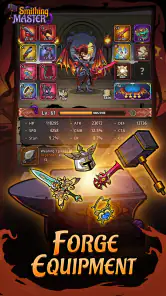
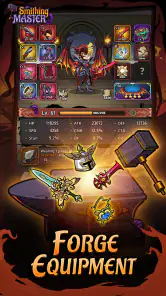
The visual presentation also benefits from having a focused theme. Equipment, crafting-related actions, and character development feel connected rather than like unrelated systems placed beside one another. I found it easier to remember where I had been than in casual games that scatter rewards, missions, collections, and upgrades across many disconnected screens.
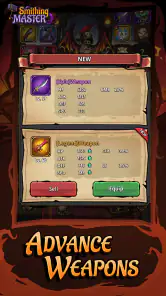
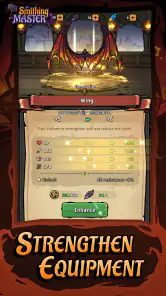
That said, casual does not always mean effortless. A progression game can still ask you to inspect several panels, compare improvements, and decide where to spend resources. When several rewards or upgrade prompts appear close together, the important action may compete with secondary information. I recommend taking a moment to read the full description of an improvement instead of tapping the most prominent button immediately. This is especially useful when you are playing quickly and the interface is encouraging you to claim or purchase something.
For readers who prefer larger text, the practical question is whether the device itself can make the game comfortable. Smithing Master is a mobile title, so readability will depend partly on screen size, resolution, and the system settings available on the phone. On a larger display, small labels and resource information are easier to inspect. On a compact phone, I would expect the busiest screens to require more concentration, particularly for anyone with reduced vision or difficulty distinguishing small interface elements.
I also found that the game’s navigation is easier when I approach it with a routine. I check the main progression first, review available improvements second, and only then look through optional rewards or customization. This prevents the game from feeling like a collection of unrelated buttons. It is a small habit, but it makes the experience more manageable for players who prefer predictable steps.
Why the smithing theme helps new players
Smithing Master does a good job of giving casual progression a concrete identity. Instead of feeling like I am simply filling bars, I can frame each action as part of improving a workshop or becoming a better smith. That narrative framing is useful for players who lose interest in purely numerical upgrade loops.
It also makes the game suitable for people who want a low-pressure introduction to mobile role-playing progression. Compared with a traditional action game, the smithing concept does not require the same level of constant visual tracking or rapid decision-making. Compared with a full crafting simulator, it is easier to approach because I do not need to learn a detailed real-world production process before making progress.
Still, players who rely heavily on text-to-speech or need very strong semantic labeling should test the game on their own device before committing time or money. I did not find enough evidence to describe it as specially designed for assistive technologies. My positive comments are about the general clarity of the theme and flow, not a claim of formal accessibility support.
Motor demands, sensory comfort, and everyday play
From a motor perspective, Smithing Master is more forgiving than a game built around precise timing, fast aiming, or repeated swipes. Most of the appeal comes from choosing actions and managing progression, so a player who prefers deliberate taps may find it more comfortable than an arcade-style alternative. I could play without needing to maintain a rapid rhythm for the entire session.
That does not make every interaction equally easy. Mobile games still involve tapping small controls, moving between screens, and sometimes responding to several prompts in sequence. Players with limited fine-motor control may prefer using the game when the phone is supported on a stable surface rather than holding it in one hand. That simple change reduces accidental taps and makes it easier to pause between decisions.
My most useful practical tip is to avoid playing the game while walking, standing on public transport, or carrying something in the other hand. The game is casual enough for interruptions, but its menus still deserve attention when you are selecting an upgrade or checking a reward. A brief mistake may not ruin a session, yet repeated mis-taps can make the progression feel less controlled.
Sensory comfort is more personal. The smithing presentation gives the game a clear visual identity, but players who are sensitive to animation, bright effects, or frequent visual changes should try it in a calm setting first. I would also keep the phone brightness at a comfortable level rather than assuming the game will suit every display automatically. Playing in a dark room with a bright screen can make even a pleasant game tiring.
Sound is another situational consideration. I often treat mobile games as silent experiences, especially when I am in a waiting room or sharing a room with someone else. Smithing Master works well for that kind of use because its main appeal is not dependent on having audio turned up. Using headphones may help players who enjoy a more immersive session, but it is not the only sensible way to play.
A realistic short-session routine
Imagine having ten minutes before an appointment. I would open the game, collect anything ready, inspect the next useful improvement, and then stop once I had made a clear decision. That works better than trying to complete every available activity in a hurry. The game’s casual structure suits this kind of check-in, provided you are comfortable leaving some tasks for later.
For someone with fluctuating energy or attention, this routine is valuable because it creates a natural stopping point. You do not have to treat every launch as a long gaming session. I found that the experience is most pleasant when I decide in advance whether I am checking progress or settling in for longer play. Without that intention, the repeated upgrade prompts can make a short break feel more demanding than expected.
Players who need frequent pauses should also appreciate that the game does not have to occupy your full attention every minute. However, I would still avoid making important progression choices while distracted. Casual design reduces pressure; it does not remove the need to read what a button does.
Access across places, schedules, and play styles
Smithing Master fits naturally into everyday mobile use. I can imagine playing it during a quiet break, at home while relaxing, or in a waiting area where I want something more engaging than scrolling. Its category makes it a better match for fragmented time than a long story game that expects uninterrupted concentration.
The free entry point is helpful for trying the core experience without making an immediate financial commitment. At the same time, the game includes in-app purchases ranging from $0.99 to $99.99 per item. That wide range changes how I would recommend it to different players. Someone who wants a free casual pastime should decide on a personal spending limit before exploring optional purchases, especially if upgrade screens repeatedly draw attention to faster progress or additional items.
This is not only a budgeting issue. Purchase prompts can also affect cognitive comfort. If you prefer games with a completely quiet, uninterrupted interface, the presence of monetization may become more noticeable than the smithing itself. I would recommend treating every paid option as optional and judging the game by how enjoyable its free progression feels. If the free route already gives you satisfying decisions, there is less reason to spend impulsively.
The Teen content rating is worth considering for families. It does not automatically tell me whether the game will suit every younger player, and parents should make their own decision based on the child’s maturity and comfort with in-app purchases. For a teenager who enjoys customization and gradual improvement, the theme may be a good fit. For a child who needs a very simple, tightly controlled experience, a game with fewer progression layers and no purchase pressure may be easier.
The current version is 0.34.0, and the minimum operating system is Android 7.0. That makes the game available to many older Android devices, although actual comfort will still depend on the phone’s screen, performance, and available storage. I would check that the device feels responsive before investing heavily in progress, particularly if it is an older model.
Who will enjoy it, and who may want another option
I would recommend Smithing Master to players who like casual role-playing progression, customization, and the feeling of building toward mastery without committing to a demanding action game. It is also a reasonable choice for someone who enjoys checking a game several times during the day and making small improvement decisions.
It is less suitable for players looking for a deep blacksmithing simulation. The fantasy of becoming a legendary smith is appealing, but anyone expecting detailed metallurgy, physically accurate forging, or a workshop-management system with extensive real-world complexity may prefer a dedicated simulation. Likewise, players who want a competitive multiplayer experience, a strongly authored story, or a precision-based challenge should look elsewhere.
Compared with a typical idle game, Smithing Master gives the progression a more distinctive identity through its smithing focus and customization. Compared with a traditional crafting game, it is easier to enter and better suited to brief sessions. The trade-off is depth: the more accessible structure may not satisfy someone who wants every material, tool, and production decision to have complicated consequences.
Another important distinction is patience. If you enjoy gradual improvement, small rewards can feel motivating. If you need immediate variety or a clear finish line, the loop may begin to feel repetitive. I suggest playing in short blocks at first rather than deciding after one rushed launch. The game’s appeal depends on whether incremental progress feels rewarding to you.
The barriers that remain
The biggest limitation is that accessibility here is mostly a matter of personal setup rather than a clearly specialized design approach. A player with good vision, steady tapping, and a comfortable device may find the interface straightforward. Someone who needs large controls, strong contrast, extensive remapping, or explicit assistive support may encounter more uncertainty.
Screen size can make a real difference. On a small phone, resource counts and secondary descriptions may demand closer reading. On a tablet or larger handset, the same information should be easier to inspect, though a larger display does not solve every issue. If you use system magnification or other device-level tools, check that they do not interfere with tapping or cause the game to reframe awkwardly.
Monetization is another barrier for players who are sensitive to spending prompts or who need strict purchase controls. The best approach is to establish a rule before playing: either avoid purchases entirely or set a limit that you will not change during a session. Families should use the purchase protections available on their device and discuss the difference between an in-game reward and a real payment.
There is also a mental-load barrier. A game built around repeated improvements can encourage constant checking, and that may not suit someone who is trying to reduce screen time or avoid pressure to optimize. I found it more comfortable when I treated the game as a small hobby rather than a task list. If the notifications, rewards, or upgrade choices make you feel obliged to return, another casual game with a fixed session structure may be a better fit.
Finally, the Teen rating means I would not recommend handing it to a younger child without supervision simply because the gameplay looks casual. Casual presentation and age suitability are not identical. The same applies to adults who want a completely family-neutral experience: they should consider whether the rating and purchase model match their household expectations.
My inclusive verdict after playing
Smithing Master is an approachable casual game with a clear identity and a progression loop that works particularly well in short, interrupted sessions. I like that the smithing theme gives ordinary upgrades a sense of purpose, and I appreciate that the game does not demand the reflex speed of an action title. For many players, that makes it easier to settle into than a busier alternative.
Its strongest accessibility quality is its general approachability: the concept is easy to grasp, the play style favors deliberate interaction, and the game can fit around everyday schedules. Its weakest area is the lack of certainty for players who need specialized interface support. Comfort will depend heavily on the phone, display, motor control, visual preferences, and tolerance for monetization prompts.
My practical recommendation is to try the free experience on the device you actually plan to use, with brightness, text scaling, and purchase controls adjusted before you begin. Play a few short sessions rather than forcing a long one, and notice whether the menus remain readable and whether the upgrade loop feels relaxing or demanding.
For me, this is a good choice for a player who wants a friendly smithing-themed progression game and is happy to move forward gradually. I would skip it in favor of a deeper simulator if detailed crafting is the priority, or choose a simpler title if purchase prompts and layered menus create stress. Within its casual niche, though, Smithing Master offers a pleasant middle ground: more character than a bare idle loop, less mechanical pressure than an action game, and enough flexibility to make it useful during ordinary spare moments.
Pros
- Simple controls make crafting easy to learn.
- Many weapon designs provide variety during crafting.
- Short sessions suit quick mobile gameplay.
- Progression gives upgrades a clear sense of purpose.
- Works well for players who enjoy collecting and improving gear.
Cons
- Grinding materials can become repetitive over time.
- Some upgrades may require considerable waiting or resources.
- The gameplay offers limited depth for experienced players.
- Ads or in-app purchases may interrupt the experience.
- Progress can feel slow without investing extra time or money.

- Category
- Casual
- Version
- 0.34.0