Cross-Stitch World
- 13.41K
- 4.7
- Installs
- 1.00M
- Price
- Free

Screenshots
Analysis by Reviewed
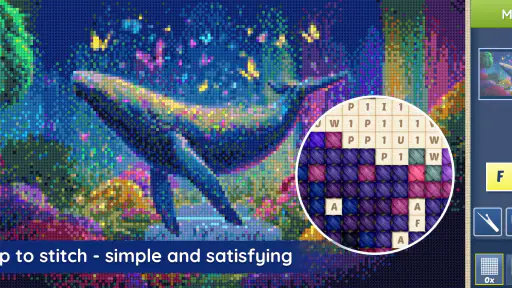
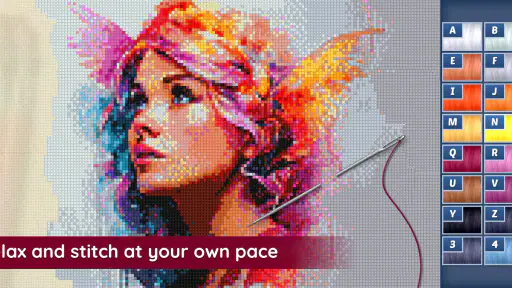
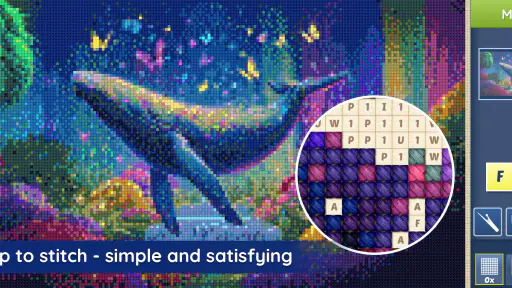
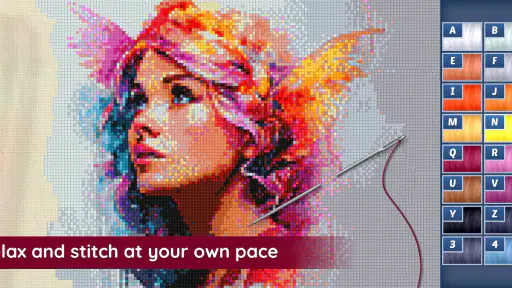
I approached Cross-Stitch World as the sort of casual game I might open during a quiet coffee break rather than something I would play with a competitive goal. That expectation turned out to be important. Its appeal comes from settling into a gentle rhythm, choosing a pattern, and filling it in gradually. There is no need to learn a complicated control scheme, and the basic idea is immediately understandable: work through colorful cross-stitch designs at your own pace.
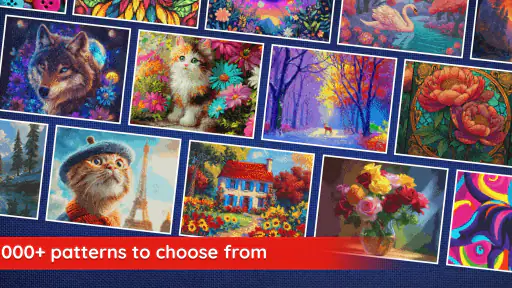
Developed by Inertia Software, this is a free game for everyone, with a 4.7 average from around 64 thousand ratings. It has passed the one-million-install mark, which fits my impression that it is aimed at a broad audience rather than a narrow group of hobby experts. The store summary points to more than 10,000 patterns and the option to create your own, but the real question is whether that amount of material remains useful after the first burst of curiosity. In my experience, it can, although the answer depends heavily on how much you enjoy repetitive, low-pressure progress.
From an easy first session to a comfortable routine
The first week is where the game makes its strongest impression. I could understand the central interaction almost immediately, so there was no tutorial-heavy barrier between installing it and starting a design. That simplicity is a genuine strength when I want something calming after work. I do not have to remember a complicated storyline, manage a large inventory, or react quickly to enemies. I can simply concentrate on the next small section of the picture.
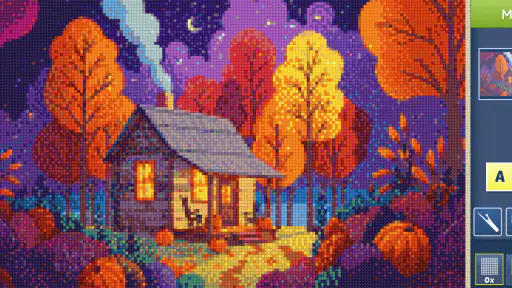
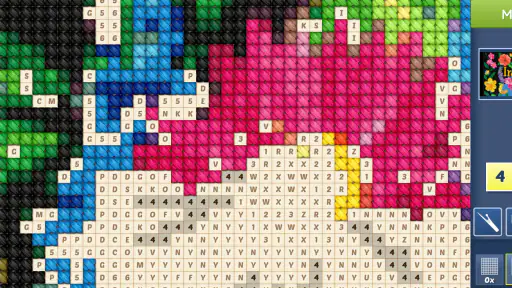
That small-section approach also makes the game suitable for short sessions. I might complete a few areas while waiting for an appointment, then return later without feeling that I had abandoned an important objective. For people who like digital coloring books, jigsaw puzzles, or other quiet activities, the appeal is familiar but not identical. Instead of freely brushing color across a blank image, I follow the structure of a stitch pattern. The satisfaction comes from turning scattered marks into a recognizable picture.
I found the experience especially pleasant when I treated each design as a short project instead of trying to consume the catalog as quickly as possible. Rushing through patterns makes the interaction feel more like tapping through a checklist. Slowing down gives the colors and shapes more room to work as a relaxing visual process. That is one of the first useful habits I would recommend: choose a pattern because you like its subject or palette, not merely because it looks easy to finish.
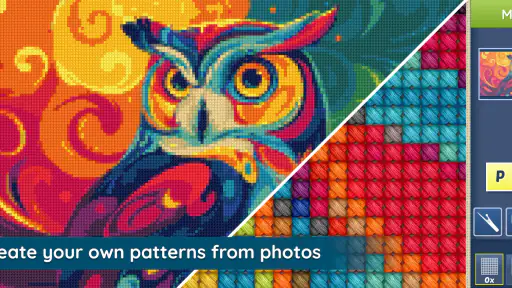
The create-your-own side adds a welcome change from selecting finished designs. It gives the game a more personal angle because I can think about what image would be satisfying to convert into a stitch-style pattern. I would use that option when the available designs do not match my mood or when I want to make a small personal project. It also helps prevent the experience from feeling entirely dependent on browsing the existing collection.
Still, the first-week appeal is not based on deep strategy. There is no reason to expect the kind of dramatic discovery found in an adventure game or the constant challenge of a puzzle game with escalating rules. The pleasure is quieter: visual completion, repetition, and a steady sense of progress. If that sounds boring rather than soothing, the novelty may disappear quickly.
For a realistic everyday example, I could open it on a crowded train, finish a handful of stitches, and close it when my stop arrives. Later that evening, I could continue the same picture without needing to reconstruct a complicated plan. That makes it a good companion for fragmented time. It is less suitable for a long uninterrupted session if I need frequent changes of pace to stay interested.
What keeps the collection useful over time
A large pattern library matters because it gives me room to change the mood of a session. I might want something simple when I am tired, a more detailed design when I have patience, or a brighter image when I need a little visual energy. The breadth suggested by the catalog means the game has a better chance of serving different moments than a title built around only a small group of fixed boards.
However, a large collection is not automatically the same as meaningful variety. After working through several designs, I began to notice that the basic action remained constant even when the picture changed. The subject can provide motivation, but it does not transform the underlying activity. This is where my comparison with usual alternatives becomes important. A digital coloring app may offer more freedom in how I apply color, while a conventional puzzle game may provide stronger problem-solving pressure. Cross-Stitch World sits between those experiences: more structured than free coloring, but much less demanding than a logic-focused puzzle.
That middle position is its long-term advantage for some players. I can use it when I want structure without pressure. A coloring app may leave me unsure how to begin, while a demanding puzzle may feel like work. Here, the pattern tells me what to do, but the presentation still gives me the pleasure of building an image. The trade-off is that players who want creative control or intellectual challenge will probably find those alternatives more rewarding.
The custom-pattern option is also more valuable after the first month than it may seem at installation. It can become a way to create a personal rotation rather than endlessly searching for something appealing. My practical approach would be to keep a small mental list of themes I actually enjoy, then use creation as a deliberate project instead of treating it as an experiment I never revisit. That makes the feature part of a habit rather than a one-time novelty.
Another useful routine is to avoid opening the game only when I am already bored. If I reserve it for specific low-energy moments, such as winding down before sleep or taking a short break between chores, it feels more like a reliable activity. That is different from forcing daily use. The game works best as an optional ritual, not as another obligation competing for attention.
The free entry point makes testing that routine straightforward. I can see whether the interaction suits me before committing to it as a regular pastime. There are in-app purchases ranging from $4.99 to $45.99 per item, so I would approach spending carefully. The important question is not whether I can obtain more content, but whether I am genuinely using the existing experience often enough to justify paying for additional convenience or material. For a casual game, that distinction helps prevent a relaxing hobby from becoming an impulse purchase.
The work involved in keeping it enjoyable
Maintenance is light in the practical sense. I do not need to organize a complicated build, remember changing systems, or maintain a competitive ranking. The current version is 3.2.4, and the game supports devices running Android 6.0 or later. For someone deciding whether it can fit into an older Android setup, that minimum makes the compatibility question relatively approachable. On my side, the larger maintenance task is personal: choosing patterns with intention so the collection does not turn into a pile of unfinished distractions.
That is an easy problem to underestimate. When a game offers a huge number of designs, browsing can become more tiring than playing. I found it better to pick one pattern and stay with it for a while rather than repeatedly scrolling for a perfect choice. The more time I spend searching, the less relaxing the session becomes. A simple rule helps: if a design looks appealing enough, start it and give it a few minutes before judging it.
I would also avoid treating completion as the only measure of value. Some designs are satisfying because of their final image, while others are useful mainly as a repetitive activity during a restless moment. If I demand that every pattern produce a memorable result, the game begins to feel like a content hunt. If I accept that some sessions are about the process, it remains easier to return to.
The custom-design workflow needs a similar mindset. Creating something personal sounds more substantial than selecting a ready-made picture, but it can require more patience because the result depends on how well the source image translates into a limited stitch-like form. I would start with a clear, simple image and a strong subject rather than something visually crowded. That gives the feature a better chance of producing a pattern I actually want to complete.
There is also a device-use consideration that matters for comfort. Fine pattern work can encourage me to stare closely at the screen and make repeated taps for longer than intended. I would use it in short stretches, especially on a smaller phone, and stop when the activity begins to feel like visual labor. The game is relaxing only while the interaction remains comfortable.
Where repetition can start to wear thin
The main source of fatigue is obvious but important: the core action does not change very much. New pictures provide fresh goals, yet the moment-to-moment work remains similar. I can enjoy that repetition for weeks if I use the game as a calming tool. I can also reach a point where another pattern feels like another version of the same task.
This fatigue is more likely if I play in long sessions or chase completion numbers. The game does not seem designed to force me forward, which is positive, but that also means my own motivation has to carry the experience. Players who need frequent rewards, new mechanics, or a strong narrative reason to continue may find the long-term loop too gentle.
The purchase structure can add another kind of friction. Because the game is free to start but includes individual purchases, I would pay attention to how often I feel tempted to unlock something simply because I have run out of patience. My advice is to decide on a spending limit before buying anything and to judge the game by the free experience first. If the basic activity already feels repetitive, purchasing more patterns will not solve the underlying issue.
Another limitation is that the game is not a substitute for making physical cross-stitch. Someone who enjoys fabric, thread, tactile resistance, and the slower craft process may appreciate the visual theme but still find the digital version too detached from the real hobby. Conversely, someone who wants a completely free-form drawing tool may feel constrained by the pattern structure. It is best understood as a guided digital pastime, not as a full craft simulator or an art program.
I also would not choose it for social competition. Its value, at least in my use, comes from private concentration rather than comparing performance with other players. If my goal were to challenge friends, improve a score, or discover complex tactics, I would choose a different type of casual game. This one earns attention through calm repetition, not urgency.
Who will still be using it after the novelty fades?
After the initial excitement settles, I think the game earns lasting space for people who genuinely like structured relaxation. It works particularly well for players who want an activity that can be paused at any moment, for adults looking for a quiet screen-based hobby, and for anyone who enjoys seeing a picture emerge through small, orderly steps. The Everyone age rating also makes its tone broadly approachable, although personal interest matters more than age here.
I would recommend it to a friend who likes coloring, simple crafts, or puzzle books but does not always have the time or physical setup for them. I would describe it as a dependable waiting-room or evening game rather than a title that will dominate a weekend. That distinction is a compliment: its usefulness comes from fitting around life instead of demanding that life fit around it.
I would tell a friend to skip it if they need constant novelty, deep decision-making, or a strong sense of mastery. I would also suggest looking elsewhere if they dislike tapping through repeated visual tasks or feel uncomfortable with optional purchases in a free game. A coloring app is likely better for unrestricted artistic expression, and a logic puzzle game is likely better for mental challenge. Cross-Stitch World is the better choice only when its particular balance of guidance and calm is what I want.
The developer, Inertia Software, has built something easy to understand and easy to revisit, but the same simplicity limits its reach. I appreciate that I can open it without preparation, create progress in a short session, and return later without pressure. I also recognize that a broad pattern catalog cannot completely disguise a fixed interaction loop. The lasting value comes from my habits, not from an endless stream of surprises.
My final judgment is positive but measured. Cross-Stitch World is worth keeping installed when you want a quiet, structured activity rather than a conventional challenge. I would begin with the free experience, select designs deliberately, use the custom option when I have a clear idea, and avoid turning completion into a daily obligation. Used that way, it has a realistic chance of remaining useful after the first-week novelty disappears. Used as a content-collecting marathon, it is more likely to become repetitive.
For me, that makes it a successful casual game with a specific purpose. It does not need to compete with every coloring, puzzle, or craft app. Its best quality is that it gives idle moments a gentle shape. When that is the kind of space I need, the simple stitch-by-stitch rhythm is enough to bring me back.
Pros
- Relaxing gameplay suitable for short or extended sessions.
- Large variety of patterns keeps the experience fresh.
- Color-by-number format makes designs easy to complete.
- Progress saves automatically for convenient pick-up-and-play sessions.
- Works well for players seeking a quiet
- low-pressure activity.
Cons
- Some patterns and features may require in-app purchases.
- Repeated tapping can become tedious on larger designs.
- The visual style may feel too simple for experienced stitchers.
- Limited creativity if you prefer designing patterns from scratch.
- Ads may interrupt play unless removed through a paid option.
- Category
- Casual
- Version
- 3.2.4