Color Maze
- 8.55K
- 4.8
- Installs
- 5.00M
- Price
- Free

Screenshots



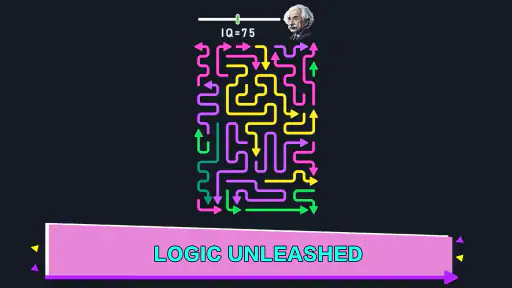

Analysis by Reviewed
Color Maze makes its promise through a simple visual idea: guide color along a maze by pulling and planning paths. My first impression is that this is a small, focused casual game rather than an elaborate puzzle adventure. Its appeal is the moment-to-moment act of looking at a route, deciding how to connect it, and seeing whether that plan carries the color where it needs to go. That gives it an easy-to-understand starting point without requiring a long tutorial or a big commitment.
I would reach for it when I have a few spare minutes and want something more involving than scrolling, but less demanding than a strategy game. The maze framing gives each puzzle a clear visual task, while the color-path idea keeps the central interaction easy to grasp. That combination is a good fit for short sessions: you can focus on one route, pause, and return without having to remember a complicated story or a large set of rules.
Who gets the most from a route puzzle
A realistic use for this kind of game is the small gap before a meeting or while waiting for someone to arrive. I would open it, inspect one board, and treat the route as a brief concentration exercise rather than something to play while juggling messages. If I have only a minute, I would avoid beginning a puzzle that already looks crowded; the pleasure comes from noticing how its turns fit together, not from rushing to clear it.
It is especially suited to players who enjoy spatial tasks but do not want a long setup. A parent and child can look at a board together and talk through possible turns, for example, without needing a shared account of characters or story events. That can make it a low-pressure way to take turns suggesting a route. It is less suitable as a lively group game: the central activity rewards looking closely, so a noisy room or a crowd offering conflicting suggestions can make the puzzle harder to enjoy.
How the maze’s visual language shapes play
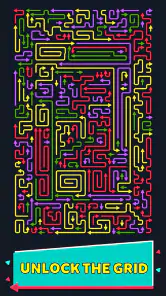
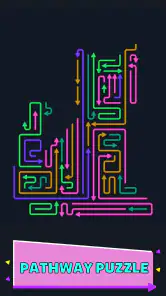
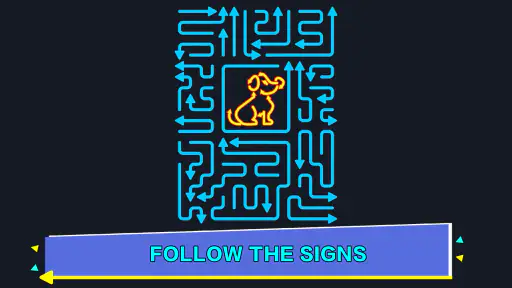
The setting is deliberately abstract: the maze and its colored paths do the communicating. That restraint is useful. In a puzzle built around routes, decorative detail can compete with the lines you need to read, so a clean visual language helps keep attention on planning. The color is not just a surface treatment; it is the clue that makes the route feel tangible and gives the board its identity.
That also means the experience depends on how comfortably you can distinguish the paths and read the maze. If you enjoy puzzles that ask you to scan a board and mentally trace possibilities, this format has a natural appeal. If you prefer richly illustrated places, characters, or a narrative reason to move through each level, the sparse setting may feel more like a tool than a world. I see that as a clear trade-off, not automatically a flaw: Color Maze puts the puzzle first.
A practical way to approach a new board is to look for the route’s constraints before making the first move. Trace the obvious corridor with your eyes, then check the turns and junctions that could force a detour. This small pause helps separate a genuinely workable path from one that only looks direct. In a game centered on pulling and planning color paths, careful observation can matter more than rushing to interact.
You May Like

Clash of Clans Is Won Between the Battles

Android Auto Makes the Case for Quieter Car Software

MobiOffice: Transforming Mobile Productivity with Seamless Integration

EA SPORTS FC™ Mobile Soccer: Redefining Mobile Sports Gaming

How Microsoft OneDrive Became a Mobile Productivity Giant

How Google Translate Breaks Language Barriers Effortlessly
The visual concept also makes the game easy to share with someone nearby. A friend can glance at the maze and suggest a route without needing much explanation. That makes it a handy pass-the-phone puzzle for a relaxed moment, although it is still best approached as a focused single-player-style task rather than a social game built around conversation or competition.
Sound and the pace of a short session
The game’s mood is shaped primarily by its visual task and its measured puzzle rhythm. I would not choose it for a sweeping soundtrack or a dramatic atmosphere; the appeal is the small pause between seeing a path and committing to it. That quiet pacing suits a casual maze, since it leaves room to think instead of pushing every move toward urgency.
For everyday use, that makes it a reasonable option during a break, while waiting for an appointment, or between other tasks. A useful habit is to finish a board before putting the phone away rather than starting one when you know you have only a moment. The short-session format is convenient, but a puzzle can still be more satisfying when you give yourself enough attention to inspect the route instead of tapping through by instinct.
Because the mechanics rely on reading colored paths, the experience is also more about visual concentration than audio cues. If you usually play with your phone muted, the core appeal should still be understandable from the board itself. On the other hand, anyone looking for sound-led action, strong sensory variety, or a high-energy pace should consider a different kind of casual game. Color Maze’s mood comes from calm focus, not spectacle.
Where the mechanics fit—and where they may not
As a casual puzzle, Color Maze sits between a classic line-drawing maze and more elaborate logic games. It has the immediate readability of finding a route through corridors, while the color-path framing gives that familiar task a specific visual hook. Compared with a typical match-three game, it asks for more spatial planning and less pattern matching. Compared with a large logic puzzler, it appears easier to approach in short bursts because the central idea is straightforward.
The trade-off is that a simple core can become repetitive if you want a steady stream of new mechanics, a campaign with a strong narrative, or a wide variety of puzzle types. I would not assume that a clear premise alone will keep every player engaged for long sessions. The best fit is someone who enjoys repeating a compact planning loop and finds satisfaction in making a route work, rather than someone who needs frequent changes of pace or a sense of progression beyond solving the immediate board.
One useful tactic is to plan from the endpoint backward when a path seems confusing. Starting with where the color needs to end can reveal which turns are essential and which apparent shortcuts are distractions. Another is to check junctions before committing: a route that passes a constrained corner too early may leave the remaining path awkward. These are small habits, but they make the puzzle feel more deliberate and reduce aimless trial and error.
It is also worth noticing how you use the game across different situations. If you are playing while distracted, the maze may feel less forgiving because the main challenge is visual planning. If you have a quiet few minutes, that same focus becomes the point. For a commute or a noisy waiting room, it can work as a compact attention task; for a moment when you need something that can be played almost entirely on autopilot, a simple arcade game may be a better choice.
Who should try it, and who should pass
I can see Color Maze working well for people who like route puzzles, clean boards, and a calm challenge that does not require learning a complicated rulebook. It is also a plausible choice for families: the content rating is Everyone, and the basic visual premise is easy to explain. That does not mean every child will find it engaging, but the accessible setup makes it easier to try together than a game built around advanced strategy or a dense story.
The game is free, and Beijing Youyoutang Technology Co.,ltd. is its developer. It has an average rating of 4.8 from around 651 thousand ratings, with over 5 million installs. Those figures suggest that the simple maze concept has found a broad audience, but popularity is not a substitute for personal fit. I would treat them as context, then decide based on whether this kind of route-planning loop sounds enjoyable to you.
On Android, the listed minimum requirement is version 6.0, and the current version is 1032. If you are checking whether it will run on a particular device, that operating-system requirement is the practical detail to compare with your phone’s software. The release date is October 30, 2025, so this is a relatively recent entry, but I would judge it by the play style rather than its age.
Since it costs nothing to try, I would use the first few boards as a fit check: do you enjoy tracing possibilities before acting, or do you keep wishing the game would move faster? That answer is more useful than guessing how long it might hold your attention. The Everyone rating also makes it approachable to consider for a family device, though the same visual focus means younger players may still need someone to explain the goal and help them read a complicated-looking route.
One practical trade-off is where you play. A small screen or bright glare can make careful route-reading less comfortable, so I would choose a moment when the board is easy to see rather than trying to solve it while walking or in a hurried queue. If you find yourself repeatedly losing track of a line, pause and scan the board again instead of making a series of speculative moves. That turns the puzzle into deliberate observation, which is where this format is strongest.
I would skip it if you mainly want a deep campaign, character-driven storytelling, a competitive leaderboard experience, or action that keeps changing from moment to moment. I would also look elsewhere if the sight of a maze makes you impatient; the core pleasure depends on stopping to inspect routes. For those preferences, a narrative puzzle, a fast arcade title, or a broader logic game is likely to offer a better match.
A calm puzzle mood with a clear limit
What I like most about Color Maze is the alignment between its visual idea and its pace. The colored route is both the thing you manipulate and the thing you must understand, so the board feels coherent rather than dressed up with unrelated decoration. That gives the game a distinct, quiet mood. Its strongest moments are likely to come when a route initially looks tangled, then becomes clear after a careful scan.
Its main limitation is the same focus that makes it approachable: the experience is built around one recognizable kind of task. If that loop clicks for you, the simplicity is refreshing. If you need levels to introduce new systems or a larger world to explore, the restrained presentation may not hold your attention. I would try it for a short puzzle break, not expect it to replace a more varied game in your rotation.
If you are choosing between this and a standard maze app, the deciding point is the color-path interaction: this is not simply about finding the exit as quickly as possible. If you would rather race a timer or wander through a maze with a more elaborate setting, another option will likely suit you better. If you like quietly working out how a route should connect, the compact focus here is a sensible reason to give it a try.
Overall, I recommend Color Maze to anyone who enjoys visually clear path puzzles and wants a low-pressure way to exercise spatial thinking in brief sessions. It is not the right pick for players seeking narrative depth or constant novelty, but it understands the appeal of tracing a route and committing to a plan. For me, that focused identity is its best quality—and the most useful thing to know before installing it.
Color Maze Frequently Asked Questions
What is Color Maze, and how do you play it?
Color Maze is a casual puzzle game centered on guiding color through a maze. You navigate passages and work toward filling or coloring the required spaces while avoiding blocked routes and planning around the maze’s layout. The exact objective and controls can vary by level or version, so check the instructions shown in the game before starting. It is designed for short play sessions and does not require advanced gaming experience.
Is Color Maze free to download and play?
Availability, pricing, and in-app purchases can depend on the store, device, and specific version of Color Maze. Check the app’s listing before downloading for any purchase price, optional paid features, or advertising disclosures. A game may be free to install but still include ads or offer purchases. Review the store page and the game’s purchase prompts carefully, especially if children use the device, and avoid assuming that every feature is available at no cost.
Does Color Maze work offline?
Many maze puzzles can be played without a continuous internet connection, but offline availability is not guaranteed for every release of Color Maze. The game may need internet access for its initial download, updates, advertisements, analytics, or online features. To check, open the game after installation with your device disconnected and see which modes remain available. Also consult the current store listing and permissions, since connectivity requirements can change with updates.
Is Color Maze suitable for children?
Color Maze’s maze-solving format may be approachable for younger players, but suitability depends on the particular version, its difficulty, advertisements, and any in-app purchases. Before handing it to a child, review the age rating and content information on the relevant app store, then check the game’s settings and purchase controls. If ads or spending prompts are present, consider using parental controls or playing together so children can ask for help when needed.
What should I check before downloading Color Maze?
Confirm that the store listing is for the Color Maze game you intend to install, as similarly named apps may be made by different developers and offer different features. Check device compatibility, the latest update date, user reviews, requested permissions, privacy information, and whether the game includes ads or in-app purchases. Download through the official Apple App Store or Google Play listing where available, and make sure your device has enough storage for the app and its updates.
Pros
- Simple swipe controls are easy to learn.
- Short levels make it suitable for quick play sessions.
- Colorful visuals make the maze paths easy to distinguish.
- Restarting a level is quick if you make a wrong move.
- No complex rules or lengthy tutorials to get in the way.
Cons
- Gameplay may feel repetitive after many levels.
- Some puzzles can be frustrating if a move is hard to undo.
- The minimalist presentation offers little variety between stages.
- Ads may interrupt play
- depending on the version.
- It may not appeal to players looking for a deep story or progression.

- Category
- Casual
- Version
- 1032