Cash Jar - Win Real Money Easy
- 194.00
- 4.8
- Installs
- 100.00K
- Price
- Free
Screenshots




Analysis by Reviewed
Cash Jar - Win Real Money Easy caught my attention because it takes an extremely simple idea and places it in a casual, reward-focused format: tap, return later, and see what becomes available to cash out. I approached it less like a traditional game with levels or a story and more like a small routine that can sit beside everyday activities. That distinction matters. If you want deep strategy, a dramatic world, or a long session, this is unlikely to replace your usual favorite. If you enjoy brief interactions and the appeal of checking progress throughout the day, its straightforward design makes sense.
Created by SpinZ Gaming LLC, this free casual game is aimed at Teen users and runs on Android 8.0 or later. The current version is 1.0.9, and its reception is notably strong, with a 4.8 average from around two thousand ratings. I also noticed that it has passed one hundred thousand installs, which suggests that the tap-and-return format has found an audience beyond people simply trying it once.
How Cash Jar turns a tiny action into a playable routine
The first impression is deliberately light
The first thing I felt while using Cash Jar - Win Real Money Easy was that it does not ask me to learn a complicated ruleset. The central action is tapping, and the store summary points to a reward and cash-out cycle that can be checked every three hours. That gives the game a very different pace from a conventional casual title. Instead of asking for a continuous block of attention, it fits into small gaps: while waiting for a bus, taking a short break, or checking a phone after lunch.
That simplicity is both the attraction and the main test. A game built around one repeated action has to make that action feel clear and worthwhile. Cash Jar benefits from not burying the basic loop under layers of menus or explanations. I could understand its purpose quickly, which is useful for anyone who dislikes spending the first few minutes of a mobile game learning currencies, upgrades, missions, and event screens.
At the same time, I would not describe the opening as a complete game introduction in the traditional sense. There is no reason to expect a narrative hook or a carefully staged tutorial adventure from this format. Its first impression is closer to opening a small digital reward jar and seeing what the next interaction offers. That makes it approachable, but it also means your interest depends heavily on whether you personally enjoy repeated, low-effort progress.
The important mindset is to treat it as a short-session reward game, not as an income replacement. The word “cash” may create expectations that are too high if read as a promise of dependable earnings. I found the experience more sensible when viewed as casual entertainment with a reward mechanic attached. Anyone installing it should also read the in-app cash-out instructions carefully and make sure the available requirements suit their expectations before investing time.
A setting built from suggestion rather than story
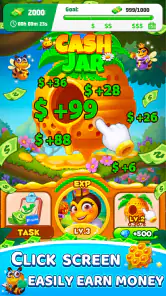
Cash Jar’s setting is easy to understand because the jar itself supplies the visual idea. It gives the game a compact identity: the player is not exploring a large map or managing a detailed character, but interacting with a container associated with collecting and rewards. That visual language is more practical than elaborate. It tells me what the activity is supposed to feel like without requiring a fictional world around it.
This minimal setting works particularly well for a game designed to be opened repeatedly. A busy fantasy environment might become tiring when the actual purpose is a quick tap. The jar concept keeps the focus on accumulation, waiting, and checking back. Even without a large narrative, there is a small sense of anticipation in returning to see whether the next interaction is available.
The trade-off is that the world does not provide much reason to stay for its own sake. In a puzzle game, I might continue because I want to solve a harder board. In a runner, I might chase a better route or score. Here, the setting mainly frames the reward loop. If the reward cycle stops feeling interesting, the surrounding presentation may not be enough to pull me back.
I think this is where the game’s visual direction and mechanics are most closely connected. The jar is not simply decoration; it represents the entire promise of the experience. It suggests something immediate, understandable, and repeatable. That coherence is a strength, although it also makes the game’s limited scope very visible.
Sound and rhythm matter more than complexity
With such a small mechanical vocabulary, rhythm becomes important. The game’s natural rhythm comes from the contrast between an immediate tap and the longer wait before the next cash-out opportunity. That pause gives the experience a gentle stop-and-start structure. I can interact, leave, and return later instead of feeling pressure to remain on screen.
That pacing is more relaxing than the constant escalation found in many casual games. There are no obvious demands to complete a long chain of actions before the moment is lost. For me, this makes Cash Jar easier to fit into a normal day. It can be part of a phone-checking habit rather than the habit itself.
The limitation is equally clear: players who need constant feedback may find the rhythm too thin. A tap-and-wait structure does not provide the rising tension of a timed puzzle, the satisfaction of building a deck, or the momentum of clearing a level. The appeal depends on enjoying anticipation in small doses. If you prefer a game that keeps presenting new challenges every few minutes, another casual option will probably be more rewarding.
The sound and visual presentation should therefore support clarity rather than compete with the action. In a game this focused, unnecessary noise would make the experience feel busier without making it deeper. What I value most here is the sense that the presentation serves the routine: tap when available, understand what happened, and leave without confusion. That kind of restraint is useful for a reward-centered game, even if it is less memorable than a highly stylized adventure.
Where the mechanics fit everyday use
The strongest practical use case is a person who wants a very low-commitment mobile activity. Imagine checking the game in the morning before work, interacting when the cycle is ready, and returning later during an afternoon break. The three-hour spacing creates a natural schedule without demanding a long play session. I would not set alarms solely for it, but I can see it fitting into moments when I already reach for my phone.
That timing also creates a useful trade-off. The game feels less intrusive than an always-on title because it does not appear designed around continuous play. However, it may be less satisfying for someone who wants to make visible progress whenever they have free time. Once the available interaction is finished, there may be little reason to remain in the app until the next opportunity. That is not necessarily a flaw; it is simply the consequence of choosing a scheduled reward loop.
One non-obvious way to use it is as a boundary around phone time. Instead of opening a game and losing half an hour to repeated rounds, I can check Cash Jar briefly and close it. Its narrow purpose makes it easier to keep the session short. The downside is that this only works if I resist repeatedly checking before the next cycle is ready. The best experience comes from treating the interval as part of the design, not as an obstacle to defeat.
Another useful habit is to separate entertainment value from withdrawal expectations. I would first decide whether the tapping loop is enjoyable even when the reward is modest or delayed. Then I would inspect the cash-out process and any conditions shown inside the app before spending regular attention on it. This approach protects the experience from becoming frustrating and helps distinguish a casual reward game from a financial tool.
What the game does better than familiar alternatives
Compared with a standard idle game, Cash Jar appears more direct. Idle games often surround passive progress with upgrades, production chains, character systems, and increasingly complex decisions. Those systems can be satisfying, but they also require more attention and can make the screen feel crowded. Cash Jar’s appeal is the opposite: a smaller loop with a clear reward-oriented purpose.
Compared with tap-to-earn apps that rely on a large collection of tasks, this game’s identity is easier to grasp. There is less need to decide which activity to perform next. That can be a relief for users who do not want surveys, offers, or a list of unrelated actions competing for attention. On the other hand, task-based alternatives may offer more variety, while Cash Jar is more dependent on whether its central tap remains engaging.
It also differs from ordinary casual games because the reward theme is part of the motivation. A match-three title can keep me playing through level design alone; a runner can rely on mastery and score chasing. Cash Jar is better suited to someone who wants a quick interaction with a practical-feeling objective. It is not the better choice for a player seeking expressive art, deep sound design, character development, or a skill ceiling.
The game’s audience size and rating suggest that the uncomplicated approach works for many people, but popularity does not remove the need for personal fit. I would recommend it to a friend who enjoys checking small progress markers during the day. I would skip it for a friend who becomes annoyed by waiting, expects substantial returns from mobile play, or needs fresh challenges every session.
Small details that affect whether the loop stays pleasant
The first detail I would watch is the relationship between the three-hour cycle and my own routine. If I naturally use my phone at similar intervals, the schedule feels convenient. If my day is irregular, the timing may feel easy to miss or may encourage unnecessary checking. The game works best when it supports an existing habit rather than creating another obligation.
The second is patience. A simple reward loop can feel rewarding at the beginning because the action is new, but repetition exposes its limits quickly. I would give it a short trial based on whether I enjoy the act of returning, not only on the promise of cashing out. If the waiting period feels like dead time, no amount of attractive wording around rewards will make the core loop a good match.
The third is responsible expectation-setting. Since the title emphasizes real money, I would avoid making decisions based on the name alone. I would check the withdrawal screen, understand the applicable threshold or steps displayed there, and confirm that the process is practical for me. Those checks are not chores to ignore; they are part of evaluating whether this particular reward game deserves a place in my routine.
A fourth insight is that the game may work better as a background habit than as a primary game. I would open it after completing something else, such as during a break or while waiting for an appointment, rather than reserving a dedicated gaming session. This keeps its limited mechanics from feeling repetitive and lets the compact presentation do what it does best: provide a quick, clearly framed interaction.
Who should install it, and who should pass
I see Cash Jar as a reasonable choice for Android users who want a free casual title with a very low learning curve. The Teen content rating is worth keeping in mind for families, and the Android requirement means devices running version 8.0 or newer are the intended audience. The game’s current version, 1.0.9, also makes it sensible to keep the app updated through the normal store process so the installed build matches the one being maintained.
I would recommend it to people who like short check-ins, simple reward loops, and a calm pace. It may also suit someone who has tried more complicated earning-style apps and wants something less cluttered. The jar theme, tap-focused interaction, and spaced return cycle form a consistent package rather than a collection of unrelated mini-games.
I would not recommend it as a substitute for work, a reliable source of money, or a full-featured casual game. Players who want strategic decisions, story progression, competitive rankings, or substantial audiovisual variety should choose a different category of game. Even fans of reward apps may prefer a broader alternative if they want several activities instead of one repeated action.
My atmosphere verdict after using it
Cash Jar succeeds when its modest ambition is understood clearly. Its art direction centers on a recognizable jar-and-reward idea, its setting stays compact, and its pacing is built around brief taps followed by a wait of roughly three hours before the next cash-out opportunity. Those choices create a coherent mood: light, simple, and oriented toward occasional checking rather than extended play.
That coherence is more valuable than pretending the game offers depth it does not have. I enjoyed the fact that I could understand the purpose quickly and fit it into an ordinary day without learning a complicated system. I also found the limitations impossible to ignore: the central action can become repetitive, the scheduled rhythm will not suit everyone, and the reward focus requires sensible expectations.
With around one hundred thousand installs and a 4.8 average from roughly two thousand ratings, it has clearly attracted a positive audience. Still, I would make the recommendation personal rather than universal. If you want a free, casual tap-based routine and are comfortable checking the in-app cash-out details before committing time, it is worth trying. If your priority is rich gameplay or dependable financial value, I would look elsewhere.
My final view is that Cash Jar - Win Real Money Easy is best used in small portions. Open it when the timing fits, enjoy the simple interaction, and judge it by whether the routine remains pleasant without exaggerating what it can provide. As a compact reward game, it has a clear identity and a consistent mood. Its success depends less on technical complexity than on whether that restrained rhythm matches the way you already use your phone.
Pros
- Simple interface makes it easy to browse games and available cash rewards.
- Short activities can fit conveniently into quick spare-time sessions.
- Multiple earning options may keep the experience from feeling repetitive.
- Reward progress is usually visible
- helping users track their accumulated balance.
- Free to download
- so you can try the app without an upfront purchase.
Cons
- Earnings may be very small compared with the time required to complete tasks.
- Cash-out eligibility can depend on minimum thresholds and account verification.
- Reward availability may vary by country
- device
- or promotional campaign.
- Frequent ads can interrupt gameplay and reduce the overall user experience.
- Some tasks may redirect you to third-party offers or require extra permissions.
- Category
- Casual
- Version
- 1.0.9