Arrow Dash Cash
- 0.00
- 0.0
- Installs
- 100.00K
- Price
- Free

Screenshots

Analysis by Reviewed
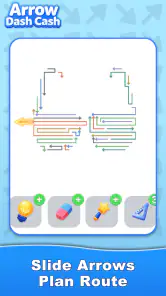
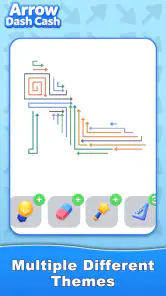
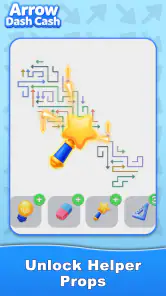
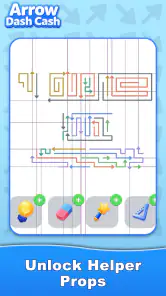
I approached Arrow Dash Cash as a quick, casual puzzle rather than a game meant to occupy an entire evening. Its central idea is easy to understand: arrows move in the direction they point, and I have to clear a safe route by choosing the right order. That sounds simple, but the appeal comes from turning a small visual problem into a sequence of decisions. One careless choice can leave another arrow blocked, so the real challenge is reading the board before tapping.
My overall view is that this is best enjoyed in short sessions. It has the kind of straightforward premise that works when I want something light, focused, and immediately playable. It does not ask me to learn a complicated control scheme or understand a long story before getting started. At the same time, anyone looking for deep progression, a large strategic system, or a competitive multiplayer experience should approach it with different expectations. The value here is concentrated in the puzzle itself.
Why the arrow-order idea works
The strongest part of the design is the relationship between direction and space. Each arrow gives me information about where it wants to travel, but that information is only useful if the route is open. I cannot treat every piece as an isolated tap. I have to inspect the surrounding paths, decide which movement will free another one, and avoid making an early move that closes off the solution.
That creates a pleasant change of pace from casual games built around constant speed. The important moment is often before the tap, when I pause and scan the arrangement. A board can look crowded without being difficult, while a seemingly open layout can punish a rushed decision. The game therefore rewards careful visual planning over random tapping, which gives its simple premise more substance than the short store wording suggests.
I also like how naturally the concept fits mobile play. A directional puzzle can be understood with one glance, and the interaction feels suited to a phone held in one hand. This makes it a practical choice for a short break, a wait in a queue, or a few minutes after finishing another task. I do not need a long uninterrupted session to appreciate what the game is asking me to do.
One useful habit is to trace each arrow mentally before touching anything. I look for the pieces whose routes appear least obstructed, then consider whether moving one of them exposes a better option. This is more reliable than simply choosing the arrow nearest to an edge. An edge position may look safe, but its movement can still interfere with another route depending on the arrangement.
A second habit is to identify bottlenecks. If several arrows seem to depend on one open lane, that lane becomes the board's key resource. I try to understand which move protects it and which move might consume it too early. This turns the game from a visual reaction test into a compact exercise in ordering and space management.
That small distinction is important. A generic casual game may keep me busy through rapid input, bright rewards, or repeated swipes. Here, the satisfying moment comes from recognizing the sequence before executing it. When the order is right, the board clears in a way that feels earned. When I fail, the mistake is usually understandable: I missed a blockage, assumed a route was available, or acted before checking the remaining arrows.
Useful ways to play without rushing
I found that the best approach is to separate observation from action. First, I scan the entire arrangement. Next, I choose a likely opening move and imagine what the board will look like afterward. Only then do I tap. This extra pause is especially helpful when several arrows point toward nearby spaces and the first movement could affect multiple possibilities.
Another practical technique is to work backward from the most restricted arrow. If one piece has only one plausible route, I treat it as a clue rather than immediately moving it. I ask which other arrows must disappear before that route becomes usable. That question often reveals the intended order more clearly than starting with the most obvious-looking piece.
I would also avoid playing while distracted. The controls may be simple, but the puzzle depends on noticing relationships between several arrows. A noisy commute or hurried break can make the game feel more frustrating than it really is. When I give it a little attention, the same board becomes calmer and more readable.
For a realistic everyday example, I can see myself opening it while waiting for a coffee or sitting down for a short rest between errands. I would play a few boards, stop when my attention shifts, and return later without needing to remember a story or a complicated objective. That makes it more convenient than a longer casual title that expects a substantial commitment every time it opens.
It is also a reasonable option for someone introducing a younger player to basic sequencing and spatial thinking. The content rating is Everyone, and the premise is accessible without relying on frightening themes or mature subject matter. I would still recommend that adults judge the experience according to the child's patience, because an easy-to-understand rule is not the same as a puzzle that every child will find easy.
Where the simplicity becomes a limitation
The same narrow focus that makes the game approachable can also limit its appeal. If I want character development, exploration, a strong narrative, or a broad collection of mechanics, this is not the right destination. The arrow-order puzzle is the main event, so players who lose interest once they understand the basic pattern may find the experience too restrained.
There is also a natural risk of repetition. Rearranging directional pieces can remain satisfying when the layouts make me reconsider my assumptions, but the formula needs enough variation to stay fresh over time. I would not choose this as my only mobile game. It works better as a focused side activity than as a replacement for a larger puzzle collection or a more varied casual game.
Another point of friction is the possibility of overthinking. Because the board invites planning, I can spend too long trying to prove a sequence before making the first move. That is not a fault in the controls, but it affects the rhythm. I get the most from it when I plan enough to avoid obvious mistakes, then allow myself to test a reasonable move instead of searching endlessly for certainty.
Players who prefer immediate feedback may need a short adjustment period. The game is not primarily about tapping quickly; it asks me to notice consequences. Someone accustomed to match-style play or endless runners may initially find the quiet pace less exciting. In those cases, a faster alternative may be a better fit for a commute or a moment when the goal is pure stimulation rather than concentration.
I would also be cautious about treating the title as a serious strategy game. It offers a compact logic challenge, not the kind of long-term planning found in a complex board-game adaptation or a deep tactics title. That comparison helps set the right expectations: the pleasure comes from solving the immediate arrangement, not from building a persistent strategy across a campaign.
Who will get the most from it
Arrow Dash Cash is a good match for players who enjoy visual puzzles, orderly problem-solving, and short mobile sessions. If I like looking at a board, spotting dependencies, and feeling a small burst of satisfaction when the correct sequence becomes clear, the design has a clear appeal. It is especially suitable for people who want something more thoughtful than a reflex game without taking on a complicated ruleset.
The free price also lowers the barrier to trying it. I can install it without treating the decision as a major purchase, which suits a casual game built around quick experiments. The developer is Kashif Iqbal, and the game has reached over one hundred thousand installs, suggesting that its uncomplicated concept has found an audience beyond a tiny group of puzzle enthusiasts.
Its Everyone age rating makes it easier to consider for shared devices and family-friendly play. Still, I would recommend it most strongly to people who enjoy the act of solving rather than players who need a constant stream of new activities. A child, parent, or older player can understand the basic objective quickly, but enjoyment will depend on whether arranging moves feels rewarding to that person.
I would skip it if my main priority were action, social competition, elaborate customization, or a story with memorable characters. I would also look elsewhere if I wanted a game that could absorb a long flight or a full evening without feeling repetitive. A broad puzzle suite would offer more variety, while an action-oriented casual title would provide a more energetic pace.
For someone unsure whether it will run on an older phone, the listed minimum operating system is Android 7.1. The current version is 202600701-1723, so I would check the device's software compatibility before installing, particularly if the phone has not been updated in a long time. That is a practical consideration for a lightweight game intended to be easy to pick up across different everyday situations.
How it compares with familiar casual alternatives
Compared with a match-three game, this title places less emphasis on creating chains and more on preserving a route. I am not searching for identical symbols or chasing a high-scoring combination; I am deciding which movement must happen first. That makes it a better choice when I want a logic problem and a weaker choice when I want colorful momentum and frequent rewards.
Compared with an endless runner, the contrast is even clearer. An endless runner tests reaction and timing while the world moves toward me. Here, I control the pace by studying the arrangement. Someone who plays games to switch off completely may prefer the runner, but someone who enjoys a quiet mental task may appreciate the control this format gives me.
Traditional sliding-block puzzles can offer a deeper sense of long-range planning, especially when every move changes the whole board. Arrow Dash Cash feels more immediately readable because the directional goal is visible from the start. The trade-off is that it may not provide the same layered complexity as a dedicated strategy puzzle. I see it as a convenient middle ground: more thoughtful than a purely reflexive diversion, but less demanding than a full puzzle system.
That middle position is its clearest strength. I can recommend it to a friend who says, “I want something casual, but I do not want to match colored tiles for the hundredth time.” I would not recommend it to the same friend if they asked for a game with a campaign, a social layer, or substantial character progression. Matching the game to the mood matters more here than chasing a universal recommendation.
My final assessment
After spending time with it, I see Arrow Dash Cash as a focused casual puzzle with a clear thesis: the order of movement matters more than speed. Its best moments come from reading the board, protecting open paths, and turning a crowded arrangement into a clean sequence. The controls are easy to approach, the concept works well in short sessions, and the Everyone rating broadens its potential audience.
Its limitations are equally clear. The experience depends heavily on the continued interest of its arrow-order puzzles, so players seeking variety or a larger progression system may outgrow it. It is not the game I would choose for action, storytelling, or a long uninterrupted session. I would treat it as a compact mental break rather than a complete all-purpose mobile hobby.
My recommendation is specific: try it if you enjoy visual logic, prefer deliberate decisions to frantic tapping, and want a free game that can fit around ordinary parts of the day. Before each move, scan for bottlenecks, consider the most restricted route, and resist the urge to tap the first obvious arrow. That small change in approach reveals the design at its best.
For me, the game succeeds because it keeps its promise without pretending to be something larger. It offers a simple board, a meaningful order of operations, and just enough uncertainty to make each arrangement worth examining. If that focused loop sounds appealing, Arrow Dash Cash is worth a try; if I wanted a broader or more energetic casual experience, I would choose a different kind of game instead.
Pros
- Quick
- simple gameplay suited to short breaks.
- Easy-to-learn controls make it accessible for casual players.
- Lightweight design should run well on many Android devices.
- Bright visuals make targets easy to recognize during play.
- Short rounds encourage repeated attempts without a large time commitment.
Cons
- Gameplay may feel repetitive after extended sessions.
- Progress can depend heavily on accuracy and timing.
- Small screens may make precise aiming more difficult.
- The cash-themed rewards may create unrealistic expectations.
- Performance and reward availability may vary by device or region.

- Category
- Casual
- Version
- 202600701-1723