 About Prison Break: Stick Story
Prison Break: Stick Story Is a Quick Escape, Not a Lasting Adventure
Some mobile adventures ask you to learn a world; Prison Break: Stick Story asks you to make a decision, watch it go wrong, and try again. That difference is the whole contest. Against Roblox’s player-made sprawl, Pokémon GO’s real-world routines, and the broader exploration of Super Bear Adventure, this is the quick-hit choice: a sequence of prison-escape puzzles built around timing, observation, and the pleasure of seeing a plan fall apart. It is easy to sample and harder to treat as a long-term destination.
What it is up against
The rivals here are not four versions of the same game. Roblox is a platform of changing experiences, so its appeal comes from variety and other players. Pokémon GO folds collection and battles into everyday walks, giving a short session a reason to happen outside the game. Super Bear Adventure is the more traditional adventure: a character to guide, spaces to explore, and progress that feels like a journey. School Party Craft leans into a different kind of freedom, with an open-ended social and creative setting.
Against those choices, Prison Break: Stick Story is deliberately narrow. It does not promise a community, a living map, or a sprawling world. Its appeal is a compact premise: get out of prison by reading a scene and choosing what to do next. The question is not whether it has more content than its competitors. It does not. The useful question is whether a focused, funny puzzle sequence fits the way you actually play on a phone.
Where it wins immediately
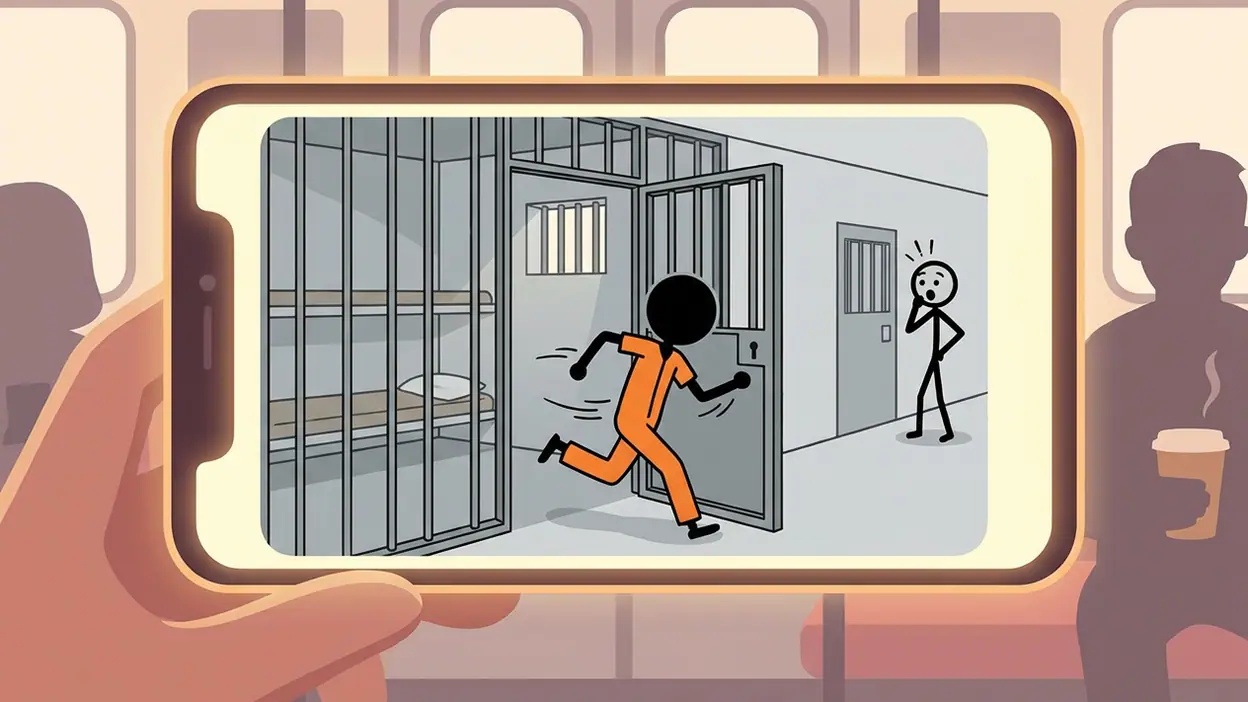
The first advantage is clarity. You can understand the basic appeal without a long tutorial or a commitment to a larger system. A scenario presents a problem, the player makes a choice, and the result supplies either a small payoff or a reason to rethink the plan. That brisk exchange gives the game an almost comic rhythm: setup, decision, consequence. When a choice produces an unexpected outcome, failure can be part of the entertainment rather than a punishment.


That rhythm suits short sessions exceptionally well. Roblox can ask you to pick an experience before the real play begins. Pokémon GO often feels most rewarding when you are already out walking, and a platform adventure naturally invites more time than a single puzzle. Prison Break: Stick Story has a lower entry cost in attention. You can open it for a quick round and leave without needing to remember a quest, coordinate with friends, or return to a particular location.
It also has a cleaner comic hook than its competitors. Escaping prison gives each decision an immediate context, and the stick-figure presentation keeps the situations light rather than grim. This is not a tense simulation of incarceration; it is a cartoon escape fantasy. That directness helps the game communicate quickly, especially to players who prefer visual gags and simple cause-and-effect over dense menus or layered progression.
Where the rivals stay stronger
The same focus that makes the game approachable also caps its reach. Roblox can keep changing because its experiences and social interactions vary. Pokémon GO can turn a familiar route into a collection loop and tie progress to places beyond the screen. Super Bear Adventure gives exploration room to breathe. In each case, a player can form a broader routine or attachment. Prison Break: Stick Story has a much smaller promise: solve the next situation, enjoy the result, and see what follows.
Latest News


That limitation matters most for replay value. A choice-based puzzle is satisfying when you are curious about the alternatives, but once the outcomes become familiar, curiosity fades. The game’s central joke can carry a scene; it cannot automatically make the same scene feel new on a return visit. By contrast, a changing Roblox experience, an outdoor Pokémon GO session, or a new stretch of an adventure can supply fresh context without relying on a surprise punchline every time.
School Party Craft and Roblox also leave more room for self-directed play. If you want to build, socialize, experiment, or invent your own objective, a short escape puzzle is the wrong tool. Prison Break: Stick Story gives you a prompt and asks for a response; it does not hand over a playground. That distinction is worth knowing before you download it. Players who call freedom the main attraction will likely feel the boundaries quickly.
Daily-use differences that matter
These games fit different gaps in a day. Prison Break: Stick Story is best suited to a brief pause when you want an immediate prompt and a visible outcome. It asks little of your memory, and its basic premise is easy to resume. Pokémon GO is a better companion to a walk or a familiar daily route, where its real-world layer gives the routine purpose. Roblox makes sense when you have time to choose an experience and settle into playing with others or exploring a new one.
Super Bear Adventure is the stronger pick when you want a conventional session: move through a world, look around, and make progress at your own pace. School Party Craft suits a player who wants to drift between activities rather than follow a tightly framed escape scenario. These differences are not minor features. They determine whether a game feels like a pleasant five-minute diversion or an activity you plan your evening around.
There is a welcome lack of ceremony in the escape-game format. You do not need to think about where you are in a map or what a group of friends expects you to do. The trade-off is that a compact session can feel disposable. A game that is effortless to pick up is not necessarily one that gives you a compelling reason to return tomorrow.
Speed, usability, and the hidden trade-off
On speed, Prison Break: Stick Story has the natural advantage. Its play is built around short decisions rather than the exploration, collection, or social coordination that can stretch a session elsewhere. That makes it a sensible choice for players who dislike long openings and want the premise to arrive quickly. Its simple visual language also keeps the focus on the immediate puzzle instead of asking you to learn a complicated control scheme.
But speed is not the same as depth. A compact game can be easy to understand and still run out of surprises. The best version of this format keeps choices legible without making the outcomes feel obvious. If you begin predicting the result before you tap, the quick pace starts to expose the thinness beneath it. Larger rivals take longer to get going, but they can reward that extra time with more systems, places, or social variation.
The surprising advantage here is also the weakness: limited scope makes the game remarkably easy to recommend as a trial. You can see whether its humor and decision loop work for you without first signing up for a sprawling commitment. Yet that same narrowness means it is hard to recommend as a substitute for an adventure you can inhabit. Treat it as a pocket-sized diversion, not as a rival that will match another game’s breadth.
Who should choose each option
Choose Prison Break: Stick Story if you want quick, self-contained puzzles, a playful escape premise, and a game that gets to its point without demanding a long session. It makes the most sense for casual players who enjoy testing choices and seeing the immediate comic consequence. If you are browsing for a lightweight adventure rather than a persistent world, it has a clear case.
Choose Roblox if variety and player-made experiences matter more than a single authored loop. Choose Pokémon GO if walking, collecting, and a real-world routine are part of the appeal. Choose Super Bear Adventure if exploration and a more familiar platform-adventure structure sound better. Choose School Party Craft if you want open-ended activities and room to make your own fun. None of these choices is an all-purpose upgrade; each is better at a different kind of play.
The best-value verdict
For sheer range, Roblox is the tougher competitor to beat, while Super Bear Adventure is the more satisfying choice for a player who wants a coherent adventure. Pokémon GO offers a distinct daily habit that none of the others replicate. Prison Break: Stick Story earns its place by asking less of you. Its value is not measured in hours of exploration but in how readily it turns a spare moment into a small, complete game session.
That is a narrow value proposition, but a useful one. If you already have a favorite world to explore, this probably will not replace it. If you often want something lighter than a sprawling game, its short decision-and-consequence loop is the point. The potential drawback is equally plain: once the surprises stop landing, there is less here to sustain a habit.
My recommendation is straightforward: try Prison Break: Stick Story for quick puzzle entertainment, not for a deep adventure or a long-term social game. It wins on immediacy, approachable humor, and the convenience of a self-contained escape scenario. It loses on breadth and staying power to rivals built around exploration, community, or real-world routines. If that trade sounds right, it is a good change of pace; if you want a world to live in, pick one of the bigger adventures instead.