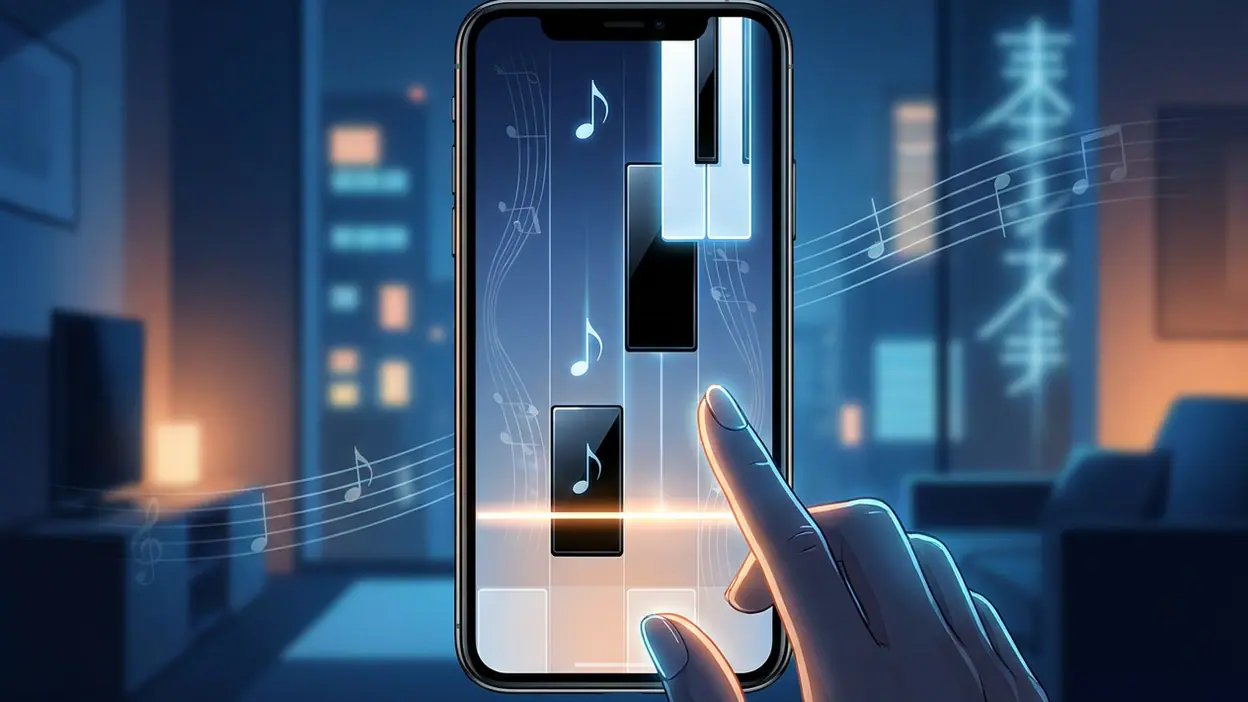
 About Piano Game: Classic Music Song
Piano Game: Classic Music Song Shows Where Tap-to-Play Falls Short
A piano game can still make a thumb feel like a conductor’s baton: one clean tap catches the beat, a missed note breaks the spell, and the next song is already tempting you back. But the category has grown beyond that simple thrill. Players now expect a music game to deliver readable timing, a satisfying sense of performance, and enough variety to make a familiar tap-to-the-beat loop worth repeating. Piano Game: Classic Music Song is a useful measure of that shift: it understands the appeal of instant play, while showing how narrow the old formula can feel when the music and interaction do not evolve together.
The standard is no longer just hitting the notes
The basic contract of a mobile piano game remains easy to grasp. Notes travel toward a target; tap the right tile at the right moment; keep the streak alive. The appeal is physical as much as musical. A short run of accurate taps turns into a little performance, with the player listening for the pulse while watching the screen for the next cue. It works in a queue, on a commute, or in the few minutes before bed because the rules need almost no explanation.
That accessibility is now the baseline, not the selling point. A competent game needs clear lanes, responsive taps, a forgiving introduction, and a difficulty curve that gives both casual players and rhythm-game regulars a reason to continue. It also needs to communicate why a song matters in play. Does a chorus bring a faster pattern? Does a sustained note ask for a different gesture? Does a successful run build toward a musical payoff? The category is moving from “recognize the tune and tap” toward “feel the arrangement through your hands.”
In Piano Game: Classic Music Song, the strongest signal is its commitment to the low-friction version of that promise. It puts the central action first: follow the notes, hold concentration, and try to stay on the song’s path. There is no elaborate world to learn before the music begins. That directness is a real strength for newcomers, particularly anyone who wants a quick rhythm challenge rather than lessons in music theory or a full instrument simulator.


The loop has a pleasingly clear tension. Early notes let you settle into the beat; a denser passage asks you to read ahead instead of reacting at the last instant. A clean streak makes the next sequence feel manageable, while one slip can turn a relaxed session into a small test of nerve. The replay impulse comes from that gap between a run that was good and a run that might have been perfect. It is the same compelling arithmetic that has kept falling-tile games alive: one more attempt, this time with steadier hands.
What the familiar formula still gets right
The game follows several conventions for good reason. A vertical stream of notes gives the eye a predictable path, and tapping tiles is more immediately legible on a touchscreen than trying to reproduce a piano keyboard in miniature. Song-based progression also supplies a natural unit of play: a track has a beginning, a build, and an ending, so each attempt feels complete even when it lasts only a few minutes. For mobile play, that compactness matters.
There is also value in keeping the entry point simple. A player who has never touched a real piano can still understand a successful run as a sequence of well-timed decisions. The game does not need to make that player feel foolish for missing a note. A good rhythm game teaches through repetition, letting the hands learn the timing before the mind has time to overthink it. Piano Game: Classic Music Song gets the appeal of that accessible challenge, even if the larger category has begun asking more of it.
Latest News

The convention it challenges is the assumption that a piano-themed interface is enough to make a music game feel musical. Tapping a tile can be satisfying, but the gesture risks becoming interchangeable if every passage is just another set of rectangles arriving at the same pace. The piano theme promises touch, phrasing, and melody; the mechanics need to make those ideas felt, not merely decorate a tap test with a keyboard setting. This is where the genre’s next step lies: not necessarily more complicated controls, but more deliberate variation in how songs ask to be played.
Related games clarify the distinction. Tiles Hop Music & Ball Game turns rhythm into movement, asking players to guide a bouncing ball across a changing path. The musical response is tied to navigation, so the player’s body of attention shifts from lane-reading to steering. Magic Tiles 3™ - Piano Game stays closer to the familiar tile structure but demonstrates how a more extensive song catalog and performance framing can make repetition feel like a larger routine rather than a series of isolated tests.
Other neighboring products stretch the promise in different directions. Real Drum electronic drums set makes the instrument itself the interaction, inviting users to strike a kit rather than follow a note highway. Piano - Music Keyboard & Tiles sits closer to the boundary between game and practice, while Piano Music Go-EDM Piano Games shows how electronic arrangements can shift the energy and pattern language of the standard format. These comparisons are not a scoreboard. They show that “music game” now covers several distinct desires: reflex play, instrument-like control, song collection, and a taste of learning.
The emerging standard is therefore a combination, not a single feature. Players increasingly expect the song to shape the challenge, rather than serve as a soundtrack beneath a generic pattern. That can mean recognizable changes in density, gestures that reflect the music, and difficulty settings that feel authored instead of merely faster. It also means a collection should offer more than a long list: strong curation, a clear sense of progression, and enough stylistic range to change the way a session feels.
There is a practical side to that standard, too. A mobile rhythm game has to respect the realities of a small screen and short attention spans. Notes need to remain readable at speed; touch response must feel dependable; and the game should make a missed beat understandable rather than arbitrary. Players should be able to see how they are improving, whether through a better score, a longer streak, a harder arrangement, or simply a song that once felt chaotic and now feels comfortable. Those details create stickiness without demanding a complicated social system or a sprawling feature list.
The category still lags in the relationship between music and mechanics. Many piano games rely on the same visual grammar for vastly different pieces, which can flatten a lively melody into a procession of taps. Some also confuse quantity with variety: more tracks do not necessarily mean more interesting play if the patterns, pacing, and feedback barely change. And while a familiar song can hook a player quickly, a game must be thoughtful about how its library is presented and what it asks users to do to access it. Friction around music selection can undo the goodwill built by a smooth first run.
For users, the consequence is a higher bar for “simple.” A streamlined game is still welcome, but simplicity should feel intentional. Newcomers need an immediate route into the rhythm; regular players need a reason to refine their timing; and anyone drawn by the piano theme should find at least a hint of musical expression beyond keeping a streak alive. When those needs line up, a short session can feel like a performance. When they do not, the game may remain playable while losing its ability to surprise.
Piano Game: Classic Music Song makes the enduring appeal of the genre easy to see: a clear beat, a narrowing window, and the little rush of getting through a song cleanly. Its limitations are also instructive. The category can no longer rely on falling tiles and familiar melodies alone to feel fresh. The next generation of piano games will keep the instant accessibility, but give each song a more distinctive physical character and each replay a clearer purpose. Until then, this is a straightforward invitation to tap along, and a reminder that the best rhythm games make the music feel like it is asking something specific of your hands.