 About Candy Crush Saga
Candy Crush Saga Is a Sweet Short Break—Until Lives and Difficult Levels Get in the Way
Candy Crush Saga is easiest to recommend when you know what you want from it: a bright, compact puzzle to fill a few spare minutes, not a game that respects every limit on your time, patience, or data. Its familiar match-three board still has a satisfying snap, and a good cascade can turn a dull wait into a small victory. But the same design can make a quick break feel like a negotiation with lives, boosters, and a level that refuses to budge. The right verdict depends less on whether you enjoy matching candy than on how you plan to play.
Decision premise: a tiny puzzle with a long tail
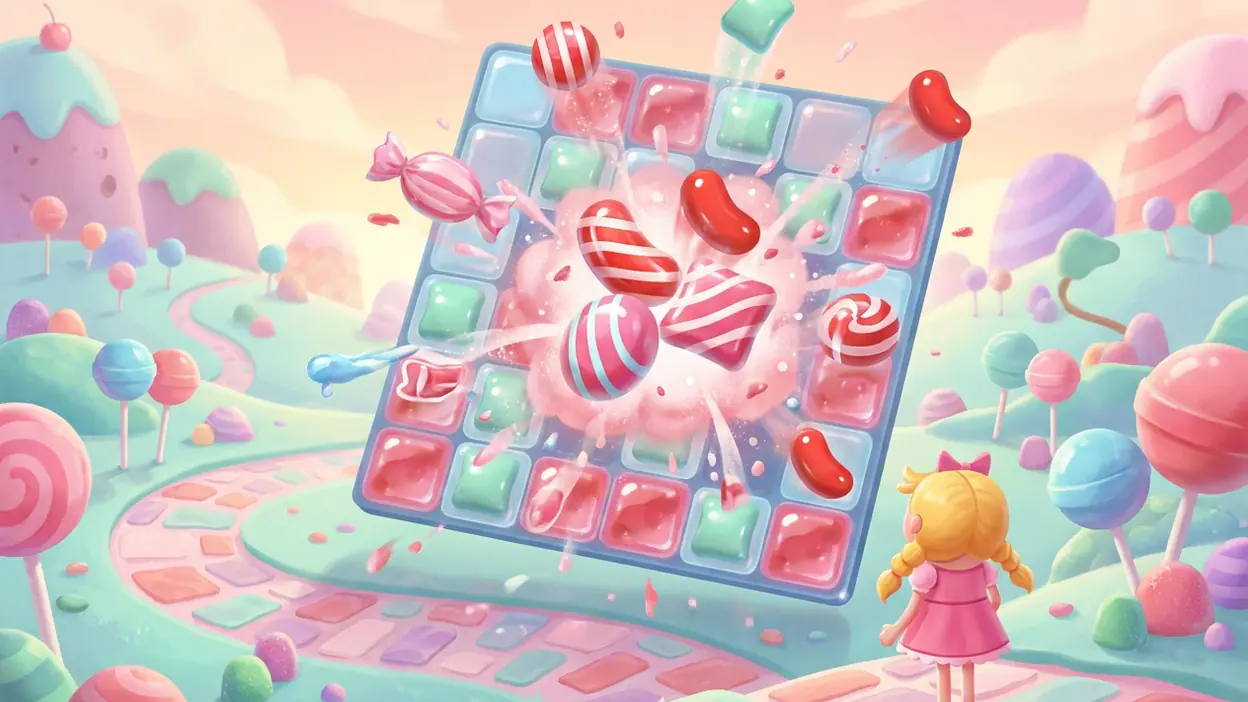
The central loop is simple: swap adjacent candies to make matches, clear the level’s objectives, and move along a winding map. The board explains itself almost immediately. The challenge comes from matching the right pieces while working around blockers, jelly, chocolate, or other obstacles, often with a strict move limit. When a match triggers a chain reaction, candies tumble into place and the board seems to solve itself for a moment. That little burst of motion is the game’s signature reward.
Yet Candy Crush is not just a stack of isolated puzzles. It is built to draw you from one level to the next, with lives limiting how many failed attempts you can make before waiting or finding another way to continue. Events, timed rewards, and boosters add reasons to return. This structure makes the game unusually easy to pick up and unusually good at turning “one level” into a longer session. Adopt it if you enjoy short puzzles and can leave a difficult board unfinished. Test it cautiously if waiting, repeated failure, or purchase prompts tend to frustrate you.
The beginner case: a friendly first hour
For a new player, the opening stretch is welcoming. The rules arrive through play rather than a dense tutorial: line up three or more candies, watch them disappear, and learn how special combinations affect the board. Early levels leave room to experiment, so a newcomer can see why a striped candy clears a row or column without needing to study a manual. The colorful feedback makes cause and effect easy to read, even on a small screen.


That accessibility is real, but it should not be mistaken for a promise that every level will stay gentle. The game gradually adds more specific objectives and obstacles, and a move that looks productive may not help with the actual goal. Newcomers should pay attention to the level target before making the first swap. The most useful habit is to look for combinations that solve the objective, not simply the biggest match available.
Recommendation: adopt if you want an immediately understandable puzzle and are comfortable treating a failed attempt as information. A beginner who expects a steady, effortless climb should test it first; the early warmth eventually gives way to deliberate difficulty.
The frequent-user case: satisfying rituals, deliberate friction
For someone who returns every day, the game’s rhythm is the attraction. A level can take only a minute or two, and the next board is always waiting. Daily rewards and rotating events give regular players small goals beyond clearing the map. The loop has a pleasing cadence: inspect the board, make a few purposeful swaps, watch a cascade, then decide whether to spend another life on the same challenge.
Latest News


That last decision is where the design becomes less generous. Lives can run out while a player is learning a hard level, and a run of unlucky boards can interrupt the habit just as it becomes enjoyable. Boosters can soften the pressure, but they also complicate the feeling of a clean win: was the board solved through a good plan, or because a saved power-up removed the worst obstacle? A frequent player may enjoy building a small stock of tools, but should not assume that every obstacle has a satisfying skill-based answer.
Recommendation: adopt with limits if you like a recurring puzzle ritual and can stop when lives run dry. If you want uninterrupted play, or dislike a game that places a timer between attempts, skip it. Its best daily sessions are the ones you choose to end, rather than the ones an exhausted streak keeps extending.
The constrained-device case: easy to run, not always easy to live with
Candy Crush’s basic play is well suited to a phone: touch controls are direct, boards are readable, and a level does not demand a long stretch of concentration. It is a natural fit for a commute, a waiting room, or a short break. The uncomplicated presentation also means the core puzzle does not ask for the reflexes or visual precision of a fast action game.
Still, “small puzzle” does not mean “no device constraints.” The game is regularly updated, and its online features, events, and account-related functions can make it less convenient for someone managing limited storage or an unreliable connection. Exact download size and requirements change, so check the current store listing on your device rather than relying on an old estimate. If you plan to play offline, test that situation before depending on it for a trip; some features may not behave as they do while connected.
The experience also depends on a responsive touch screen. A cramped display can make a crowded board harder to scan, particularly when several objectives compete for attention. Recommendation: test before committing on an older phone, a device low on storage, or a connection you cannot count on. The puzzle itself is light; the surrounding service and updates are the part to verify.
The shared-use case: pass the puzzle, not the account
One board can be a pleasant group challenge. A friend can suggest a move, a child can watch a cascade, or two people can take turns deciding which obstacle matters most. Because turns are short and the rules are visible, Candy Crush can work as casual shared entertainment without requiring everyone to learn a complicated control scheme.
But it is not designed as a proper local multiplayer game. There is no shared board where two players compete or cooperate in real time, and handing over a personal device can expose account progress, purchases, or settings. If children are involved, an adult should check purchase controls and the game’s current age and privacy information rather than assuming the candy-colored look makes every interaction child-proof. Shared play works best as conversation around one player’s puzzle, not as a family game built around equal turns.
Recommendation: adopt for occasional couch-side collaboration, but skip it if you need a structured multiplayer game or a carefully managed shared account. For a group looking for a real contest, the appeal fades quickly after the first few boards.
The specialist case: for pattern readers, not puzzle purists
Players who enjoy planning around constraints will find more to chew on than the simple premise suggests. Move limits make each swap consequential, and the board’s layout can force a choice between clearing a path, breaking a blocker, or setting up a special candy. The most satisfying wins often come from noticing how one match will change the board several moves later. There is genuine pleasure in spotting a route through a messy grid.
But Candy Crush is not a deterministic puzzle laboratory. New candies fall in after matches, and those cascades can create opportunities that were not part of the original plan. That unpredictability is part of the spectacle, but it means a carefully reasoned move does not always produce a carefully controlled outcome. Some levels feel like tests of attention and adaptation; others can feel dependent on a favorable board or repeated attempts. Boosters further shift the balance between solving and managing resources.
Recommendation: test it if you like tactical puzzles with a little randomness and a clear objective. Skip it if you want every solution to be fully legible, repeatable, and earned through pure deduction. A specialist can enjoy the puzzle-making without mistaking it for a perfectly balanced logic game.
Where recommendations diverge
The differences between these cases come down to control. Beginners benefit from the simple rules; frequent users benefit from the short, repeatable sessions. People on constrained devices need to confirm storage, connectivity, and screen comfort. Shared users get a fun conversation piece, but no deep multiplayer system. Puzzle specialists get tactical decisions, though not always the certainty they want.
Compared with a reading app such as Google Play Books & Audiobooks, Candy Crush asks for active attention in tiny bursts rather than giving you a chapter to settle into. Compared with Google Home or Google News - Daily Headlines, it is not a utility that solves a practical task or keeps you informed. That distinction matters: its value is the pleasure of a small challenge, not information, productivity, or a lasting creative skill. If you want a game that fills a brief pause, it has a stronger case than if you want your phone time to produce something beyond the moment.
The common deal-breaker: waiting after a wall
Every kind of player eventually meets the same friction: a level that consumes several lives without yielding. The game’s most appealing features, including boosters and timed events, sit beside a system that can make continued play feel scarce. You can wait, use resources, or choose to spend; none of those options is automatically unreasonable, but the pressure is part of the experience and should not be waved away as a minor inconvenience.
This is the point where a harmless snack of a game can become a nagging habit. If you find yourself replaying a level long after the fun has gone, or spending money to escape frustration rather than because you planned to, step back. The clearest test is whether you can close the game with a difficult level still unsolved. If that feels impossible, the design is working against your limits.
Best-fit profile and final decision rule
The best-fit player wants a bright, tactile puzzle for spare moments, enjoys spotting patterns, and does not mind a little randomness. They are happy to make a few moves, take a win, and leave the map for later. They do not need a story-rich campaign, a competitive mode, or a guaranteed stream of free attempts. For this player, the old-fashioned appeal of making pieces fall into place still holds up.
Candy Crush Saga earns an adopt recommendation for casual players with clear boundaries, a test recommendation for anyone with limited storage, shaky connectivity, or low tolerance for difficulty spikes, and a skip recommendation for people who want uninterrupted sessions or dislike monetized waiting. The final rule is simple: install it if a two-minute puzzle sounds like a treat, and keep it only if you can stop when the treat stops being fun. That boundary is the difference between a satisfying little game and a persistent drain on your patience.