 About MadOut 2: Grand Auto Racing
MadOut 2: Grand Auto Racing Makes the Open Road a Playground
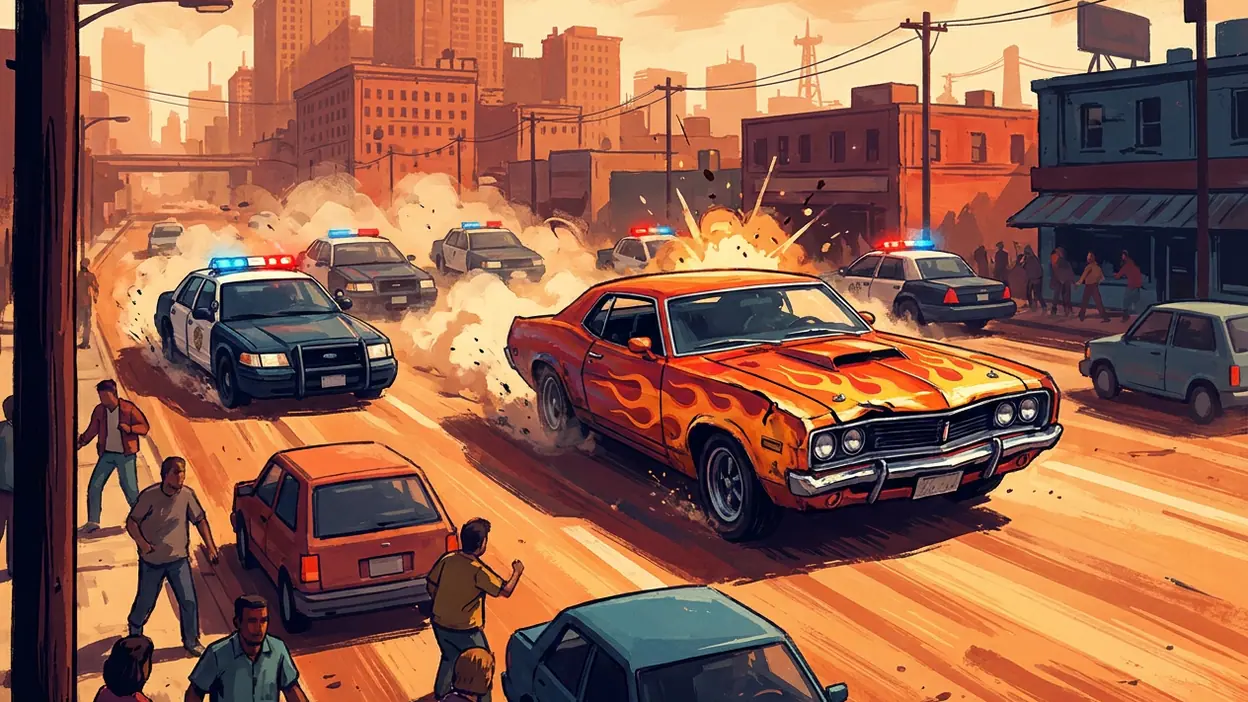
The best reason to try MadOut 2: Grand Auto Racing is not that it can out-polish the biggest mobile racers. It cannot. Its appeal is more unruly: you get a broad city, a car, and enough freedom to turn a routine drive into a police chase, a collision, or an improvised race before you have time to plan one. MadOut 2 is at its best when the world feels less like a menu of activities and more like an invitation to make trouble.
That distinction matters. Plenty of mobile driving games make speed the whole point, then funnel every run through a track and a finish line. This one leans into the fantasy of being loose in a car-centered open world. The handling, missions, and online activity give that fantasy a playable shape, but the real hook is the possibility of choosing your own next distraction. If you want immaculate racing lines, look elsewhere. If you like the idea of driving fast and seeing what breaks, there is a specific pleasure here.
A city that keeps interrupting your plans
The opening hook
The first minutes make a simple promise: get moving. You are dropped into a world where a car is not just a tool for completing a race; it is your way into the action. Point it down a road, weave into traffic, and the map begins to feel like a place to roam rather than a sequence of locked events. The scale encourages curiosity. A distant route or busy stretch of road can look more tempting than the objective you were supposed to follow.
There is a pleasing lack of ceremony to that start. MadOut 2 does not need a long dramatic setup to sell its premise. The city, the vehicle, and the possibility of trouble do the work. A drive can become a pursuit once the police are involved, or a test of nerve when you force your way through traffic. Even a short session has room for a small, self-made story: take a car, push your luck, escape the mess, and decide whether to do it again.


How the core loop feels
At the center is a fast, deliberately rough cycle: drive, chase an opportunity, make a mess, and keep moving. Missions and races give the session direction, while open-world driving fills the gaps with unscripted detours. That mix is why the game feels different from a pure track racer. You are not always looking for the cleanest corner or the best lap. Sometimes the fun is simply staying on the road long enough to reach the next thing.
The driving has an arcade sensibility, with collisions and abrupt changes of direction part of the texture rather than rare disasters. Traffic makes the streets feel active, but it also turns speed into a gamble. Threading through a gap is satisfying; clipping a vehicle can wreck your momentum and send a casual run sideways. The controls and response can feel less exact than those in a focused racing game, so careful drivers may find the handling blunt. But precision is not always the point. MadOut 2 gets much of its character from the fact that a drive can go wrong in a loud, immediate way.
That looseness shapes the rhythm. A structured event gives you a clear target, then free driving lets the pressure ease or rise again on your terms. You can chase progression, or ignore it for a while and see where the roads take you. The game is most convincing when those two moods overlap: you have somewhere to go, but the world keeps offering reasons not to arrive neatly.
Latest News



Progression and the pull of another run
Progression gives the roaming a purpose. Completing activities and earning rewards creates a reason to return, whether you are aiming for a new vehicle, looking to improve your options, or simply trying to build momentum through the game. The reward loop is familiar, but it fits the fantasy: a better garage means more ways to approach the same city, and a new vehicle can make a well-known route feel worth taking again.
There is a practical satisfaction in having a goal beyond driving in circles. An event can turn a vague afternoon session into a focused run, and a reward at the end makes the next stretch feel earned. Yet the game does not depend entirely on that ladder. Its strongest sessions often begin with a plan and end somewhere else, because a chase or a collision gave you a more entertaining problem to solve. That flexibility is useful for a mobile game: you can drop in for a quick objective or stay longer because your own little adventure has not quite played out.
The rewards are not all equally compelling, and progression can feel familiar if you have spent time in other free-to-play racers. Still, the open-world structure gives the grind a different backdrop. You are not only repeating a track to shave seconds from a time. You are returning to a place where the next run can unfold differently, even when the broad objectives repeat.
Why sessions are hard to stop
MadOut 2 understands the power of an unfinished intention. You might be driving toward a mission, spot a chance to pick up speed, then decide to see how long you can keep control through the traffic. After that, there is the temptation to finish the event you abandoned, or to take one more route back across town. The session extends through small decisions rather than a single cliffhanger.
That is a strong fit for short bursts of play. There is no need to wait for a perfect hour or settle into a long campaign chapter. The game can give you a quick hit of movement and mischief, and then leave a larger goal hanging for next time. When it clicks, the loop feels less like checking off tasks than following a chain of impulses: one road leads to a chase, the chase leads to a recovery, and the recovery becomes a reason to take another drive.
Online play can add another layer of unpredictability, bringing other players into a world that already rewards improvisation. It also changes the mood: the streets become a shared playground rather than a backdrop for a solo run. The appeal depends on what you find there and how stable the experience feels on your device, but the social possibility suits the game's chaotic temperament better than a rigid leaderboard alone would.
A scrappy identity, not a showroom finish
MadOut 2 has a rough-edged personality. Its world is built to support driving, chasing, and collisions, not to make every corner look like a glossy automotive advertisement. Cars and streets carry a blunt, street-level energy, and the overall presentation sells a fantasy of speed and disorder more than luxury. The result is less elegant than the genre's most polished entries, but also less formal. This is a game that wants you to use the city, not admire it from a perfect camera angle.
That identity is important because the roughness can cut both ways. A visually busy scene or a sudden collision may make the action feel lively, while uneven presentation can also expose the game's limits. Players looking for pristine graphics, highly readable effects, and finely tuned vehicle feedback may notice those compromises quickly. I found the right way to approach it was to meet it on its own terms: not as a precision simulator, but as an arcade sandbox where the memorable moments are often the ones you did not set up.
Who should take the wheel
This is a natural fit for players who enjoy open-world driving, arcade chaos, and self-directed sessions. If your ideal mobile racer involves picking a destination, ignoring it halfway through, and making your own entertainment from traffic and pursuit, MadOut 2 has a clear appeal. It also suits players who like progression but do not want every minute dictated by a linear event list. You can chase objectives when you want structure and drift away when the city feels more interesting.
It is a weaker match for anyone who values exact handling above all else, or expects every mission to feel tightly designed. Players who want quick, streamlined races may find the larger world distracting, while fans of highly polished track action may prefer the concentrated speed of Asphalt 8. Those are different kinds of pleasures. MadOut 2 is not trying to deliver a cleaner version of a circuit racer; its appeal lies in the space between activities, where a drive can become whatever you make of it.
How it compares with genre favorites
Dr. Driving makes a useful contrast because it centers on controlled road tasks and careful maneuvering. MadOut 2 takes the opposite instinct: less patience, more room to roam, and a greater appetite for disorder. Race Master 3D: Car Racing compresses its action into quick, obstacle-filled runs, making it easy to understand and finish in a short sitting. MadOut 2 spreads its fun across a larger setting, so the reward is not just clearing a course but finding your own reason to keep driving.
Asphalt 8 is the more immediate comparison for speed and spectacle, but its event-driven racing has a stronger sense of polish and presentation. Traffic Rider, meanwhile, builds its identity around the focused rush of threading through traffic from a motorcycle's perspective. MadOut 2 borrows the thrill of traffic without narrowing the experience to a single road or vehicle fantasy. The trade-off is clear: it offers more freedom and less refinement. Whether that is a bargain depends on whether you would rather perfect a run or make a story out of a messy one.
Where it frustrates
The same freedom that gives the game its hook can make its structure feel loose. Not every activity has the clarity or finish to keep you invested, and the driving can lack the precision that makes a close race deeply satisfying. The open world may also feel less rewarding if you need a constant stream of well-paced missions. There are moments when the promise of possibility is stronger than the immediate activity in front of you.
Performance and comfort can vary with device and session conditions, so it is worth judging the experience on the phone or tablet you actually use. Crowded action is demanding, and rough edges become more noticeable when control or visual clarity slips. These are genuine caveats, not reasons to dismiss the game outright. They simply explain why MadOut 2 works best as an impulsive arcade playground rather than a technically polished racing showcase.
Why it is worth installing now
The case for installing is straightforward: if you are tired of mobile racers that turn every drive into a score screen and a repeatable lane, this one gives you room to wander. There is enough structure to support goals, but not so much that every session has to follow a script. That balance makes it easy to sample and easy to revisit. You can arrive with a plan, abandon it, and still feel that the time was well spent.
Just set the right expectations. This is not the most refined racer on a phone, and it does not need to be. Its strongest feature is the way open-world freedom, arcade driving, and unpredictable trouble feed one another. When the loop catches, even a simple trip across town feels like a chance for something to happen.
MadOut 2: Grand Auto Racing is worth a place on your device if you want a mobile driving game that prizes freedom over polish and stories over perfect laps. Its world can be rough, its handling can frustrate, and its activities do not always match the scale of its promise. But when a casual drive turns into a chase and then into one more attempt to get back on the road, the game finds its own kind of momentum. Install it for the chaos, stay for the detours, and do not expect the city to let you keep your original plan.