 About Subway Surfers
Why Subway Surfers Keeps Finding Its Moment
Every few years, Subway Surfers seems to be everywhere again: in clips, on new phones, and in conversations about games people have played for years. The explanation is not a mysterious algorithm or a reinvention. It is a remarkably legible loop, dressed in a world that keeps changing just enough to feel newly discoverable. Its current visibility can look like a fresh viral breakthrough, but the deeper story is more interesting: this is a durable hit that has learned how to manufacture new moments without changing its core.
Why the run keeps returning to the feed
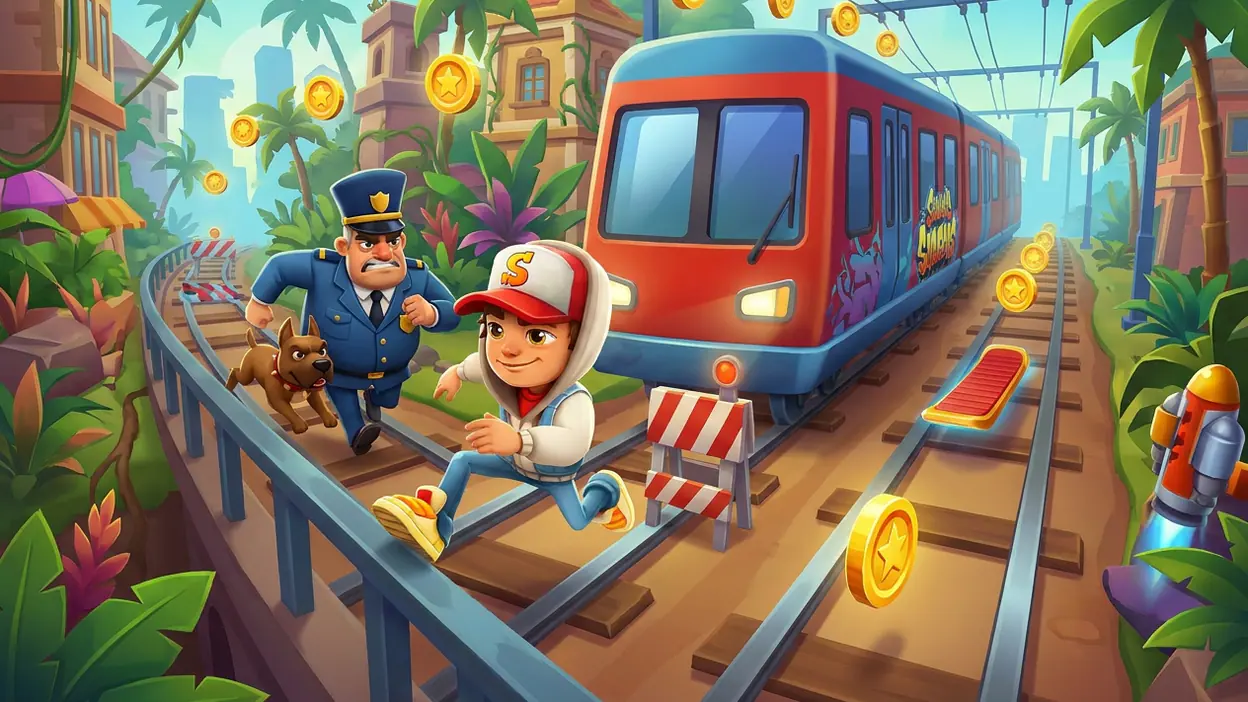
The game’s setup takes seconds to understand. Jake is caught tagging a subway train, the Inspector and his dog give chase, and the player sprints down tracks crowded with barriers, trains, and coins. Swipe to change lanes, jump, or roll under an obstacle; keep moving for as long as your reflexes hold. No tutorial lecture is needed, and no long session is required. That clarity makes the game easy to recommend, easy to pick up, and unusually easy to show to someone who has never touched it.
Its renewed circulation also benefits from a steady supply of visual change. The World Tour updates move the action through different cities and seasonal settings, swapping in fresh scenery, characters, and board designs. These changes give returning players a reason to look again and give social posts a new backdrop. The underlying track still behaves like a fast arcade corridor, but a different skyline can make a familiar run feel like a new episode.
That pattern matters more than the idea of a single viral moment. A game can surge because one clip travels widely, then disappear when the joke or challenge wears thin. Subway Surfers has something more repeatable: a format that produces a new visual wrapper while keeping the same immediately understandable action. Its buzz is less a sudden eruption than a series of small reintroductions.


What players react to
The first pleasure is the pace. A run starts with room to breathe, then the tracks fill with decisions. A train blocks one lane; a barrier demands a jump; a low sign calls for a roll. Coins tempt you toward danger, while the Inspector’s steady pursuit makes hesitation feel costly. The game turns simple swipes into a rhythm of reading, committing, and recovering. When it works, your hands seem to move before your thoughts can finish naming the obstacle.
There is also a satisfying visual language to the chase. Bright colors, broad shapes, and clear silhouettes make hazards readable at speed. Trains feel imposing without obscuring the route; pickups register instantly; the board’s hover effect lends a brief, buoyant escape from the ground. The presentation is cheerful, but the run itself has a sharp edge. One late swipe can end a promising streak, and that tiny mistake is often more compelling than a drawn-out failure in a slower game.
Coins and missions give each session a small purpose beyond survival. A player might chase a score, finish a task, collect a particular item, or simply beat a personal record. Those goals do not demand a deep strategy, but they do help a short run feel complete. The game’s appeal is not that every attempt tells a grand story. It is that even a minute of play can contain a clean arc: start, pressure, mistake or escape, then the urge to try again.
Latest News


The retention hook is the near miss
The strongest retention mechanic is not a complicated progression system. It is the almost-successful run. A player who crashes immediately has little to mourn; a player who reaches a personal best and clips a barrier at the last second has a reason to restart at once. The loop keeps the distance between failure and another attempt almost nonexistent. There is no long loading ritual or elaborate setup to interrupt the impulse.
Power-ups and hoverboards add useful variation to that basic rhythm. A magnet can turn a risky stretch into a sweep of coins; a jetpack lifts the runner above the track for a moment; a board can absorb a crash and extend a run. These boosts create little bursts of relief and spectacle, though they do not fundamentally change the game’s demands. The player still needs to read the track and act quickly. The best runs feel earned even when a helpful pickup gives them extra room.
Progression gives repetition a wider frame. New characters and boards provide visible goals, while missions encourage players to approach the same tracks with different priorities. The game does not become a tactical puzzle, and it should not pretend to. Its stickiness comes from frictionless replay: the next attempt is always close, and improvement is easy to measure in distance, score, and collected rewards.
Built to be watched, copied, and shared
Subway Surfers is naturally streamable because its action reads without explanation. A viewer can see a train approach, understand the danger, and react to a last-second lane change. The run also produces clear emotional beats: a risky coin line, a narrow escape, a sudden crash. That makes it a good fit for short clips, casual challenges, and the kind of social post that invites a simple question: how far can you get?
Its bright, consistent look helps those clips travel. Even when the city setting changes, the central grammar remains recognizable: a runner, the tracks, the pursuit, and a quick sequence of swipes. People can encounter a clip out of context and still grasp what is happening. The game’s accessibility also supports social spread across age groups and levels of gaming experience. A veteran can chase a demanding score; a newcomer can understand the joke of getting caught by a train within seconds.
That simplicity has limits as spectacle. There is little room for elaborate team coordination or the surprising player-made strategies that fuel conversation around more open-ended games. A typical run is personal, and the most memorable moments often come down to reflexes rather than a clever plan. Its shareability is built on clarity and speed, not on a vast range of stories players can create together.
Where the chatter sits
The conversation around the game tends to cluster around familiar pleasures: favorite characters, high scores, new World Tour locations, and the satisfying absurdity of a run that seems to last forever until one small mistake ends it. There is also a nostalgic current. For many players, returning is less like discovering a new game than opening an old one and finding that its basic pleasure still works.
That nostalgia can bring people back, but it is not enough on its own to sustain attention. The recurring updates matter because they offer an excuse to return without asking players to relearn the game. In contrast, a party collection such as Stickman Party 234 MiniGames spreads attention across different activities, while Fruit Ninja® makes its appeal through a distinct slicing gesture. Subway Surfers commits to one chase, and its social identity is strongest when people compare runs or react to a new look for the same familiar sprint.
What newcomers should expect
New players should expect a polished arcade runner, not a campaign with a final chapter. The first few runs teach the controls quickly, but survival becomes more demanding as speed and traffic build. A good early score may come fast; consistent, lengthy runs take practice. The challenge is mostly about timing and attention, and the game asks for quick decisions rather than complex planning.
It is also a free-to-play game with progression and optional purchases, so the experience includes more than the run itself: unlocks, rewards, and prompts to keep building a collection. Those systems can give goals to players who enjoy ticking off tasks, but they are not the reason the controls feel good. Anyone hoping every reward will meaningfully transform the game may find the repetition plain. Anyone content to chase a cleaner run has a much simpler path to enjoyment.
Compared with survival horror such as Granny or the more exploratory appetite of Hungry Shark Evolution, Subway Surfers is deliberately low-friction. It does not ask for patience, atmosphere-building, or a map to master. Its world is a track that keeps advancing. That makes it excellent for short breaks and less suited to players who need each session to reveal a new system or narrative turn.
How durable is the trend?
The trend looks durable because the game is supported by two kinds of longevity: a timeless input loop and ongoing cosmetic renewal. Swiping to dodge a moving obstacle is easy to understand across generations of phones, and a changing city gives the familiar sprint fresh color. The combination can keep the game visible without requiring a risky overhaul that might alienate its returning audience.
Still, durability is not the same as endless novelty. New locations and collectibles can renew attention, but they cannot make every run feel fundamentally different. Once players have seen the rhythm, the surprises come from their own near misses and improvements. That is a strong base for an arcade game, but it also sets a ceiling on how much the conversation can evolve. The game can remain a regular fixture without dominating every cycle of gaming chatter.
What could cool it down
Repetition is the obvious threat. The track’s visual details change, but its core choices remain familiar: shift lanes, jump, roll, collect, and keep moving. A player who wants a deeper learning curve may eventually feel that a new setting is a fresh coat on an old route. If updates become less visible or less enticing, the return visits could thin out.
There is a second risk in leaning too heavily on rewards. If the chase for unlocks begins to feel like the main reason to play, the clean arcade pleasure can get buried beneath menus and incentives. The game is at its best when the next run is an invitation, not an obligation. Its longevity depends on preserving that directness and keeping new content as a welcome nudge rather than a substitute for meaningful change.
My verdict is that Subway Surfers has earned its recurring attention. The game is not a new idea each time it trends, and its endless-runner format will eventually feel repetitive to players who want structural surprises. But the controls remain crisp, the danger is instantly readable, and the near-miss loop still creates that irresistible “one more run” feeling. Its cultural staying power comes from an unusually efficient bargain: a little time, a clear challenge, and just enough fresh color to make the tracks worth visiting again.