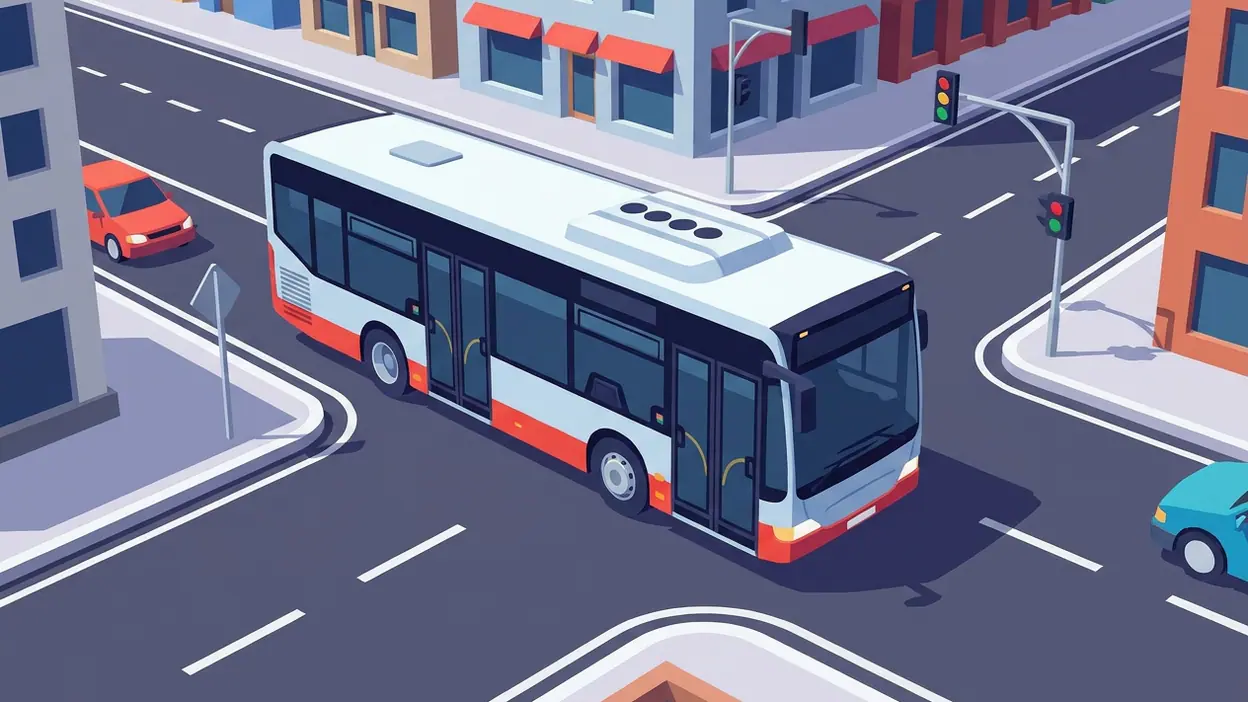
 About Bus Simulator - Bus Games 3D
Bus Simulator - Bus Games 3D: Can a Familiar Driving Loop Keep Players Coming Back?
Bus games have a quiet advantage in the attention economy: everyone understands the fantasy before the first turn. You take the wheel, find the route, and try to deliver passengers without turning a routine drive into a mess. Bus Simulator - Bus Games 3D leans hard on that legibility. Its appeal is immediate, its sessions are easy to dip into, and its central question is whether a familiar driving loop can build lasting momentum rather than just a brief burst of curiosity.
This is not a role-playing game in the character-building, story-heavy sense. Its role is the job itself: manage a bus, navigate roads, and keep a run moving. That gives it a useful contrast with mobile hits built around makeover choices, such as Hair Dye and Monster High™ Beauty Salon, or playful crafting like Masha and the Bear Pizza Maker. Those games promise transformation or a finished creation; this one promises the satisfying process of getting somewhere.
Why the bus is suddenly everywhere
Part of the genre's current pull is that it turns ordinary work into a playable challenge. Driving a bus sounds simple, but the fantasy carries built-in stakes: a vehicle has weight, passengers have somewhere to be, and every junction invites a small mistake. Players do not need a long tutorial to understand the objective. That low entry barrier helps a game travel through recommendations and short clips, where a viewer may only give it a few seconds.
There is also a social-media-friendly mismatch at the heart of the premise. A bus is not a glamorous vehicle, and that is exactly why it can be funny to watch. A careful route can look oddly soothing; a clumsy turn can become instant slapstick. Games designed around flashy competition often need a big win to make a clip work. A bus simulator can get a reaction from a minor wobble, a tight maneuver, or the tension of trying to keep a trip on track.


Still, a visible trend is not proof of a specific viral moment. Without reliable public figures for installs, active players, or creator reach, it is better to describe the game's momentum as a strong fit for the current short-session culture than to claim it has taken over feeds. The concept has the right ingredients for discovery, but durable popularity depends on what happens after the novelty of driving a bus wears off.
What players react to
The first pleasure is physical rather than narrative. A bus asks for a different kind of attention from a small car: you feel the need to think ahead, give yourself room, and treat a turn as a commitment. Even in a simplified mobile game, that change in scale gives familiar roads a new texture. The player is not just racing toward a finish line; the vehicle itself becomes the problem to solve.
The second pleasure is the steady cadence of a route. Start moving, read the road, negotiate a turn, and reach the next point. That rhythm can feel calming when the game gives the player enough space to settle into it. It can also produce the opposite mood if steering or camera handling makes a maneuver awkward. In a driving game, control is not a background detail: it is the difference between feeling like a driver and feeling like someone fighting a screen.
Latest News


That is where the game has to earn its audience. The promise of simulation raises expectations, even when the experience is clearly built for casual play. Players want the bus to feel substantial, but they also want a route they can understand and controls they can learn quickly. If either side wins too completely, the balance suffers. A bus that feels weightless drains the fantasy; a bus that is frustrating to steer turns a relaxing session into a chore.
The retention hook: another route, another run
The retention loop is straightforward: drive, complete the immediate task, and decide whether to take another run. This kind of loop has a natural advantage on phones because it does not demand a long stretch of uninterrupted attention. A player can make a little progress in a spare moment, then return when the itch to drive comes back. The act of finishing a journey gives each session a clean stopping point.
But a clean stopping point can become a clean exit. Strong retention needs more than the ability to repeat the same basic action. Players need a reason to care about the next trip: a meaningful new challenge, a change in pace, a sense of mastery, or a clear reward that makes the previous run feel useful. The durable version of this game is one where familiarity turns into competence. The fragile version is one where familiarity simply makes the next drive feel identical.
Replay value also depends on how much the player can improve. A better route, smoother handling, and fewer mistakes can be satisfying even without a deep story. That is a respectable foundation for a casual driving game, but it asks the design to make small gains visible. If progress feels vague, the game is relying on the premise alone, and premises have a short shelf life.
Built for clips, but not only clips
There is a natural creator format here: show a difficult maneuver, share an unexpected mishap, or compare a neat run with a chaotic one. The most shareable moments are easy to explain without context. A viewer can understand the aim at once and judge the result at a glance, which makes bus-driving footage more portable than a complicated role-playing encounter.
That does not mean every session is inherently entertaining to watch. A routine route may be rewarding to play but flat on a feed, especially if the scenery and tasks do not change much. Streamability needs variation: pressure, surprise, a visible skill test, or enough freedom for a player to set their own challenge. If the game mostly asks for careful repetition, its audience may be broader among casual players than among stream viewers looking for constant escalation.
Its social spread is likely to live in a mix of short videos, recommendations, and familiar search behavior rather than a single community with a shared competitive scene. That is a different kind of buzz from Avakin Life - 3D Virtual World, where self-expression and social interaction can keep a conversation going beyond any one activity. A bus simulator has a narrower social identity, but its basic joke and challenge travel well.
Where the chatter sits, and what newcomers should expect
The conversation around games like this tends to gather around simple questions: Is it relaxing? Are the controls manageable? Does the route feel satisfying? Those questions are useful because they point to the product's real strengths and risks, not just its premise. They also help explain why people may recommend it to one friend and not another. Someone looking for a low-pressure driving session may enjoy the routine; someone expecting a detailed transport-management simulation may want more depth.
Newcomers should arrive expecting an accessible mobile driving game, not a full-scale professional simulator. The bus gives the experience its identity, but the appeal rests on short, legible tasks and the pleasure of handling a larger vehicle. It is sensible to judge it by how quickly the controls make sense, whether a trip feels coherent, and whether finishing one run creates an urge to start another.
It is also worth keeping expectations grounded about the trend itself. Mobile discovery can make a game feel omnipresent for a week even when its audience is scattered and casual. A surge of clips may bring curious players in, but only a satisfying play loop can turn that glance into a habit. The game's strongest pitch is not that it needs to dominate a social feed; it is that the act of driving can make a few spare minutes feel pleasantly occupied.
How durable is the trend?
The bus-simulator premise has more staying power than a one-joke novelty because it can support an enduring fantasy: taking control of a large vehicle and learning to handle it well. It is also easy to refresh in principle. New routes, sharper driving challenges, different conditions, and meaningful progression could give regular players new reasons to return without changing the core identity.
That potential should not be confused with proof that this particular game has a deep content pipeline. The longevity question depends on the variety and quality players actually encounter, not on what the genre could theoretically add. If the available routes and objectives feel repetitive, the initial appeal will fade quickly. If each run asks for a slightly different kind of attention and rewards better driving, the simple loop can hold longer than its modest premise suggests.
The trend could cool for the same reason many casual hits do: the first-session novelty is easy to understand, but the second week asks for substance. Awkward controls, repetitive scenery, thin goals, or a lack of meaningful progression would all shorten the runway. The biggest danger is not that the game is too simple. Simplicity is part of the invitation. The danger is that it has nowhere interesting to go once players have learned the invitation by heart.
My editorial read is that Bus Simulator - Bus Games 3D has a strong discovery hook and a naturally readable play loop, making it well suited to casual trial and quick social sharing. Its long-term case rests on execution: satisfying handling, enough variation, and progress that gives each drive a reason to follow the last. The bus itself can carry the first click. To keep players aboard, the game has to make the next route feel worth taking.